12
March 2017 - posted on 13 March from Alter do Chao, Amazon River, Brazil
 It’s
a rainy Sunday, and the town we’re visiting is closed until the afternoon. So I’m catching up on blogging. We’ve had a full few days of visiting places
along the Amazon, so much to report.
It’s
a rainy Sunday, and the town we’re visiting is closed until the afternoon. So I’m catching up on blogging. We’ve had a full few days of visiting places
along the Amazon, so much to report. On
Thursday, we visited the small village of Boca da Valeria. This really is a tiny place, with something
like 120 inhabitants. This tiny town was
first visited by the cruise ships by accident – a ship broke down and needed
some
On
Thursday, we visited the small village of Boca da Valeria. This really is a tiny place, with something
like 120 inhabitants. This tiny town was
first visited by the cruise ships by accident – a ship broke down and needed
some  work, so rather than sit in the middle of the river, the passengers were
sent to shore in tenders. The
inhabitants of the village had no idea what was happening, just that boatloads
of
work, so rather than sit in the middle of the river, the passengers were
sent to shore in tenders. The
inhabitants of the village had no idea what was happening, just that boatloads
of  strangers were descending on their community. So they did what anyone would do when invaded
– they hid in the jungle and watched as these people came
strangers were descending on their community. So they did what anyone would do when invaded
– they hid in the jungle and watched as these people came  ashore. It took several visits until the townspeople
were comfortable with these periodic foreign invasions. And now, they welcome us as a
ashore. It took several visits until the townspeople
were comfortable with these periodic foreign invasions. And now, they welcome us as a  source of
income.
source of
income.
The
people of Boca da Valeria are mostly of indigenous origin, maybe with some
Portuguese ancestors fairly far back.
They live in stilt houses, because the river level rises during rainy
season. In mid-March,  we’re in the
middle of rainy season – the rains will continue until about June, when the
river level may be as much as 30-36 feet (10-12 meters) higher than it
currently is. And the current level is
pretty high, with islands and banks and trees totally submerged in the muddy
waters of
we’re in the
middle of rainy season – the rains will continue until about June, when the
river level may be as much as 30-36 feet (10-12 meters) higher than it
currently is. And the current level is
pretty high, with islands and banks and trees totally submerged in the muddy
waters of  the Amazon.
 we’re in the
middle of rainy season – the rains will continue until about June, when the
river level may be as much as 30-36 feet (10-12 meters) higher than it
currently is. And the current level is
pretty high, with islands and banks and trees totally submerged in the muddy
waters of
we’re in the
middle of rainy season – the rains will continue until about June, when the
river level may be as much as 30-36 feet (10-12 meters) higher than it
currently is. And the current level is
pretty high, with islands and banks and trees totally submerged in the muddy
waters of  the Amazon.
At
this point, we have mixed feelings about Boca da Valeria. It’s cute.
It’s quaint. It’s also kitschy,
and hard to say how much of what is presented as the  traditional indigenous way
of life is real, and how much is what the people think tourists want to
see. Or how much has been suggested by
publicists or marketers.
traditional indigenous way
of life is real, and how much is what the people think tourists want to
see. Or how much has been suggested by
publicists or marketers.  Depends on how
cynical one’s point of view might be. It
definitely has a somewhat real, but somewhat Disneyland
Depends on how
cynical one’s point of view might be. It
definitely has a somewhat real, but somewhat Disneyland  aspect to the town.
 traditional indigenous way
of life is real, and how much is what the people think tourists want to
see. Or how much has been suggested by
publicists or marketers.
traditional indigenous way
of life is real, and how much is what the people think tourists want to
see. Or how much has been suggested by
publicists or marketers.  Depends on how
cynical one’s point of view might be. It
definitely has a somewhat real, but somewhat Disneyland
Depends on how
cynical one’s point of view might be. It
definitely has a somewhat real, but somewhat Disneyland  aspect to the town.
When
a cruise ship stops by, it seems to be a school holiday in town. The children and  some adults gather by the
dock, and greet passengers as we come off the tenders. Some children want to shake hands, but others
have learned to latch on and escort
some adults gather by the
dock, and greet passengers as we come off the tenders. Some children want to shake hands, but others
have learned to latch on and escort  people around town, which of course means a
cash tip at the end of the visit.
people around town, which of course means a
cash tip at the end of the visit.
 some adults gather by the
dock, and greet passengers as we come off the tenders. Some children want to shake hands, but others
have learned to latch on and escort
some adults gather by the
dock, and greet passengers as we come off the tenders. Some children want to shake hands, but others
have learned to latch on and escort  people around town, which of course means a
cash tip at the end of the visit.
people around town, which of course means a
cash tip at the end of the visit.
Other
kids come up with their pets – sloths,  snakes, baby alligators or caiman or
crocodiles, I can’t tell which. Maybe
even a monkey, or a parrot. People can
hold the pets, pose for photos, all of
snakes, baby alligators or caiman or
crocodiles, I can’t tell which. Maybe
even a monkey, or a parrot. People can
hold the pets, pose for photos, all of  that.
I always feel bad for the poor animals, who should be free and in the
jungle. But I also understand that for
some families, this is their source of
that.
I always feel bad for the poor animals, who should be free and in the
jungle. But I also understand that for
some families, this is their source of  income.
So I found some cute kids, took their photo, chatted with them in my
Spanish and their Portuguese, and gave them two-real bills. (Real,
income.
So I found some cute kids, took their photo, chatted with them in my
Spanish and their Portuguese, and gave them two-real bills. (Real,
 pronounced ree-AHL, is the Brazilian currency.
I didn’t give them real bills, I gave them real. Two real is equal to
maybe 60 cents US.)
pronounced ree-AHL, is the Brazilian currency.
I didn’t give them real bills, I gave them real. Two real is equal to
maybe 60 cents US.)
 snakes, baby alligators or caiman or
crocodiles, I can’t tell which. Maybe
even a monkey, or a parrot. People can
hold the pets, pose for photos, all of
snakes, baby alligators or caiman or
crocodiles, I can’t tell which. Maybe
even a monkey, or a parrot. People can
hold the pets, pose for photos, all of  that.
I always feel bad for the poor animals, who should be free and in the
jungle. But I also understand that for
some families, this is their source of
that.
I always feel bad for the poor animals, who should be free and in the
jungle. But I also understand that for
some families, this is their source of  income.
So I found some cute kids, took their photo, chatted with them in my
Spanish and their Portuguese, and gave them two-real bills. (Real,
income.
So I found some cute kids, took their photo, chatted with them in my
Spanish and their Portuguese, and gave them two-real bills. (Real,
 pronounced ree-AHL, is the Brazilian currency.
I didn’t give them real bills, I gave them real. Two real is equal to
maybe 60 cents US.)
pronounced ree-AHL, is the Brazilian currency.
I didn’t give them real bills, I gave them real. Two real is equal to
maybe 60 cents US.)
There
were other  little kids, mostly little girls, dressed in the traditional clothing,
or some semblance of the outfits. Lots
of colorful feathers on their heads or in their hair, and on their ankles. The littlest one wasn’t too happy about this
job, because she really wanted the
little kids, mostly little girls, dressed in the traditional clothing,
or some semblance of the outfits. Lots
of colorful feathers on their heads or in their hair, and on their ankles. The littlest one wasn’t too happy about this
job, because she really wanted the  balloon another child had (and gave her
after my photos). What can I say, I’m a
sucker for kids, and so I took photos and handed over small money, and hoped it
balloon another child had (and gave her
after my photos). What can I say, I’m a
sucker for kids, and so I took photos and handed over small money, and hoped it
 somehow helps the family finances.
 little kids, mostly little girls, dressed in the traditional clothing,
or some semblance of the outfits. Lots
of colorful feathers on their heads or in their hair, and on their ankles. The littlest one wasn’t too happy about this
job, because she really wanted the
little kids, mostly little girls, dressed in the traditional clothing,
or some semblance of the outfits. Lots
of colorful feathers on their heads or in their hair, and on their ankles. The littlest one wasn’t too happy about this
job, because she really wanted the  balloon another child had (and gave her
after my photos). What can I say, I’m a
sucker for kids, and so I took photos and handed over small money, and hoped it
balloon another child had (and gave her
after my photos). What can I say, I’m a
sucker for kids, and so I took photos and handed over small money, and hoped it
 somehow helps the family finances.
Of
course, I also asked the children what was their name, and what was the name of
their pet. The little  girl holding the
baby caiman or alligator cracked up laughing when I then said hello to her pet
and addressed him by name. What can I
say, I enjoy
girl holding the
baby caiman or alligator cracked up laughing when I then said hello to her pet
and addressed him by name. What can I
say, I enjoy  being silly with kids.
 girl holding the
baby caiman or alligator cracked up laughing when I then said hello to her pet
and addressed him by name. What can I
say, I enjoy
girl holding the
baby caiman or alligator cracked up laughing when I then said hello to her pet
and addressed him by name. What can I
say, I enjoy  being silly with kids.
There
was a man at one end of town who really went to a lot of effort with his
presentation – I asked him if he was the chief, or  a medicine man, but he didn’t
understand my Spanish, and I know only three words in Portuguese. So I don’t know if he’s dressed as a warrior,
or what.
a medicine man, but he didn’t
understand my Spanish, and I know only three words in Portuguese. So I don’t know if he’s dressed as a warrior,
or what.  It was a really elaborate
headdress and all, so I thought he needed some compensation and that I needed a
photo of him.
It was a really elaborate
headdress and all, so I thought he needed some compensation and that I needed a
photo of him.
 a medicine man, but he didn’t
understand my Spanish, and I know only three words in Portuguese. So I don’t know if he’s dressed as a warrior,
or what.
a medicine man, but he didn’t
understand my Spanish, and I know only three words in Portuguese. So I don’t know if he’s dressed as a warrior,
or what. 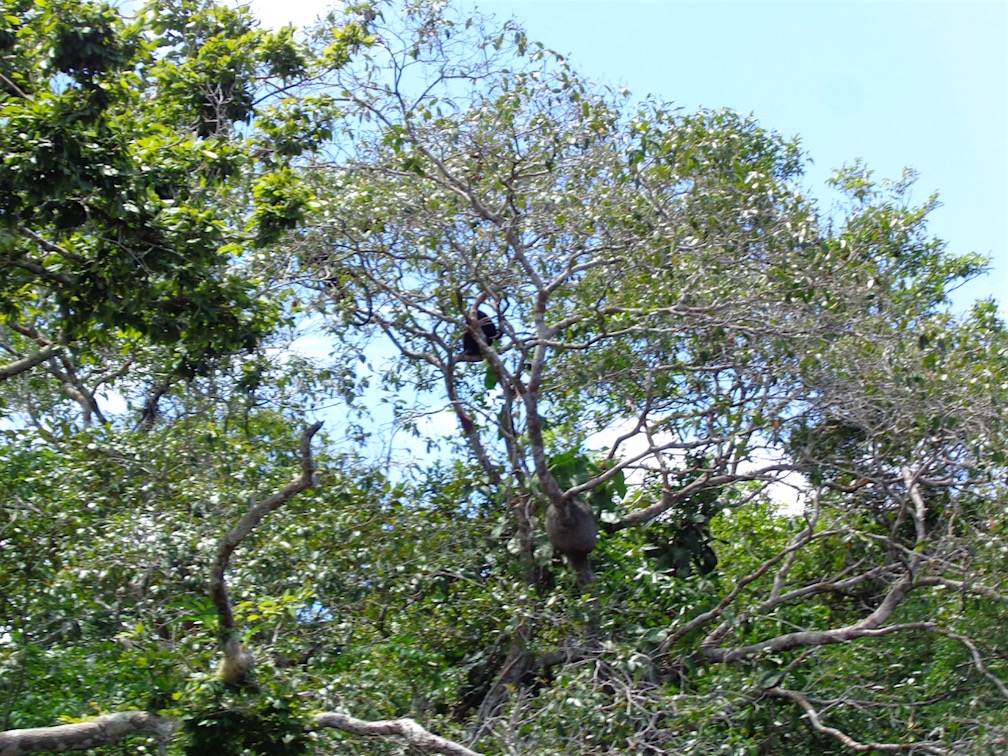 It was a really elaborate
headdress and all, so I thought he needed some compensation and that I needed a
photo of him.
It was a really elaborate
headdress and all, so I thought he needed some compensation and that I needed a
photo of him.
We
wandered around the  village, and then took a river tour. Actually, I ended up taking two river tours
with friends we’ve made on the ship, the first being a 30
village, and then took a river tour. Actually, I ended up taking two river tours
with friends we’ve made on the ship, the first being a 30  minute trip and the
second being an hour. The boats are
pretty small, sort of glorified canoes with a canopy, and several boards for
seats through the
minute trip and the
second being an hour. The boats are
pretty small, sort of glorified canoes with a canopy, and several boards for
seats through the  center of the boat.
The outboard motor has an extended metal bar with the propeller at the
end, so it can be lifted out of the mud and plants in shallow water. (We saw these in SE Asia, so we knew the point
of this odd looking system.)
center of the boat.
The outboard motor has an extended metal bar with the propeller at the
end, so it can be lifted out of the mud and plants in shallow water. (We saw these in SE Asia, so we knew the point
of this odd looking system.)
 village, and then took a river tour. Actually, I ended up taking two river tours
with friends we’ve made on the ship, the first being a 30
village, and then took a river tour. Actually, I ended up taking two river tours
with friends we’ve made on the ship, the first being a 30  minute trip and the
second being an hour. The boats are
pretty small, sort of glorified canoes with a canopy, and several boards for
seats through the
minute trip and the
second being an hour. The boats are
pretty small, sort of glorified canoes with a canopy, and several boards for
seats through the  center of the boat.
The outboard motor has an extended metal bar with the propeller at the
end, so it can be lifted out of the mud and plants in shallow water. (We saw these in SE Asia, so we knew the point
of this odd looking system.)
center of the boat.
The outboard motor has an extended metal bar with the propeller at the
end, so it can be lifted out of the mud and plants in shallow water. (We saw these in SE Asia, so we knew the point
of this odd looking system.)
And
yes, climbing into the boats often meant getting our feet wet in the Amazon,
but, well, we can only hope shoes and socks protect us from any parasites. I’m not usually paranoid, but when a river
looks this brown and muddy, it tends to make me somewhat paranoid. (At one point our first boat captain was
standing to see over the top of the boat, and steering with his foot! So funny, and of course I had to take his
photo!)
Anyway,
motoring up and down the river and a tributary and through the swamped jungle
was really the best part, and why I went on two boat trips. We saw the giant water lilies which are
famous – these really are huge! Each
lily pad looks like a giant platter, some up to six feet (nearly 2 m)
across! They have sort of a raised lip,
a vertical edge all the way around, and this is covered in thorns, as is the
underside of the giant lily pad. One
plant, rooted on the bottom of the river, sends out a number of thorny branches
that each have one of these huge leaves.
The underside of everything has the spikey thorns so that fish and other
water animals don’t eat the plant. And
there’s usually a water lily flower in the center of the plant, which only
opens at night. The flower also changes
color throughout its lifespan, based on its pollination cycle. I’m not sure of the sequence of colors, but
the flower can be white, pink, lavender, or green, depending on its age (which
isn’t long).
The
lily pads live long after the flower dies, though eventually insects and the
sunlight cause these giant leaves to disintegrate and fall back into the river.
A
specific bird seemed to hang out on top of the water lilies, sitting on the
pads. No idea what the name of it is,
but it has a dark head, russet body, and the wings in flight are sort of a pale
butter yellow. Really fascinating bird!
There
was another bird, fairly big in size (maybe crow-sized), with a bright neon
yellow torso but black wings, head, and tail.
They build nests that hang, almost like long straw socks. And they’re all in one specific tree, as if
this is their town and they only build their nests in that neighborhood. My photos show a few of the birds, but you
need to click on the photos to enlarge them enough to see the flashes of yellow
in among all the foliage. I can’t crop
the photos and get a decent image of these birds. (And again, I don’t know what kind of bird
this is – in the Caribbean the bananaquits build nests like this, but they’re
tiny birds so I don’t think they’re related.)
And yes, this tree is surrounded by water at this time of year. I just hope all the baby birds are off flying
by the time the river level rises to its maximum, since I suspect the tree
might be covered.
We
also saw monkeys in a few trees. Not
sure what kind of monkeys they were, just pretty big and very dark in
color. Monkeys are difficult to
photograph, since they’re either snuggled up or in motion. Here are two photos of the monkeys in the
tree, and they’re the very dark blobs.
The greyish blob lower in the tree is a termite nest, so the monkeys
might have been up there having a termite picnic.
I
have no idea how one navigates around, because the Amazon isn’t just the one
river. We went up and down tributaries,
side branches, other rivers, and through what I can only think is the jungle
turned into swamp or wetlands during rainy season. Really, it was like boating through a forest,
along hiking trails that were underwater.
Truly a strange experience to be in a small boat but surrounded by the
jungle, with birds and monkeys chattering at us to get out of their home. I can see how visitors like myself get
totally lost and never find their way out.
So
we spent several hours either boating around, or visiting the village. It was interesting, it was fun, and it was
also slightly disturbing. It really hit
home when we were waiting to get back on the tender. Our boat staff have chilled washcloths for
us, which is a nice refreshing way to wipe one’s sweaty face. But there I was surrounded by curious kids,
who live a very simple life. One young
girl asked me for something, and I told her I have nothing left, no money. (Some people brought pencils and things for
the children.) The girl indicated that
she’d like my used washcloth. Well, what
could I do, I gave her the washcloth. I
mean, she probably could use it, and I know our cruise line makes donations to
this village. So I helped them out,
right?
All
I can hope is that my monetary contributions (including the boat ride prices)
helped support some families. And that
making kids laugh brightened their day.
And that maybe, all of that somehow helped.