 It's pouring rain today, with intermittent dramatic claps of thunder and lightning, so it seems like a good
  time to catch up on blogging.
In my continuing interest in the paper money in Argentina, I present the 200 pesos note, complete with a whale. Looks like a humpback to me, but who knows. It is labelled "ballena" which means whale, obviously,
 and is usually pronounced "bah-YAY-nah" in Spanish. But in Argentina, that is "bah-ZJAY-nah" because the double L is given a different sound. Sort of confusing, but we're getting used to it. (And I find the name ballena easy to remember and hard to remember how to pronounce - because
  many whales have baleens rather than teeth, to sift the krill out of water for food - so I want to call whales "ba-LEE-nah" instead.)
We were hoping to see a
 celebration of Three Kings Day here in BA on 6 January - but I found out too late that, because 5 January was on Sunday, the three kings walked up and down Avenida de Mayo on that day rather than on Monday, the actual Three Kings Day. A bit disappointing, because
  we saw the Three Kings Day in Lima about four years ago, and it was really colorful. And I enjoy local color and culture.
But our neighborhood bakery was featuring the special Three Kings Day cake, a round ring of rich cake covered in sort of a custard, and dotted with
 candied fruits. It's supposed to represent the kings' crowns, I've read. I guess the colorful fruit looks something like jewels, in the round crown. They also had individual pieces of the same cake, almost like a pull-apart cake, so that those who wanted just one portion could also
  partake in this yearly treat.
We continue to wander around Buenos Aires - it really is a beautiful city, and has often been called the "Paris of South America" due to the prevalence of art nouveau architecture and tree-lined boulevards. I love the
 ornate buildings, some
  with little castle-like towers on the top. No idea what these mini castles are for on the roof of a building, but they just are interesting. I also like the various turrets and towers built
  into some of the buildings - they just look so romantic somehow. Definitely from a different age of architecture than the one we live
  in at the moment.
 We manage to have funny little conversations with people, sometimes in
 Spanish, sometimes half-Spanish-half-English, also known as Spanglish.
There was the taxi driver one Sunday late morning, who drove us to a café we like for brunch. He seemed to speak only Spanish, but was singing along with the radio playing familiar US hits. So after he finished "Easy Like Sunday Morning," as we arrived at our destination, I asked (in Spanish) if he spoke English. No, he replied.
 But you sing in English, I said. "Solo fonetico," was his answer. And then, as we left his taxi, he said, "Take it easy!" We all laughed, it was unexpected and funny. (And like many people we encounter, he likely knows enough English to understand, more than he thinks he will.)
 One afternoon, we went to a burger spot for lunch. It was packed, and they had small tables side by side. After we ordered at the counter, I found a free table and asked the couple at the table next to it if it was okay to sit - they said si, si. They had just begun eating, so as I sat down I said,
  "Buon provecho" which people have said to us, both waiters and people just walking by in a restaurant or café. (It may be spelled buen provecho.) The young man gave me a big smile and a nod. And then, when our food arrived, he leaned over and wished us "buon provecho" as well.
I think my favorite,
 though, was one afternoon as I was taking my walk around our neighborhood. We aren't far from several important sites, so at this point we know our way
  around. I saw an older couple with a map looking around, and heard the woman say in English, "It doesn't seem to be here." So I went over and asked if I could
  help find something. "We're looking for the place that's the oldest café in Buenos Aires," she replied. Oh, you want Café Tortoni! Okay, so it's right across
  the street, and then half a block to your right, with a green sort of awning and a big yellow sign. Can't miss it.
And then, I
 walked in the other direction, maybe half a block. A family flagged me down to ask directions, but in Spanish. I said I have a little Spanish, so speak slowly
  please. So they asked where is the Obelisk - El Obelisco. Another easy one to answer! I pointed out the main street through the neighborhood,
  just a block away, and said to turn right and go that way about four or five blocks. That it was an easy walk from here. So they went happily on their way.
 Then there was trying to find the FedEx office to send something to my brother, who basically acts as our personal assistant getting mail, sending anything
  important via email, taking care of the usual business of living while we travel. The FedEx office wasn't exactly where the Google map said it should be, of
  course - they never are. I asked a woman at the newspaper kiosk, and she didn't know, but we had a nice conversation anyway. I was planning to ask at one of the US chain fast food places that plague the world, but as I started to walk
  away, a man went by wearing a FedEx shirt! A quick "perdóneme, señor" and I could easily ask him where the FedEx office was located. I didn't catch everything he said, more of a "down this street, three blocks, number 6-something." It was enough to get me there! (I always feel so
  brilliant when I have the most simple conversation, LOL!)
 I've visited some of the usual places in our neighborhood, starting with the Plaza del
 Mayo. This is in front of Casa Rosada, and the place where
many of the political demonstrations are held. Also, the Mothers of
Plaza del Mayo (Asociación Madres de Plaza de Mayo)
meets here every Thursday, and has for decades. These women are the
mothers of thousands of people who were "disappeared" during the 1970s
and 80s, during Argentina's military regime. These women have been
trying to find their children, or what happened to their children when
they were taken away - are they still alive, were they killed, now that
they are presumably adults do they have children of their own? These
brave women originally brought these human rights violations to the
world's view, and their actions may have helped curb such actions on the
part of the military. But they are still searching for their children
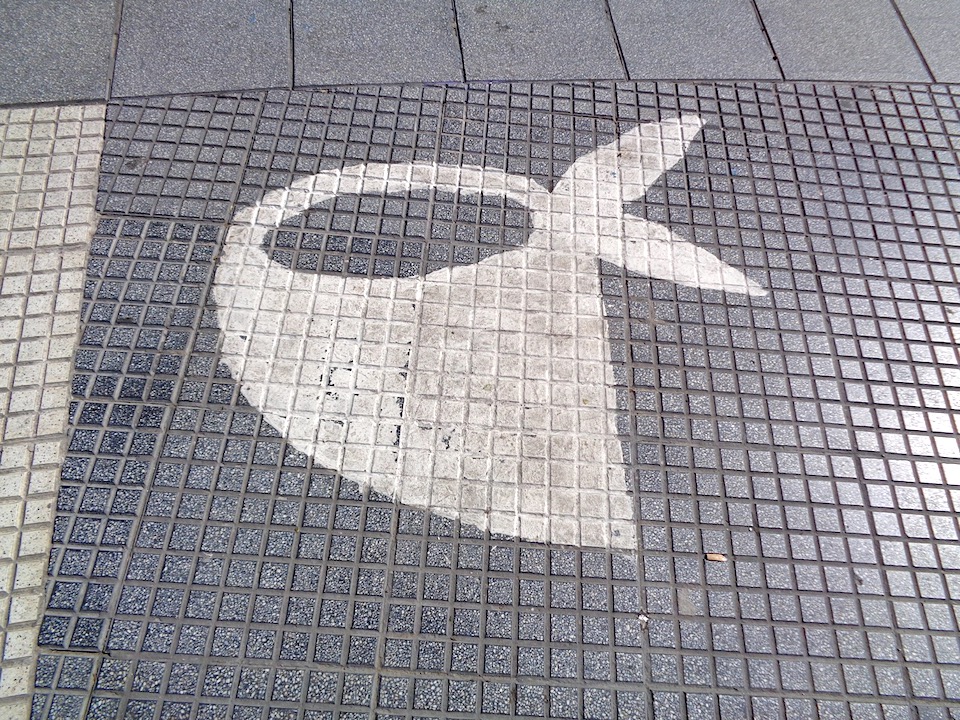
and possible grandchildren. The Mothers often wear head scarves
embroidered with the names and birth dates of their children, and
symbolic head scarves have been painted around the perimeter of the
circle that forms Plaza del Mayo.
Mayo. This is in front of Casa Rosada, and the place where
many of the political demonstrations are held. Also, the Mothers of
Plaza del Mayo (Asociación Madres de Plaza de Mayo)
meets here every Thursday, and has for decades. These women are the
mothers of thousands of people who were "disappeared" during the 1970s
and 80s, during Argentina's military regime. These women have been
trying to find their children, or what happened to their children when
they were taken away - are they still alive, were they killed, now that
they are presumably adults do they have children of their own? These
brave women originally brought these human rights violations to the
world's view, and their actions may have helped curb such actions on the
part of the military. But they are still searching for their children
and possible grandchildren. The Mothers often wear head scarves
embroidered with the names and birth dates of their children, and
symbolic head scarves have been painted around the perimeter of the
circle that forms Plaza del Mayo.Casa Rosada is the presidential building, and is a truly odd shade of dusty pink that borders on almost a terra cotta color. This is where the Perons lived, probably the most famous Argentinian couple, at least for those of us who aren't from Argentina.
And the Obelisk. El Obelisco. This is the usual generic white obelisk, modeled after the Egyptian obelisks. I know, most people don't realize that obelisks were an ancient Egyptian architectural feature, place at the entrance to temples some 4000 or so years ago. The Egyptians called these single pointed pillars or towers "tekhenu," but the Greeks used their word, "obeliskos," to describe them and that's the word that continued into English.
The Buenos Aires Obelisk was constructed in 1936 to commemorate the 400th anniversary of Buenos Aires. It's at the intersection of Avenida 9 de Julio and Corrientos, although there are other streets that cut through so that the intersection is more of a traffic circle, or maybe like the Parisian "etoiles" or stars.
Prior to constructing the Obelisk, a church stood on this site. This is where the first Argentinian flag was officially raised in 1812, which is why the Obelisk was built here. (This info is inscribed on the Obelisk.)
And this is where there were fireworks on New Year's Eve.
I found a really old building, possibly one of the oldest still-standing buildings in BA. This is where the town council met in the 1600s. The current building was built in 1725, and now houses both a museum to the original town council building (called the cabildo), and a museum to the revolution of May (Revolucion de Mayo) which is why we have the Avenida de Mayo.
When we head up the street our hotel is on (not sure what direction this is), there are several shops that specialize in shoes for tango dancing. Imagine three or five stores with only tango shoes!!! They need to have smooth soles for the turns and spins, so no rubber soles, just leather or possibly synthetics. One store had the most wonderful window displays, which not only had the gorgeous shoes but included photos of tango dancers, a mini pink velvet couch, miniature statues dancing the tango, and so forth! They were definitely fun windows, eye-catching and ready to make anyone want to learn to tango!
One window was full of men's shoes, many looking reminiscent of the spats and oxfords of the 1920s or 30s or so. The other window, full of women's shoes, all with stiletto heels and usually embellished with details like the black pair with a gold floral design on the heel. (My favorite!) They truly were amazing shoes, and of course I had to take a ton of photos!
I like street art, even when I don't know what is meant, especially when the message is political. I found El Tango Lo Siento (literally, the tango I am sorry) on a wall, and the images were very cool - it looks almost like strips of movie footage on film, from way back before digital became the thing. I had no idea who Julio Sosa was, but it turns out he's a musician. In the album (or CD?) of the same name and image, he recites a poem over traditional tango music. So I guess what looked to me like an apology to a famous tango dancer is really an ad for Sosa's music. (Album is here: open.spotify.com/album/7amr3RlvimM5xJ3ipKCiv9
And then there was this sign at Starbucks. I know, here I am in a city full of wonderful cafés that serve delicious coffee drinks. But they often don't have decaf, and any time after about noon, I need to drink descafeinado, not caffeinated coffee. Hence, Starbucks. Besides, I learned to drink coffee in Seattle in the 1970s, so it's also nostalgic. Anyway, they had one wall painted with this message, in Spanish. Here's the translation: "
We always treat coffee as an art. That inspiration was born in 1971 at Pike Place, Seattle. We continued taking the same passion wherever we go."
Not much else is happening. The National Academy of Tango is closed until February, so I won't be taking any tango classes this month, sad to report.
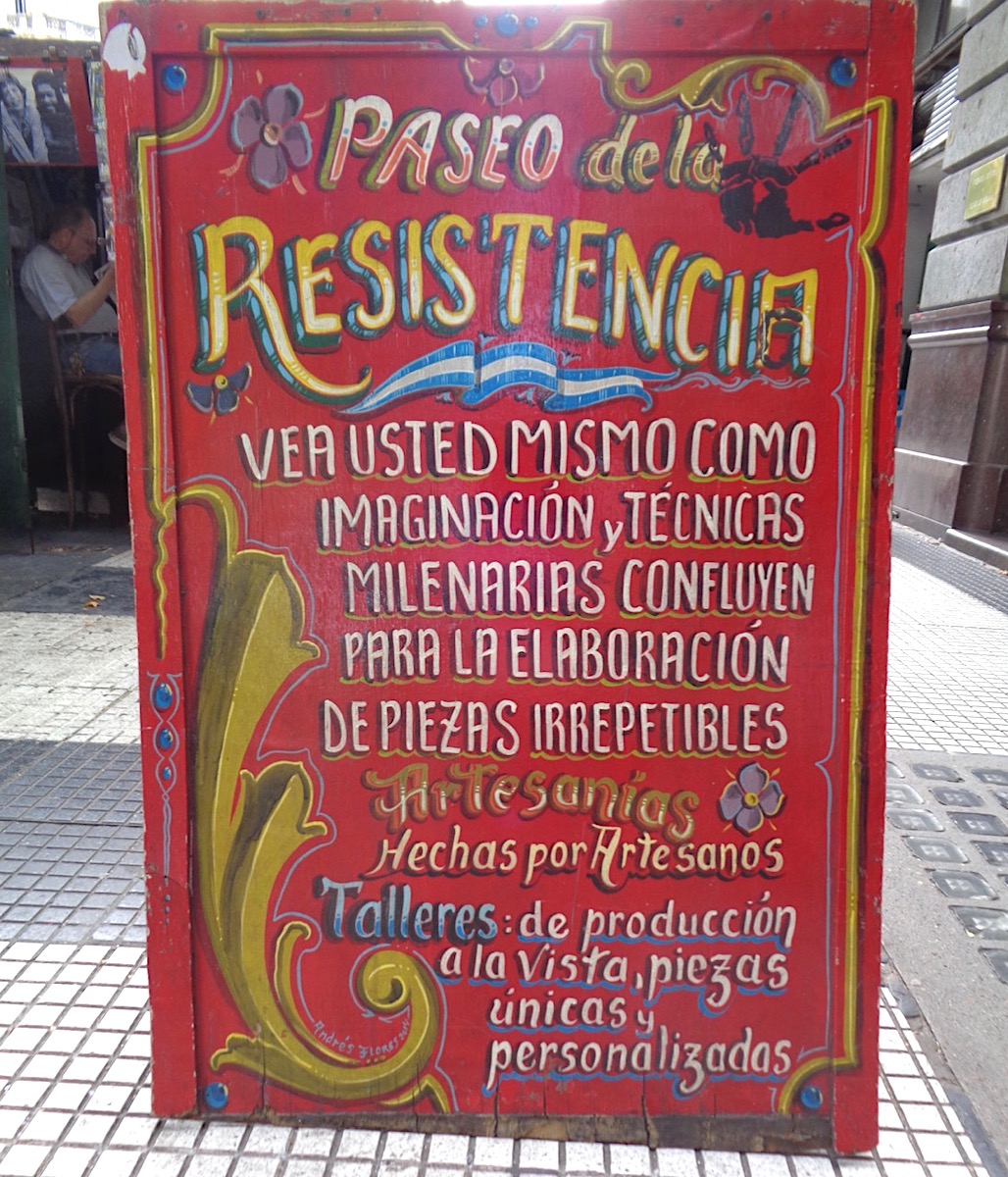
I did find a tour that I'm signing up to take - it focuses on the fileteados signs and art form that is unique to Buenos Aires and this region of Argentina. Fileteados (pronounced "fee-lay-tee-AH-dose") is almost a combination of art nouveau and traditional folk art ornamentation, once used on ox or donkey carts but now used primarily in signs and building decoration. The colors are bright, there is usually a word or phrase in the center, and the surrounding designs are painted to look three dimensional. Fileteados are somewhat reminiscent of Medieval illuminated manuscripts, but the actual artwork is different.
Anyway, the tour includes learning how to design and paint one's own fileteados, so you know this is my tour!
Now that I know what fileteados look like, of course I'm seeing these signs all around. The sign for Café Tortoni is almost like fileteados; the rest are the signs I found around the neighborhood. I hope to find more!
I also met a fileteados artist at a building with artists' tables inside, sort of a collective. I spoke with him briefly, and he told me a little about his work. But my Spanish isn't advanced enough for this kind of conversation, nor was his English, so it was pretty limited.
That's it for our excitement. More photos (because I like doors), and I'm sure there will be another blog or two before we leave BA.


