22 October 2015
The night before we left on our road trip, we were awakened by an intermittent beeping sound at about 4:30 AM. After our half-asleep discussion, we figured out it was the smoke detector battery. So I climbed up on a chair, pulled the stupid detector off the ceiling, Richard  opened it up, and I took out the battery.
It was just one of those nights, or mornings, or whatever you want to call that time of day when
opened it up, and I took out the battery.
It was just one of those nights, or mornings, or whatever you want to call that time of day when  it's still dark and most people are still sound asleep.
The rest of the day was similar. The unexpected intruding on the unsuspecting
it's still dark and most people are still sound asleep.
The rest of the day was similar. The unexpected intruding on the unsuspecting  traveller. Not that the unexpected is a bad thing - not like a beeping detector in the middle of the night. Just, out of the blue.
It took almost 90 minutes to get our
traveller. Not that the unexpected is a bad thing - not like a beeping detector in the middle of the night. Just, out of the blue.
It took almost 90 minutes to get our  rental car. There were forms. We had been offered a special insurance deal that we could only get online, not at the counter as we had thought. We
  sat in the rental agency lobby and bought the insurance online. Got extra perks because we're AARP members. It turned out okay, with a vehicle upgrade, it just took for-e-
 verrrrrrr.
We followed the directions to get to the Pan American Highway, called the Pan Americana here, heading south. It
verrrrrrr.
We followed the directions to get to the Pan American Highway, called the Pan Americana here, heading south. It  was a gorgeous drive, and we agreed we'd drive until maybe 4 PM, then look for a hotel.
We saw mountain after mountain, all looking like volcanoes, tops shrouded in clouds. And then we saw it - Cotopaxi National Park! We followed the signs, exited the Pan
was a gorgeous drive, and we agreed we'd drive until maybe 4 PM, then look for a hotel.
We saw mountain after mountain, all looking like volcanoes, tops shrouded in clouds. And then we saw it - Cotopaxi National Park! We followed the signs, exited the Pan  Americana, and looked at Cotopaxi, the volcano that has been rumbling and shooting up steam and ash, the one with all the alerts, the Alerta Amerilla
  (yellow alert) volcano!
We watched, but couldn't see much, just the base of the volcano, with the whole thing covered by
(yellow alert) volcano!
We watched, but couldn't see much, just the base of the volcano, with the whole thing covered by  clouds. We waited a bit, and there was a vague smell of smoke and sulphur in the air. But, no rumbling sounds, no lava, not even a glow behind the
  clouds. So, we turned around and got back on the Pan Americana, and continued south.
We made our way to the town of Latacunga, found a hotel, and settled in. We thought we could see Cotopaxi from our windows, but it was a cloudy afternoon and evening.
We walked around town, and looked at the hills in the distance, ringing the town. There was a lovely park with a river, various bridges crossing it, all sorts of shops, friendly people who were curious about who we were, where we were from, how long we'd be in Ecuador, and how we liked the country.
And I found guaguas in the bakery! I finally tried one, it was pretty much like French or Italian bread, but with pineapple jam in the middle of it. But even better, the window display had the most decorated and ornamental guaguas we've seen yet!
I woke up with the sunrise, and peeked out the window - and there it was, Cotopaxi, merrily steaming and puffing away! The security reports say that the steam and ash column rises about 1000 meters up from the peak - that's a one kilometer column of ash and steam!!!!!
As the sun rose above the horizon, the pillar of ash became more visible, though the clouds started to move in, and eventually they covered and hid the peak once again.
clouds. So, we turned around and got back on the Pan Americana, and continued south.
We made our way to the town of Latacunga, found a hotel, and settled in. We thought we could see Cotopaxi from our windows, but it was a cloudy afternoon and evening.
We walked around town, and looked at the hills in the distance, ringing the town. There was a lovely park with a river, various bridges crossing it, all sorts of shops, friendly people who were curious about who we were, where we were from, how long we'd be in Ecuador, and how we liked the country.
And I found guaguas in the bakery! I finally tried one, it was pretty much like French or Italian bread, but with pineapple jam in the middle of it. But even better, the window display had the most decorated and ornamental guaguas we've seen yet!
I woke up with the sunrise, and peeked out the window - and there it was, Cotopaxi, merrily steaming and puffing away! The security reports say that the steam and ash column rises about 1000 meters up from the peak - that's a one kilometer column of ash and steam!!!!!
As the sun rose above the horizon, the pillar of ash became more visible, though the clouds started to move in, and eventually they covered and hid the peak once again.

 We looked at the map and realized that the town of Baños wasn't very far away. Baños has
  several names - Baños de Incas, Baños de Agua Santa - the Baths of the Incas, the Baths of the Holy Water. The town of Baños is in a valley on the side of Volcan Tungurahua, another active volcano, and among the tallest volcanoes in Ecuador at 16,480 feet (5,023
  meters). The tallest is Chimborazo, 20,560 ft
  (6,268 meters), which is across the Pan Americana from Tungurahua. Really, the two peaks look at each other across the highway!
Tungurahua has been steaming for a while, and there are packaged tours to see the volcano. About ten years ago, the volcano was spewing lava - not enough to reach the town or endanger anyone, just enough to make a gorgeous nightly show. But now, there isn't any lava, just the steam and ash, so we'll skip the volcano tour. (We explain to the sales people that we saw Cotopaxi this  morning, and they all nod as if that explains why Tungurahua would be boring for us!)
Baños is at an  elevation of 5,971 feet, or 1,820 meters above sea level. SO much more comfortable than the 9000 or so feet elevation of Quito! I can walk without huffing and puffing and feeling like I'm gasping for air. Really such a relief!
There are waterfalls all
elevation of 5,971 feet, or 1,820 meters above sea level. SO much more comfortable than the 9000 or so feet elevation of Quito! I can walk without huffing and puffing and feeling like I'm gasping for air. Really such a relief!
There are waterfalls all  around, some just at the edge of town. I don't know how tall they are, and I imagine in rainy season they'd be either wider or in numerous cascades pouring down the mountain.
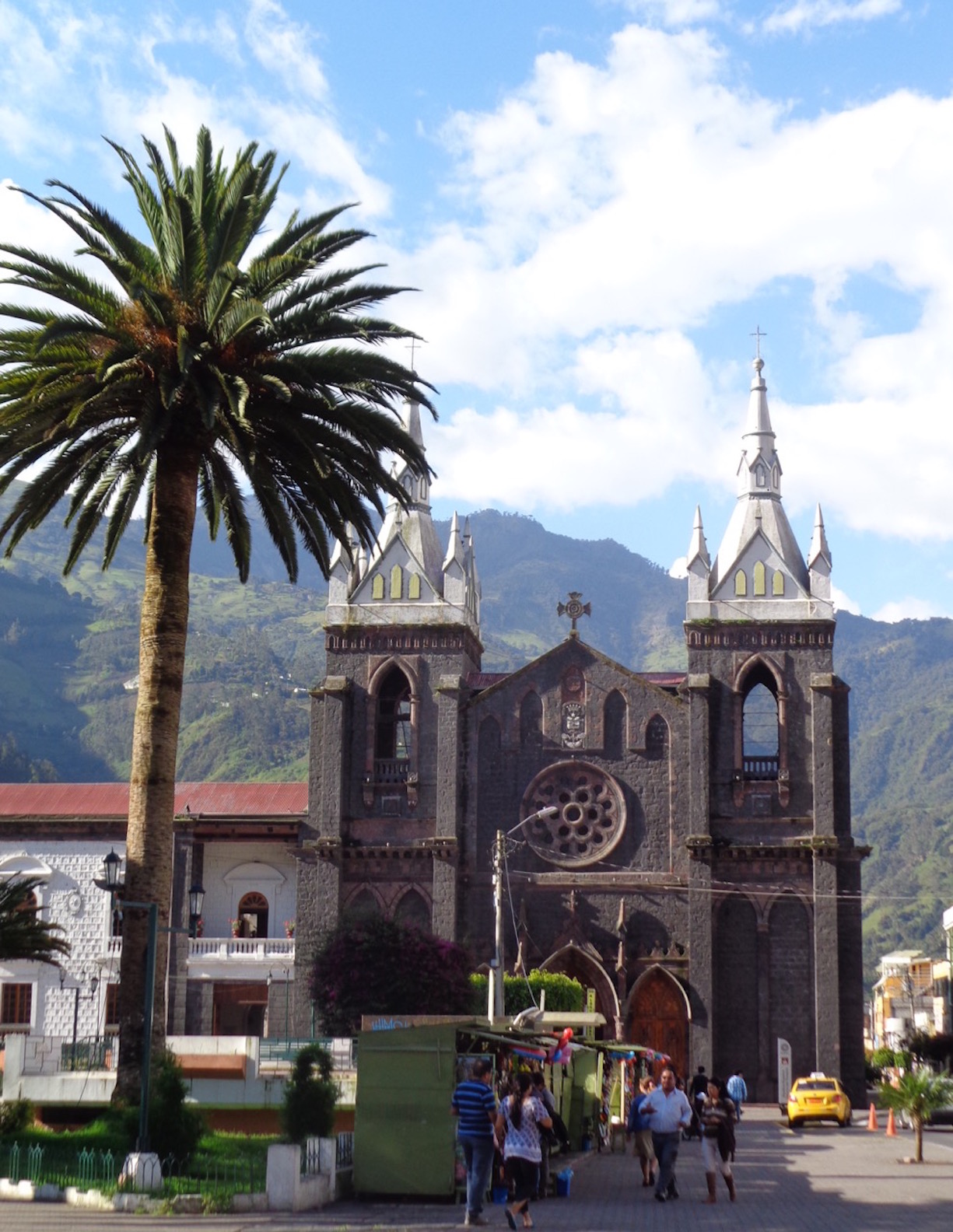
Baños has its own basilica, which really dominates the skyline of the town, with a backdrop of the huge green mountains beyond.
around, some just at the edge of town. I don't know how tall they are, and I imagine in rainy season they'd be either wider or in numerous cascades pouring down the mountain.
Baños has its own basilica, which really dominates the skyline of the town, with a backdrop of the huge green mountains beyond.  Despite looking very Gothic, the Basilica Reina del Rosario de Agua Santa was actually built in the early to mid 1900s, and was dedicated in 1944. It's a huge building, complete with carvings, stained glass windows, and twin bell towers or campenile. In fact, as I was taking these photos, the bells began to
  ring - real bells, with the ropes moving up and down, not the recorded bells that some churches have.
It turns out that today, 22 October, is the Feast of the Virgin of the Holy Waters, or Nuestra Señora del Agua Santa. We had no idea, we just spent the afternoon
ring - real bells, with the ropes moving up and down, not the recorded bells that some churches have.
It turns out that today, 22 October, is the Feast of the Virgin of the Holy Waters, or Nuestra Señora del Agua Santa. We had no idea, we just spent the afternoon  walking around, chatting with people, getting to know the town, seeing what there is available to do or see. (And I met a charming man, José, who somehow managed to have
  a long conversation with me in simple Spanish - he has children and grandchildren all over, he was chatting with me about this, though I was confused about some of the details. But he was very interesting, and wanted to know all about our travels as well. These conversations are really expanding my Spanish!)
Anyway, after dinner it started raining, and we figured okay, it'll be a quiet evening in the hotel. Richard was downstairs on the hotel's computer for guests, I was in our room, and all of a sudden I heard BAM! BAM! BAM! We had heard and seen occasional fireworks displays in Quito, never quite knowing ahead of time, or what they were for, but enjoying the colorful display despite our understanding of the events.
a long conversation with me in simple Spanish - he has children and grandchildren all over, he was chatting with me about this, though I was confused about some of the details. But he was very interesting, and wanted to know all about our travels as well. These conversations are really expanding my Spanish!)
Anyway, after dinner it started raining, and we figured okay, it'll be a quiet evening in the hotel. Richard was downstairs on the hotel's computer for guests, I was in our room, and all of a sudden I heard BAM! BAM! BAM! We had heard and seen occasional fireworks displays in Quito, never quite knowing ahead of time, or what they were for, but enjoying the colorful display despite our understanding of the events.
So I went racing down the two flights of stairs and out to the sidewalk, and it was a huge and extensive fireworks show, originating maybe two blocks down the road! We heard every rocket go off, they exploded almost right overhead with a sonic BOOOOM that I could feel in my bones, and then the lights and colors came raining down almost right on top of us, looking so close I felt like I could reach out and catch all the sparkling colors!!!!! It was amazing, just a gorgeous and very enthusiastic show of lights and sounds! Loved it!
We came inside, and I asked the guy at the hotel desk why, what were the fireworks for? He said "La Fiesta de la Virgin" - except neither Richard nor I understood his pronunciation, and we kept missing the "Virgin" part of it. Burgeon? Pigeon? We were totally baffled. Thank goodness for the internet, so we could figure out what this Fiesta and fireworks were all about, what they were celebrating!
Our plan for the next few days is to spend time in Baños, try out some of the volcano-heated baths, walk around some more, and maybe visit the monkey rescue center near Puyo, which is down toward the Amazon basin. Yes, Baños is kind of halfway between the Ecuadorean Andes and the origins of the Amazon River - pretty amazing, huh?
We're amazed, and we're here!
And of course we'll keep everyone posted about the excitement of being here!
20 October 2015
 We've been making our plans to head out of Quito and see
more of Ecuador, and of course that requires a trip to the Ministry of
Tourism for brochures and maps and all.
We've been making our plans to head out of Quito and see
more of Ecuador, and of course that requires a trip to the Ministry of
Tourism for brochures and maps and all.  Then some time online, checking
what's available, what is recommended by other travellers, where to
stay, where to end up.
Not that we have
Then some time online, checking
what's available, what is recommended by other travellers, where to
stay, where to end up.
Not that we have  much of a plan. Just wander through this part of the Andes, get to the coast, spend some time on the beaches which are supposed to be spectacular. And then decided where next.
Great plan, isn't it?
As much as we've been
much of a plan. Just wander through this part of the Andes, get to the coast, spend some time on the beaches which are supposed to be spectacular. And then decided where next.
Great plan, isn't it?
As much as we've been  enjoying Quito, especially since discovering coca leaf tea, it'll be nice to get back to warm weather.
I've included a few dramatic photos of the weather. Every
enjoying Quito, especially since discovering coca leaf tea, it'll be nice to get back to warm weather.
I've included a few dramatic photos of the weather. Every  afternoon, sometimes as early as noon but some days as late as 4 or 5 PM, dark clouds roll in over the mountains. They obscure the tops, fill in the valleys, and eventually
  cover the sky. And then the rain begins. Do you see the vague lines in the second photo? That's rain. Heavy heavy rain. The temperatures
  drop precipitously, people scurry for shelter, and we add another sweater. The rain isn't every day, but I'd say maybe 60-75% of our days here have
  had rainy afternoons.
Daytime highs might be anywhere from the mid 60s to the low 70s F (15 to 21 C) - but at night, temps drop
had rainy afternoons.
Daytime highs might be anywhere from the mid 60s to the low 70s F (15 to 21 C) - but at night, temps drop  to the 40s (maybe 5-7 C) - COLD! Our beds have a wool blanket under the sheet, to help keep sleeping bodies warm; and then two wool blankets
  and a quilt on top of that. I wrap all those blankets around myself to make a cocoon, because it really is that cold. (I don't want any cold air seeping in around the edges.) No one seems to have heat in their homes, or in traditional hotels. People just wear more clothes when it's
  cold out (or inside, as the case may be).
So we go out in the late morning, do some exploring, walk around, people watch, and try new places for
cold out (or inside, as the case may be).
So we go out in the late morning, do some exploring, walk around, people watch, and try new places for  lunch or dinner. Most of the time it doesn't rain until 3 or 4 PM, so we

 have time to walk home. But we've gotten caught in the rain, although not too often. Usually we can keep an eye on the clouds - when they get really dark and are halfway overhead, it's time to head back to the hotel.
One of the things we both find fascinating is the proliferation of graffiti. It seems to be everywhere! Much of the graffiti is tagging, just names or things like "Jose ama Maria" or something.
But there are also political graffiti slogans all over. Richard can read these much more easily than I can, since my Spanish is
have time to walk home. But we've gotten caught in the rain, although not too often. Usually we can keep an eye on the clouds - when they get really dark and are halfway overhead, it's time to head back to the hotel.
One of the things we both find fascinating is the proliferation of graffiti. It seems to be everywhere! Much of the graffiti is tagging, just names or things like "Jose ama Maria" or something.
But there are also political graffiti slogans all over. Richard can read these much more easily than I can, since my Spanish is  fairly minimal (and mostly
  menu- or direction-oriented). So there will be graffiti saying "Down with Capitalism" or "Strong women unite" or "No more class war."
There's one particular alley near our hotel that is just covered with graffiti, making it a colorful blur of indistinguishable letters and names, some being more artistic and calligraphic than others.
But then there's the occasional picture or sketch,
menu- or direction-oriented). So there will be graffiti saying "Down with Capitalism" or "Strong women unite" or "No more class war."
There's one particular alley near our hotel that is just covered with graffiti, making it a colorful blur of indistinguishable letters and names, some being more artistic and calligraphic than others.
But then there's the occasional picture or sketch,  and we have no idea what is being said, what the story is behind the image.
My favorite, of course, is the cat. NO idea what he's about. We don't know if he represents
and we have no idea what is being said, what the story is behind the image.
My favorite, of course, is the cat. NO idea what he's about. We don't know if he represents  someone who is named The Cat, or if he's a political symbol - I'm thinking maybe "belling the cat," as in curtailing the powers of the
  government? As I said, we don't know, we just have fun speculating. Since Quito is the capital, we tend to suspect that there's some political statement involved.
 We've explored several of the
 main squares or plazas in Quito, and finally found
  the Central Market. This is the food market, although they do have wonderful flowers as well. There are all kinds of food stalls with cooked meals, which smelled and looked pretty good, even if we couldn't figure out what some of the foods
  were. However, the cooked food stalls were
  intermixed with the usual market foods. So you might be thinking about chicken and rice, right next to a stand or two of dead plucked chickens. The market isn't for the squeamish. And, well, we ended up walking to a café we knew rather than eating next to the dead animals ready to be cooked.


 We haven't met very many cats, but this lovely cat was hanging out
  in his shop, and was happy to be pet. He was so happy, he even licked my hand a few times.
We happened upon two men loading a truck
in his shop, and was happy to be pet. He was so happy, he even licked my hand a few times.
We happened upon two men loading a truck  with decorative toy drums. I'm guessing they were made in the nearby building, and were being
  loaded for delivery to a store. Or
  perhaps a large children's party.
It was fascinating to watch these two men try to stack the toy drums in the back of a pickup, while parked on a hill. I can only imagine what it looked like while they were driving!
perhaps a large children's party.
It was fascinating to watch these two men try to stack the toy drums in the back of a pickup, while parked on a hill. I can only imagine what it looked like while they were driving!


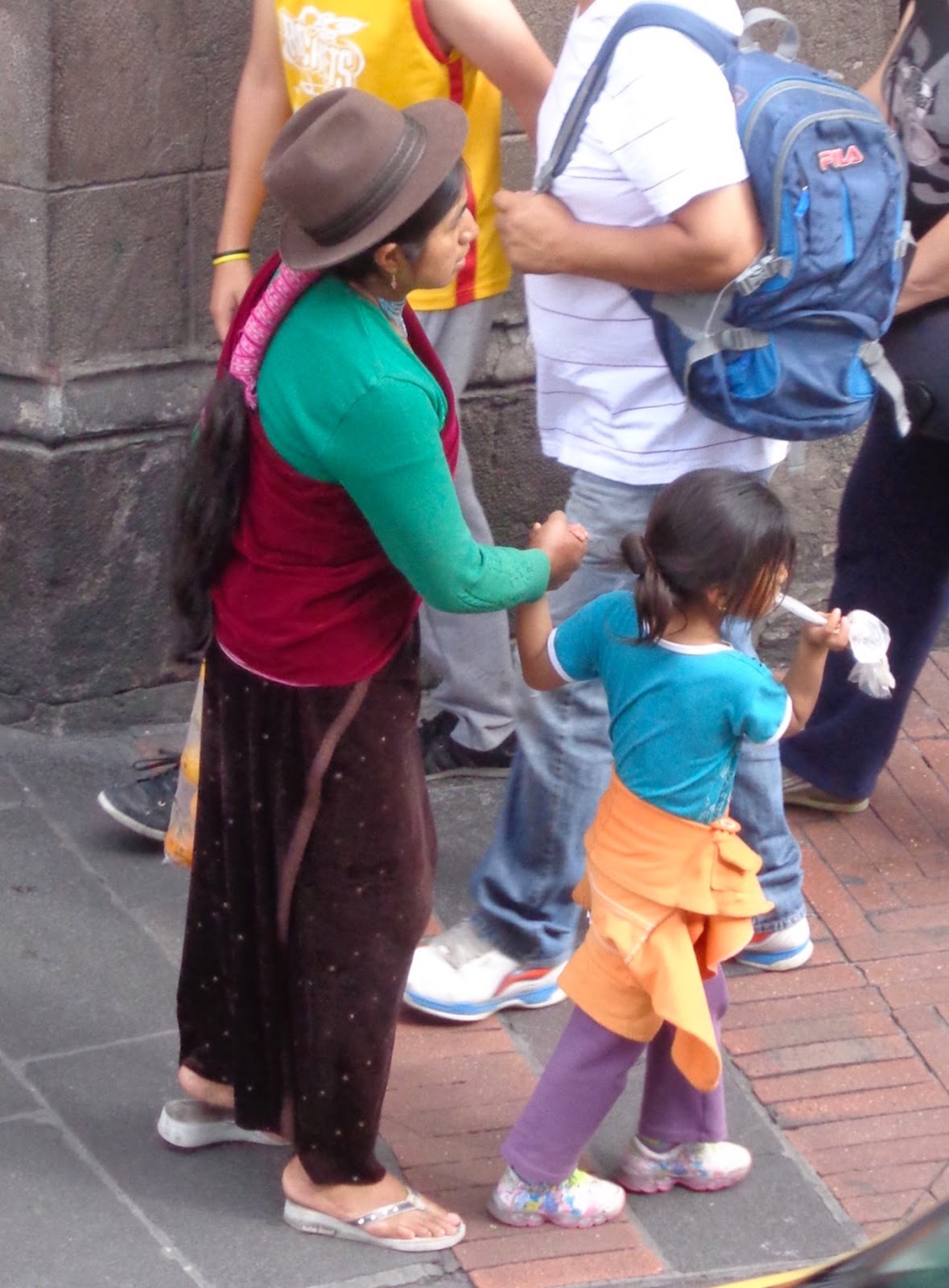
 I'm still intrigued by the variety of traditional

 clothing, especially for women. It seems as if there are different styles for different ethnic groups, though I don't really know which group might be which.
 One group of women has lovely embroidered blouses that are really dresses, often with with lace sleeves or necklines. A long dark wrap skirt is worn with this, making the underdress look more like just a blouse. Then an alpaca shawl is added,
  sometimes just sort of wrapped diagonally across the torso. These women are less likely to wear the wool fedora, and more likely to just have their hair in a long braid.
The other group of women wear short knife-pleated skirts, knee socks or tights,
sometimes just sort of wrapped diagonally across the torso. These women are less likely to wear the wool fedora, and more likely to just have their hair in a long braid.
The other group of women wear short knife-pleated skirts, knee socks or tights,  and almost always a cardigan sweater. The wool fedora tops the ensemble, always with a little feather in the band. Sometimes a shawl or scarf is added, sometimes not. And the skirt is sometimes a solid color, but sometimes has a pattern. My favorite was the woman wearing a dark skirt that had a design of kittens playing with a ball of yarn, somehow printed in or on the velvet.
We watched people on the weekend, in the park near our hotel. There's a tiny pond with a circular canal; people rent either rowboats or paddleboats, and cruise the little canal and pond. It's a nice family outing for a weekend, but also really funny to watch. Some people go in one direction, others circle in the opposite direction. Some people paddle or row slowly, others more quickly. So there are bottlenecks, boat traffic jams, the occasional bumps and crashes, and of course our favorite, the people who row their boats backwards. No, not that the rower is backwards, which is the way I was taught. No, people who row their boats with the flat square stern going forward into the water, and the pointed prow facing backwards. Ummmm, not the most efficient use of the boat. We tried to get some people to turn around, and they tried, but they couldn't quite master the prow-first technique. It really was funny.
and almost always a cardigan sweater. The wool fedora tops the ensemble, always with a little feather in the band. Sometimes a shawl or scarf is added, sometimes not. And the skirt is sometimes a solid color, but sometimes has a pattern. My favorite was the woman wearing a dark skirt that had a design of kittens playing with a ball of yarn, somehow printed in or on the velvet.
We watched people on the weekend, in the park near our hotel. There's a tiny pond with a circular canal; people rent either rowboats or paddleboats, and cruise the little canal and pond. It's a nice family outing for a weekend, but also really funny to watch. Some people go in one direction, others circle in the opposite direction. Some people paddle or row slowly, others more quickly. So there are bottlenecks, boat traffic jams, the occasional bumps and crashes, and of course our favorite, the people who row their boats backwards. No, not that the rower is backwards, which is the way I was taught. No, people who row their boats with the flat square stern going forward into the water, and the pointed prow facing backwards. Ummmm, not the most efficient use of the boat. We tried to get some people to turn around, and they tried, but they couldn't quite master the prow-first technique. It really was funny.
 Okay, last thing - these breads are called "guaguas" (singular is guagua, pronounced GWA-gwa). These special breads are shaped and decorated vaguely like babies, and are filled with different kinds of sweet flavors or jams.
 Guagua de pan is the traditional name, meaning bread babies. The guaguas are for 2 November, Dia de los Difunto - the Day of the Deceased. (Yes, the day after the Catholic All Saints Day.) This is vaguely similar to the Mexican Day of the Dead, although the customs vary around Ecuador. Basically, people take food and flowers, and visit their deceased relatives in the cemeteries, honoring their memories. While somber, it is also not exactly sad. And while there are Catholic elements to this national holiday, there are also traditions that vary from one indigenous group to another.
We don't know where we'll be on 2 November, but will definitely try to see what's going on, wherever we might be.
Guagua de pan is the traditional name, meaning bread babies. The guaguas are for 2 November, Dia de los Difunto - the Day of the Deceased. (Yes, the day after the Catholic All Saints Day.) This is vaguely similar to the Mexican Day of the Dead, although the customs vary around Ecuador. Basically, people take food and flowers, and visit their deceased relatives in the cemeteries, honoring their memories. While somber, it is also not exactly sad. And while there are Catholic elements to this national holiday, there are also traditions that vary from one indigenous group to another.
We don't know where we'll be on 2 November, but will definitely try to see what's going on, wherever we might be.
In the meanwhile, I'll collect photos of the guaguas de pan!

 opened it up, and I took out the battery.
 it's still dark and most people are still sound asleep.
 traveller. Not that the unexpected is a bad thing - not like a beeping detector in the middle of the night. Just, out of the blue.
 rental car. There were forms. We had been offered a special insurance deal that we could only get online, not at the counter as we had thought. We
  sat in the rental agency lobby and bought the insurance online. Got extra perks because we're AARP members. It turned out okay, with a vehicle upgrade, it just took for-e-
 verrrrrrr.
  was a gorgeous drive, and we agreed we'd drive until maybe 4 PM, then look for a hotel.
 Americana, and looked at Cotopaxi, the volcano that has been rumbling and shooting up steam and ash, the one with all the alerts, the Alerta Amerilla
  (yellow alert) volcano!
 clouds. We waited a bit, and there was a vague smell of smoke and sulphur in the air. But, no rumbling sounds, no lava, not even a glow behind the
  clouds. So, we turned around and got back on the Pan Americana, and continued south.

 several names - Baños de Incas, Baños de Agua Santa - the Baths of the Incas, the Baths of the Holy Water. The town of Baños is in a valley on the side of Volcan Tungurahua, another active volcano, and among the tallest volcanoes in Ecuador at 16,480 feet (5,023
  meters). The tallest is Chimborazo, 20,560 ft
  (6,268 meters), which is across the Pan Americana from Tungurahua. Really, the two peaks look at each other across the highway!
 morning, and they all nod as if that explains why
  elevation of 5,971 feet, or 1,820 meters above sea level. SO much more comfortable than the 9000 or so feet elevation of Quito! I can walk without huffing and puffing and feeling like I'm gasping for air. Really such a relief!
 around, some just at the edge of town. I don't know how tall they are, and I imagine in rainy season they'd be either wider or in numerous cascades pouring down the mountain.
 Despite looking very Gothic, the Basilica Reina del Rosario de Agua Santa was actually built in the early to mid 1900s, and was dedicated in 1944. It's a huge building, complete with carvings, stained glass windows, and twin bell towers or campenile. In fact, as I was taking these photos, the bells began to
  ring - real bells, with the ropes moving up and down, not the recorded bells that some churches have.
 walking around, chatting with people, getting to know the town, seeing what there is available to do or see. (And I met a charming man, José, who somehow managed to have
  a long conversation with me in simple Spanish - he has children and grandchildren all over, he was chatting with me about this, though I was confused about some of the details. But he was very interesting, and wanted to know all about our travels as well. These conversations are really expanding my Spanish!)