Tuesday, August 5, 2025

Tombstone Arizona, the Town Too Tough To Die

5 August 2025

I know, it seems it has been almost forever since there was a new blog post.  Not that we haven’t been busy – in fact, that is often the issue, we HAVE been busy.


So before I write about what we’ve been doing, I should finish up our fun times in Arizona.


Tombstone, Arizona, is an actual town.  It was an old mining town, founded in 1979, which burned down twice, and was the site of the shootout at the OK corral.  Really, Doc Holliday and Wyatt Earp and the whole crew.  There’s also a 1950s TV show with a fictional sheriff, ostensibly narrated by the editor of the town’s newspaper, the Tombstone Epitaph.  That’s the real name, odd as that might seem.


We drove on down to Tombstone and spent half a day.  We visited the museum, and watched a multi-media presentation on the history of the town.  Then we walked by the Epitaph and picked up copies of the paper written after the big shootout, and finished our visit by watching a re-enactment of the shootout.  It was fun, as well as funny, but also rather sad because the shootout, while inevitable, seemed pointless, as so many feuds usually do.


The silver mines are still functional, and the town is a bit of a tourist destination.  Worth of a visit if you’re in the area.  And as the sun is heading toward the horizon, you can pose like an old gunslinger!


Richard and I also drove up Mount Lemmon, the tallest peak in the Santa Catalina Mountains, which ring Tucson’s north and northeastern perimeter.  Mount Lemmon is 9,159 feet high, so the peak was full of snow, even though Tucson was having temperatures in the 60s! 


People periodically report seeing cougars around Mount Lemmon, but unfortunately, we didn’t see any.  Lots of saguaro at the lower elevations, and various rock formations that looked like giant children had tried building sand castles!


We made it to the summit by sunset, and it was a gorgeous drive back down past all the rock formations glowing various colors as the sky turned from blue to flaming pink to a muted gold, and then dark.  Tucson was spread out below, twinkling lights on the flat valley between the mountain ranges.


I joined Tucson’s Urban Sketchers, and went on a couple of meet ups.  The first was to the San Xavier Mission, a church completed in 1797.  It’s a gorgeous old church built in the Spanish style, located on the Tohono O’odham Nation.  It was a chilly morning, but plenty of people attending the worship service, as well as tourists visiting this site, and a number of vendors selling everything from traditional fry bread to woven blankets and beaded jewelry.  I mostly drew the church, and chatted with various people as they wandered by and stopped to see what I was doing.


Our niece came down from Phoenix and spent a night, and the next morning she and I joined another sketching meet up at an old motel-turned-restaurant, the Monterey Motel CafĂ©, complete with musical entertainment.  Great way to spend a Sunday morning! 


Two other Urban Sketcher events I went to included the El Rio Reserve – not quite an urban park because it’s quite a bit north of Tucson, but still close enough to be in the general metropolitan area.  Some trees for shade, a few benches for sitting, a rocky hill studded with saguaros, and a lovely pond with random ducks paddling around – what a lovely place to sketch for an hour or two!  My watercolor sketch really does capture the oddly bell-shaped hill.  Though since I work on an open page, the photos always look a bit skewed or warped.


The last sketching event was in the Mercado district, a new area built to resemble an older traditional market.  There are a number of private homes built somewhat in the old hacienda style, so it’s very picturesque.  Another great place to draw or paint! 


And even though this was in downtown Tucson, I saw a road runner!  Really, complete with the crested head, long tail, and long-ish legs!  What a weird looking bird!


The only other excitement was the desert bloom.  Tucson is in the Sonoran Desert, and most of the time the environment is muted shades of dusty green and dusty brown.  Beautiful clear blue skies turning into dramatic and fiery sunsets.  Dark skies filled with twinkling stars, because Tucson has very few street lights, it’s a dark city so that the various observatories and astronomical research stations can study the night sky.


But it spring, the desert blooms.  The cacti flower in brilliant yellows, oranges, and pinks.  The saguaro sprout white flowers on each arm, so it looks like they’re all wearing floral crowns!  Butterflies visit, bees go crazy, and tourists come to see the sudden color.  It really is a joyous time!


We liked our little house in Tucson so much, we’ve booked it for next fall to spring.  We’ve never done that before, but it really was a comfortable cottage with a large back porch and yard.  We even had an orange tree, full of Arizona sweets!  Who knew that Arizona grew delicious oranges!


Saturday, April 26, 2025

Adventures in Weaving

25 April 2025


Where does the time go?  I get involved in various projects, and suddenly four months have flown by!


Our winter was busy – Thanksgiving with our niece and her husband who live in Phoenix, plus our niece from Los Angeles came over.  The Phoenix niece came down to Tucson for a weekend.  I joined our local Urban Sketchers group, and went out with them several times.  Richard and I also joined a gym somewhat near our house, and I’ve worked my way up to nine miles (in an hour) on the recumbent bike!


Between all of that, I managed to complete two more weaving projects, and each one became easier.  Plus much smoother, with fewer mistakes.  And finally, almost straight sides!  (My students would often complain that their drawing was so much harder to do that when I drew the example on the board.  I would tell them I had twenty (or fifty) years more practice than they had.  Yes, so, weaving obviously takes a lot of practice as well!!!)


I didn’t bother taking photos of the process of weaving, just the two final woven items.  I figured anyone who follows our blog has probably read more about weaving techniques than they ever wanted to know!


So, weaving #3 – I used my original design, the castle from the San Gemini neighborhood La Rocca.  This time, instead of putting my design on the warp with the castle going vertically, or standing up, I drew it horizontally, so the castle is lying on its side.  This made it easier to have nice straight lines for the sides of the castle as well as the crenellation on the towers.


However, I had to make some changes.  I originally planned to have the diagonal line change between the red and blue background sections, but I could quickly see I didn’t have enough indigo yarn to fill half of the weaving.  So I switched it to a wide stripe to the right side of the weaving, and the rest of the ground is the red (cochineal dyed with tin mordant).  It just was easier than trying to find some comparable yarn, and then end up with tons of yarn I’d need to use up.


You can see it’s a much cleaner weave, and even my color changes (bottom of the castle, tops of the crenellations) are much cleaner interchanges.  It’s a fairly even sawtooth pattern, which is how it should look.  Definite improvement in my weaving techniques!  Especially when compared to the first castle weaving!  (LIGHT YEARS better!!!)
 

Because my design was rotated 90Âş, the fringe is at the sides.  Normally, if the design is woven as one would view it, the fringe would be at the top and bottom.


My fourth (and final) weaving was for a friend who had a rough year.  An unexpected medical issue that became more involved to deal with, and seemed to continue on far longer than hoped.  It seemed a weaving would definitely be a nice gift to cheer them up, right?


I found examples of how Navajo weavers portray birds, and copied the general style and shape.  Changed the size to fit my loom, and used my computer to experiment with colors for the bird, the background, with or without stripes.  Finally settled on a combination of colors, and managed to use up some of the yarn I accumulated with my two weaving workshops.


Set up my warp on the loom, and didn’t even have to re-do the bottom twisty line of twine!  Started my weaving, and by the end of my first day of weaving, I had the green background plus red and midnight blue stripe woven, just to where the bird’s feet began!  The bird took two days to weave, including the green around the bird.  (My favorite part is the skinny blue curving lines in the white, for the wing – I wove about three rows of yarn for each curve, and it came out just the way I’d hoped!)  Fourth day I finished the weaving, but I left it standing for several more days before I tied off the fringe.  Apparently gravity helps compact the yarn, so sure, I’ll use that to help me with my art!


I used much of what I learned in the Navajo weaving workshop, especially shredding the ends of the yarn and overlapping so nothing hangs out the back.  Also, my color changes use the Navajo style, so I have fewer mistakes.  However, I used the French style of working parts of the weaving independently – so I wove the green up to the bird’s body, then wove part of the blue outline before going back and filling in that section with the white yarn.  So, it’s kind of a mix.


But it’s pretty obvious that my skill level has improved tremendously!  As well as my speed!


Richard and I made the decision to return to Tucson next fall and winter – I’m hoping the friendly nearby yarn and textile store hosts our two wonderful Navajo weaving ladies for another workshop in March!  (They do have one scheduled for October, but the dates don’t work for me.  We have a family even on the east coast, so we’ll be heading out during October.)


So, those are my adventures in weaving!  At least for now.  We’ll see what other fun things I can come up with in the future.


Thursday, April 24, 2025

Navajo weaving workshop

15 to 17 December 2024


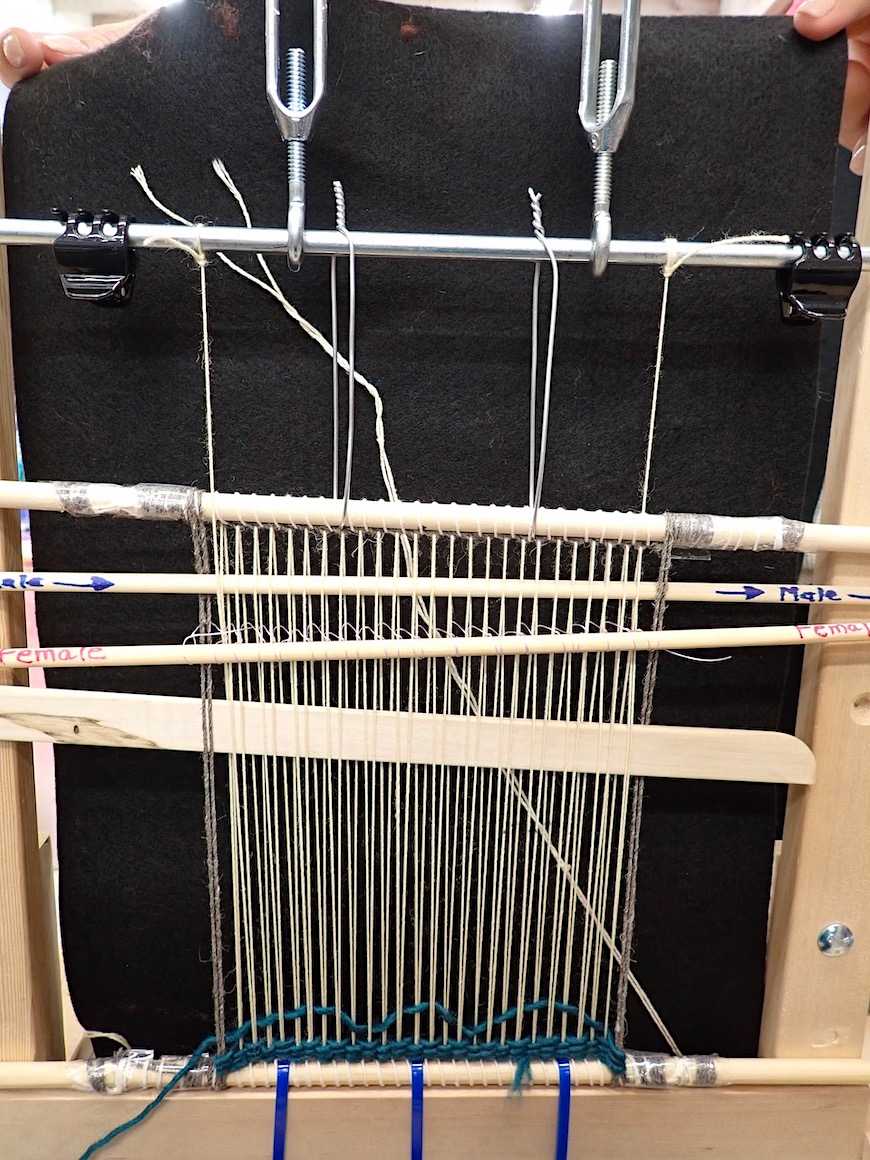
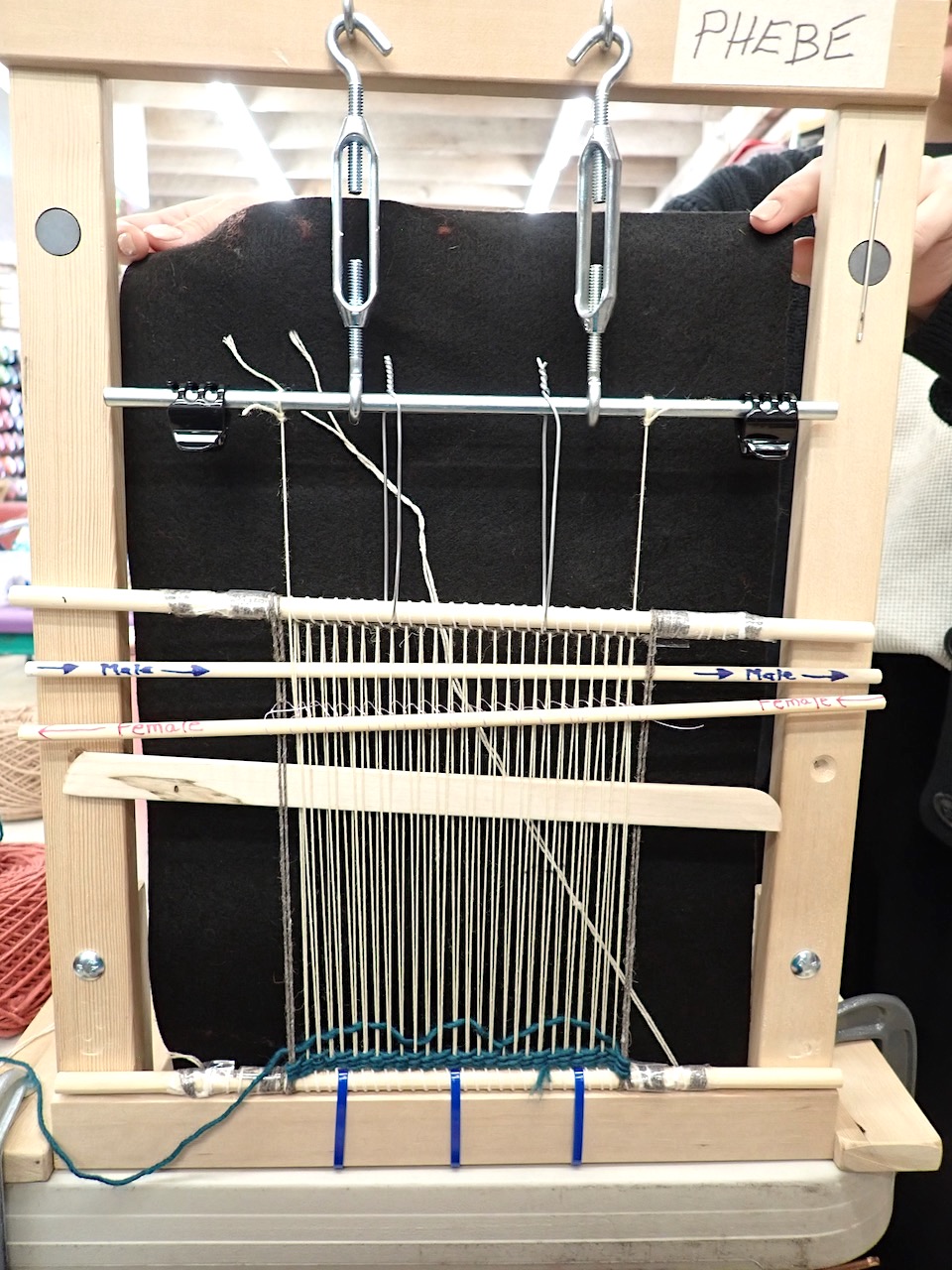
We're wintering in Tucson, so it seemed reasonable to join a three-day workshop on Navajo weaving.  The first day of the weaving workshop was good – although this is more exacting than the tapestry weaving I did in Italy, because apparently Navajo weaving has rules, and things need to be carefully measured and counted. I'm fine with the math, but, well, I'm not a very rule-oriented person. (Just in case you all hadn't noticed that, LOL!)


Anyway, it's a very complicated loom,
I can't even explain it. Plus our instructors already set up the warp, which seems to be sewn into heavy grey yarn at the top and bottom.  But it needs to be worked with the loom upright, and bolted to a table. Eight rows woven in a special weave (instead of one over and one under, it's two over and two under), then another 2" in a closer weave. Then the central design (which is measured so it's EXACTLY centered. Then 2" in basic weave, then eight rows in the beginning weave. That's what I mean, I'm not quite that exacting in my artwork.


Our two instructors are sisters, from the Navajo nation. (Hence the traditional Navajo weaving.) There are 13 students in the class (one man and the rest women). Three or four students are also Navajo, or perhaps Pueblo – people introduced themselves, and all the Native American people introduced themselves both in English and in Navajo.


I will admit, part of me was debating introducing myself as being of the tribe of Judah, and doing part of that in Hebrew. But I didn't think that
would go over well, nor that anyone would think that was as amusing as Richard and I think it is. So, I few sentences in English – I’m a retired art teacher, husband and I have been travelling since retiring in 2012, attended some art lessons in other countries learning about their cultural art forms, so sure, Navajo weaving made perfect sense.


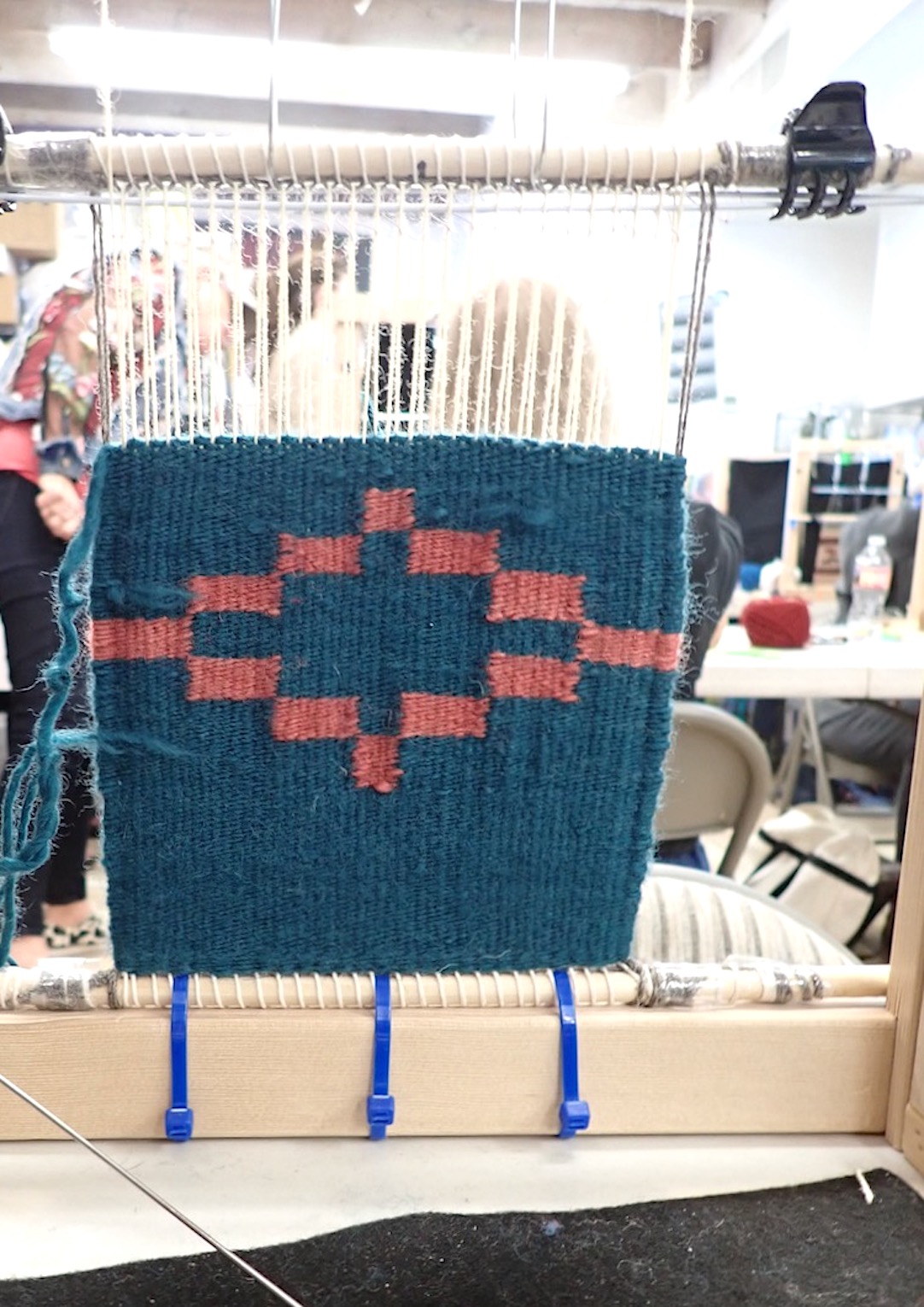
So on Day #1, I made it as far as that first 2.5" on my first day. And I had my design laid out on graph paper, and my colors selected.  On Day #2, I started on the design in a contrasting color.  Most of my day was spent at the weaving workshop, and my design is going well. Unfortunately, I'm not a speedy weaver, and I don't know that I'll get it done. I stayed an extra hour on Day #2, trying to get the design finished, and most people brought their looms home to finish up that portion. But I'm at a point where my stepped pyramid is decreasing, and I'm confusing myself on how to move the yarn when the rectangles shift over.  Part of my confusion is that the yarn is moved into position when one is weaving only in one specific direction, and of course, I keep forgetting which that direction that is, and sometimes it seems as if I'm adding an extra row to only part of my pattern which also is confusing.


Plus at our rental house, we only have a bar-height table with a metal frame under the table top and tall chairs, not a normal kind of dinner table – I'm not
sure the vertical loom can even be secured on that table. (It uses blocks of wood and C clamps to make a base, and the loom fits into that.)


So, I may need to just end my weaving with either basic weave, or make it shorter, or something. Not sure if that's possible.


Anyway, I'm having fun. If nothing else, I've learned how the Navajo weaving manages to not have the loose yarn ends showing on the back – the trick with the yarn in Navajo weaving it to break or shave the end of the yarn
so it's super tapered – then overlap another piece that's also tapered. (Overlap about 1/2 to 1 inch.) The two tapered ends prevent the yarn from working out of the weave. That way the end doesn't work itself out of the finished piece – the shaved tapered part kind of grabs onto the other piece, and they stay put! I'd guess that might work with knitting or crochet work as well!  Although the yarn is thick single ply, not four ply the way most knitting/crocheting yarn usually is.  I'm not sure if that works with multi-ply yarn, I meant to ask but forgot. We were using thick single-ply because it doesn't have as much air so it weaves more densely.


On Day #3, we finished our weavings and cut them off the loom today – and it was all so much more complicated than I had even imagined! And we actually used little electric lint shavers to clean off the fuzz that builds up and wool ends that stick out – it really is pretty impressive! 


Our class ran two hours late because three of us were slow, me being one of them. Most people took their looms home at least one evening to catch up, but I didn't think the blocks and clamps would work on the tables we have at our house. Oh well, the two instructors took pity on me and each did about four to eight rows of weaving on the last part, where it gets really tight and difficult. (The vertical warp threads are attached to a horizontal wool thread, and that wool thread is attached to cross bars on the loom. So we HAVE TO weave all the way up to that horizontal wool thread – that makes it super difficult for the last several rows – we used special large yarn needles to weave!)


When everyone was finished, our teachers said a special blessing in Navajo, thanking the Creator for all sorts of things, including the gift of weaving (which Spider Woman brought to human women, according to legend). It was pretty interesting.


Because Navajo weaving was traditionally done by women, the whole process is sort of an analogy for childbirth and child-rearing. A certain thread that creates the heddle, the process that lifts and separates the warp threads to create the weave, is supposed to have special female powers and links us to Spider Woman. The ritual is that the instructor tells us when that string needs to be cut, they begin it, and the student pulls the thread and it comes out. Weirdly, I felt a strange internal physical WHOOSH of energy! One of the instructors said we should get a rush of woman power, so who knows, maybe it was all in my head, but maybe it was real! (I will admit I'm susceptible to the power of persuasion, so I never know if it's real or if I'm convincing myself it was real.)


Yes, the whole thing with Navajo weaving is that the legends surrounding this art form are so entwined with the culture – Spider Man and Spider Woman came to Earth at a certain tall rock pinnacle (I think it's near Canyon de Chely), and they brought weaving with them. Spider Man built the first loom, and Spider Woman taught people how to weave.  I love legends like that!  Lynda, the instructor who helped each person take that special string off their loom, said something different to each person – makes me wonder if she somehow got a sense of what that person needed to hear at that moment somehow!


I did a little online research and it turns out our Navajo weaving instructors are fairly famous in this field, especially the older sister whose weavings are in museums, have won prizes, all sorts of exciting things! They both will be at the Heard Museum (in Phoenix) in March when there is a large Native American art event.


Anyway, it was a really interesting class, and I’m so glad I attended.  I’m going to try weaving another version of my design from the weaving class in Italy, and incorporate some of the techniques from Navajo weaving.  The way they do the change from one color to another in a side-by-side design is much easier than the traditional French style of color changes.


I’ll report back after I finish another castle from San Gemini!


Monday, April 7, 2025

Arrivaderci Roma – or maybe not

 21-22-23 October 2024


With travel, things don’t always go according to plan.  Even the most precise planners know that when travelling, things often go awry.  So, travellers learn to be prepared for things going wrong – missed flights, delayed flights, extra nights due to missed connections, whatever.  Preparation and a mindset of “whatever happens, I’ll get home eventually” are the best ways to deal with all those possible extenuating circumstances.


Most of our class members left La Romita on 21 October.  We arrived at the airport, and one woman was rather frantic as her flight was leaving in less than an hour.  Hopefully she made it.  Everyone else either had a flight later in the day, or, like me, planned to fly out the following day.  I didn’t really have a choice, all the flights for Tucson left in the morning – so I booked a hotel not too far from the airport, the La Romita bus drove me there, and I had a lovely night.  Turned out that a fellow student, the woman who so kindly gave me a ball of the indigo-dyed yarn she brought with her, was also staying at the same hotel.  We had a very nice dinner right at our hotel, said good-byes, and had a decent night’s sleep.


I got up early the next morning (22 Oct), had brekkie at the hotel, and took their shuttle to the airport.  I checked in, and found out my luggage had gained 15 lbs!  Made sense, I had the copper tubing loom as well as five or six jars of black truffle products in there!  It was still under the airline’s maximum, but I was surprised.  (My ticket agent agreed that Spoleto has the best black truffle products in Italy!)


Normal airport things – Customs and Immigration, waiting for the flight, boarding the flight.  Then we sat and waited.  The pilot came on the intercom and said the plane had a problem with the hydraulic system, it was being worked on, we should be off soon.  He kept us apprised periodically.  Flight attendants brought drinks, chatted, assured us things would be okay.  Two hours later, our captain came on to say all was fixed, but they needed to re-submit their flight plan or route or something.  This had to go through the Italian office that handles such things, then some European air space office, and the new route then needed to be approved by the US office of the airline.


You can see where this is going.


Once all those offices approved everything, we then had to wait for a truck to pull the plane away from the jetway.  We FINALLY were cleared to get to a runway – but at this point, the captain told us that we had to wait for our turn to get into the air.  We had exactly 13 minutes for this to happen.  If we were not in the air within 13 minutes, then all the plane’s crew would be over their time working limit before we arrived in the US.  Which meant if we were not in their within those 13 minutes, they’d be forced to cancel the flight.


Yes, that’s what happened.  Flight cancelled.  There were several people who were slightly hysterical, they were supposed to go to work the following day.  (I’ve been in that situation, so I can sympathize.  Had to call my principal at home and tell him I was stuck in Florida and would be back to work in two days, please plan for a substitute tomorrow.)


People with smartphones began to receive notification of when their new flight was scheduled, and most were on flights the following day.  I whipped out my iPad, signed on, and checked.  Yes, my flight was scheduled to leave 22 Oct, the day I was supposed to arrive.  Looked like a tight connection in Dallas, given that I’d need to collect my luggage, go through Customs/Immigration, and get to the gate.  But this is why I have MagicJack on my iPad, so I planned to call the airline later and push back the connecting flight.


Of course, with a huge plane load of people, the airline scrambled to find hotels for all of us.  None of us knew exactly what was happening, but there were a few representatives who told us to get our luggage, and eventually told us to proceed to doorway number something.  (This is why it’s good to travel with luggage you can handle yourself!  I was fine with my rolling duffel and daypack.  Other people were struggling with multiple suitcases each, because there weren’t any carts or skycaps available.)


We piled into the bus.  The driver didn’t speak much English, so one of the reps came on and told us we would stay one night at a hotel, there would be a bus tomorrow to drive us back to the airport.  The hotel would provide lunch and dinner. 


The bus drove.  And drove.  And drove.  It took probably two hours, given the traffic.  We ended up at a seaside resort in Civitavecchia, the ancient port city outside modern Rome.  (For those wondering, that is pronounced chee-vee-ta-VECK-key-ah.  I know, I’ve practiced so I can say that smoothly.)


We lined up, were assigned rooms, received keys.  Given a plastic bag with a panino (one sandwich is a panino, two sandwiches are panini) and a bottle of water.  Told what time dinner would be served.  No one seemed to know what time the buses would arrive the following morning, but it would be early – my flight was leaving at 8 AM.


My room was nice, though the floor was still damp as if it had been freshly mopped.  My guess is that this seaside resort had closed for the season, but some airline rep knew or was related to the owner, and they opened up just to house these stranded passengers.


So, I enjoyed my lunch on my lovely balcony overlooking the sea – the Tyrrhenian Sea.  I called Richard and told him I was delayed, I had an extra day in Italy.  That I’d get in tomorrow, 23 Oct.  This happens to us all the time, he said fine, not a problem.  We promised to talk later.  I called the airline and pushed back that connecting flight out of Dallas, not a problem.  I took photos of my view of the sea and the marina (it was sunset by now).


Dinner was lovely, though all portions were absolutely huge – just one course would have been enough!  Passengers recognized each other, we chatted with people at other tables, it was a room full of stranded travellers either resigned to being delayed, or happy to have an extra day in Italy.  Word spread that our buses would arrive at 4:30 AM, perfect since most of us had an 8 AM flight.


Very peaceful night by the sea, my alarm clock woke me in time, I was all set to leave – and I could not get my door unlocked and opened.  I’ve never been good with locks, or keys – people tell me to turn it to the left and I never know if they mean turn the top of the key to the left, or the bottom of the key – they obviously go in opposite directions, and it just never makes sense to me.  I turned the key one way – door stayed locked.  I turned it the other way – locked.  I pulled the door toward me and tried both directions – locked.  Pushed the door forward and tried the key – locked. 


The room didn’t have a phone to call the front desk, so I pounded on the door and hollered “Help!  Help!”  No one came.  I went out on the balcony and yelled for a while – no one answered.  I tried the door again, no luck.  More pounding, more yelling, back to the balcony.  Now I was the frantic person, because I needed to get to that bus!


On maybe my fifth trip back to the door, I finally got it open.  It was one of those things where the key stops, then you need to really crank it hard to make it unlock the rest of the way.  As I said, I’ve never been good with keys.


I was running so late, I rolled my duffel across the dew-covered lawn instead of going around on the paved walkway.  Sorry, but desperate times and desperate measures, all that.


Turns out I could have waited.  I got on the bus, and we sat.  And sat.  We were getting worried, it had taken two hours to get here, it was now 5:30 AM, our flight was due to leave a 8:00.  I got out and told the driver, in my minimal Italian, that we needed to go, we fly at eight!  He assured me we’d be fine.


I think we finally were on our way just before 6 AM.  We made it to the airport in time for our flight – as we were bused out to the plane, we realized this was exactly the same plane we had been on yesterday!  And we recognized the crew!  Same exact flight with a new time of departure, and new flight number.  Oddly, we all had new seat assignments – you’d think the airline would have kept everyone in their former seats!


I was in the same section, had the same sweetheart flight attendant – but because I was several rows back, the meal I had pre-ordered was already taken.  I explained I picked that due to food allergies, the two other options were likely to have foods that I’m severely allergic to – and that I once ended up on a flight getting shots of epinephrine in the plane’s galley!  My wonderful flight attendant went to the captain and asked if he’d be okay with a different main course for his meal, so I was able to have my chicken rather than the pilaf (with cashew) or the meat (with chutney, all too often mango).  Many thanks to the captain and flight attendant!


The rest of the trip was fine, though I’m glad I bumped back the flight to Tucson.  I kept Richard apprised of my travels, and by the time I arrived in Arizona, he was tired, it was dark, I said I’d grab a taxi and he should stay home.  I had a friendly taxi driver, made it home safe and sound, after taking what became the loooooong way home.


So – two maps of Italy.  The close up is obviously the outlined square on the first map.  The pink star is La Romita in Terni.  The pink circles are the towns we visited, and the numbers show in what sequence.  "D" is for delay, LOL!


Tuesday, February 11, 2025

The Natural Dyes - WOW the Colors!

21 October 2024


I've talked about the four women in our class who foraged for plant material and made all sorts of dyes.  They really worked hard, and accomplished a lot during our ten day class.


Not that I learned anything about dyeing, but I was having enough trouble just warping the loom!  I really did not need to try anything else in the class, trust me!


The group used a combination of foraged materials and the Saxon blue that our instructor, Shelley, brought with her.  The blues in the center are Saxon blue, some overdyed over elephant ear mushroom dye, or, well, I don't really know.


But look at all these colors!  Amazing, aren't they?  So big props to our dyers, who created these and more colors of yarn!


They then catalogued the various colors, making cards with a swatch of each yard and labelling them with the plant materials used, the mordants, percentages of whatever - so that these colors can be replicated.


As I said originally, I wanted the colors that were used in the San Gemini flags, the indigo blue, bright white, and rich red.  So I didn't get involved with the dyes.  (My big contribution, she said facetiously, was helping spread these skeins on the drying rack so the yarn could fully dry.  I know, one tiny step in a HUGE task!)


But the results really were incredible, so I wanted to be sure to include them here!