Tuesday, December 3, 2024

Tarquinia, and Il Giardino dei Tarocchi

 Tarquinia, Italia


13 October, 2024


This was a full-day excursion, broken into two parts.  We drove past part of a Roman aqueduct – you can see a bit of reflection as I took these photos through the bus window.  SO thrilling to see pieces of 2000 or so year old architecture, still standing!  The Romans certainly knew how to engineer buildings to last!


Tarquinia is one of those ancient-to-modern cities that are all over Italy.  It’s a port city, almost on the Tyrrhenian Sea, a bit north of Rome.  The city dates back to roughly the 8th century BCE, when the Etruscan culture flourished in the Italian peninsula.


One of the big features of Tarquinia is the necropolis, the ancient Etruscan cemetery.  Wealthy or important Etruscans were buried in underground tombs carved into the bedrock, with small buildings atop the tombs.  Some people in our group hiked up to the necropolis, while the rest of us went to the huge museum of Etruscan art.


I was in the second group.  The National Archaeological Museum of Tarquinia is housed in the 15th century Palazzo Vitelleschi – commissioned in 1436 by Cardinal G. Vitelleschi.  (The church hierarchy was led by wealthy princes and minor royalty or nobles.)  It’s a gorgeous building with colonnades and porticos and arches, graceful and airy.  And chockful of sarcophagi and frescoes from the Etruscan tombs.


We couldn’t take photos inside the museum because, well, those are the rules for most museums around the world.  Flash photos are bad for the art, there are copyrights on much of the art, and the museums make money by selling the images on postcards and in books and such.  Here’s the city’s website, which features some of what is housed at this museum:  https://tarquiniaturismo.com/national-archaeological-museum-tarquinia/?lang=en


Most of the sarcophagi are about the size of a modern coffin, and carved from tuff (in Italian, tuffa).  Tuff is one of those odd rocks, being basically volcanic ash that was compressed over eons and mixed with rain or groundwater, so it’s solid but still fairly porous and easy to carve.  It also is a conglomerate, meaning there are all sorts of other tiny to small rocks mixed in with all the ash.  Tuff is common in volcanic regions like Italy, and is also the rock used for the giant statues (moai) for which Easter Island (Rapa Nui) is so famous.


Most of the sarcophagi had a statue of the person carved on the slab lid that closed the body inside.  It was interesting how realistic these statues were, with the person semi-reclining.  We noticed each figure either held a carved round dish sort of thing, or there might be one next to the statue.  I sketched a picture and asked the people working in the museum what it was; turned out that food was placed on that dish, so that the deceased would have food to sustain them as they moved into the afterworld, or next life, or however the Etruscans thought of death.


There were both women and men figures, though predominantly men who were government officials.  Some more modern sarcophagi (as in only 2000 years old instead of 3500 years old) had writing carved in the sides, often the name of the person.  A few even had frescoes painted on the sides!


My favorite part, however, was upstairs, where several of the tombs had been dismantled and the frescoes were installed in the museum.  SO gorgeous!  These frescoes covered all four walls as well as the peaked ceiling of the tombs, and represent Etruscan life.  There are paintings of people playing musical instruments, or sitting at a table eating, even participating in sports!  Most of the colors are still bright, even after all these years!  (Fresco is ground natural pigments painted on wet plaster.  The plaster crystalizes over the pigment as it dries, so it preserves the color and image better than paint on canvas or wood.)


Some of the frescoes include demons or monsters, perhaps part of what was imagined as being in the after world.  The ceilings were usually geometric shapes, vaguely like a tiled roof perhaps.  At least, that’s sort of what it looked like to me.


The whole museum was fascinating, and definitely worth a visit!


Edmund, the school’s on-site director, had made a reservation for us at a seafood restaurant.  So after we finished a slow wander through the museum, we headed over there for a delicious lunch.  We had time for a quick gelato, then our bus was ready to take us to our next stop.


Il Giardino dei Tarocchi – Tarot Garden


Niki de St. Phaille was a French fashion model, but so much more.  She was born in 1930, near Paris, and led an extremely colorful life.  Much of her modelling occurred during her teen years; she posed for covers of Vogue as well as Life magazine.  While in college, she studied art.  She married young (age eighteen), had several children, rejected the traditional gender roles of wife and mother, and opted to pursue art as her career.


While living in Spain in her 20s, she visited Barcelona and was clearly affected by the sculpture and architecture of Antonia Gaudi.  Ms. St. Phaille eventually decided to create her own garden similar to Gaudi’s Parc Güell, although her images are based on the figures in tarot cards.  She bought land some 100 km (60 miles) northwest of Rome, set up a ceramics studio, and designed her garden.  Il Giardino dei Tarocchi, the Tarot Garden, was opened in 1998 after nearly twenty years of work.


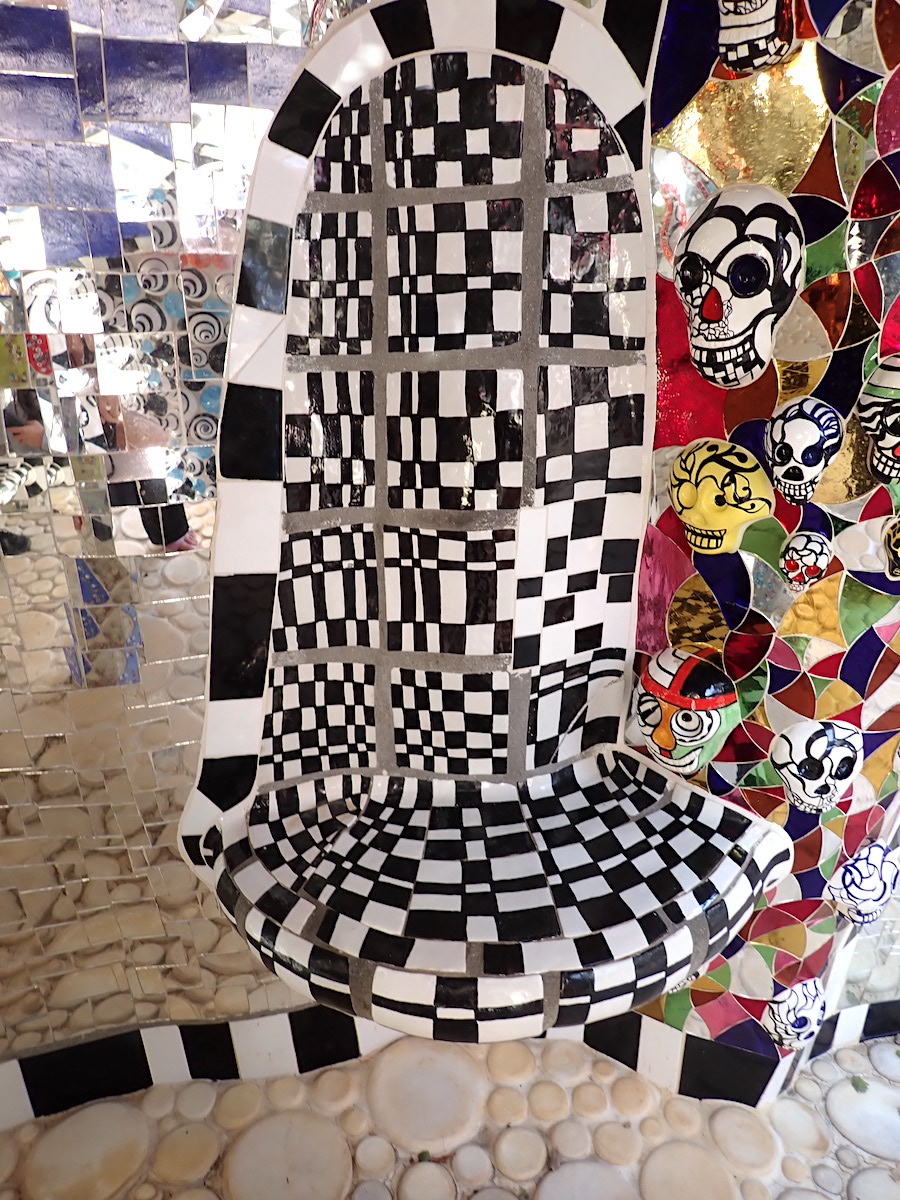
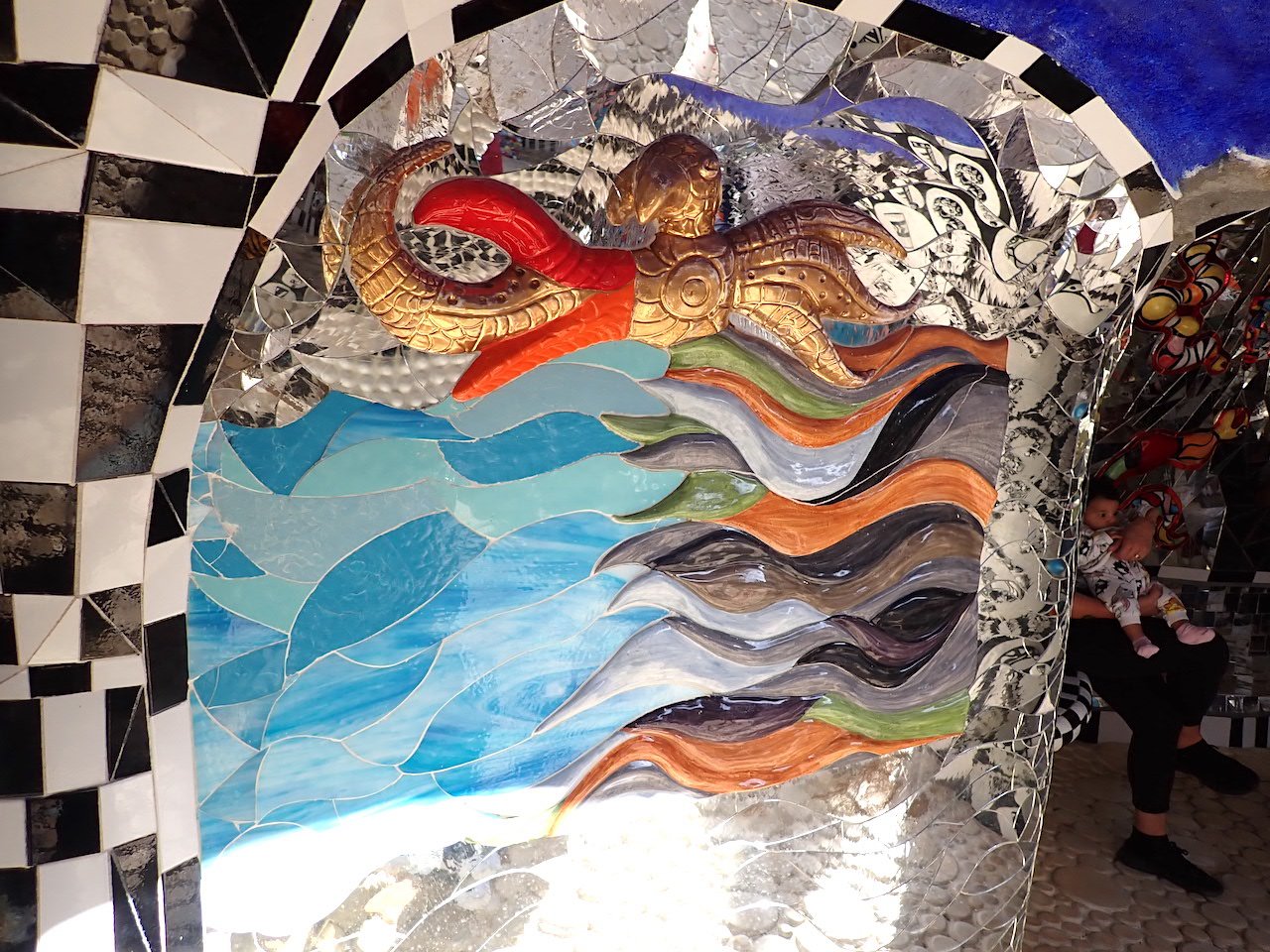
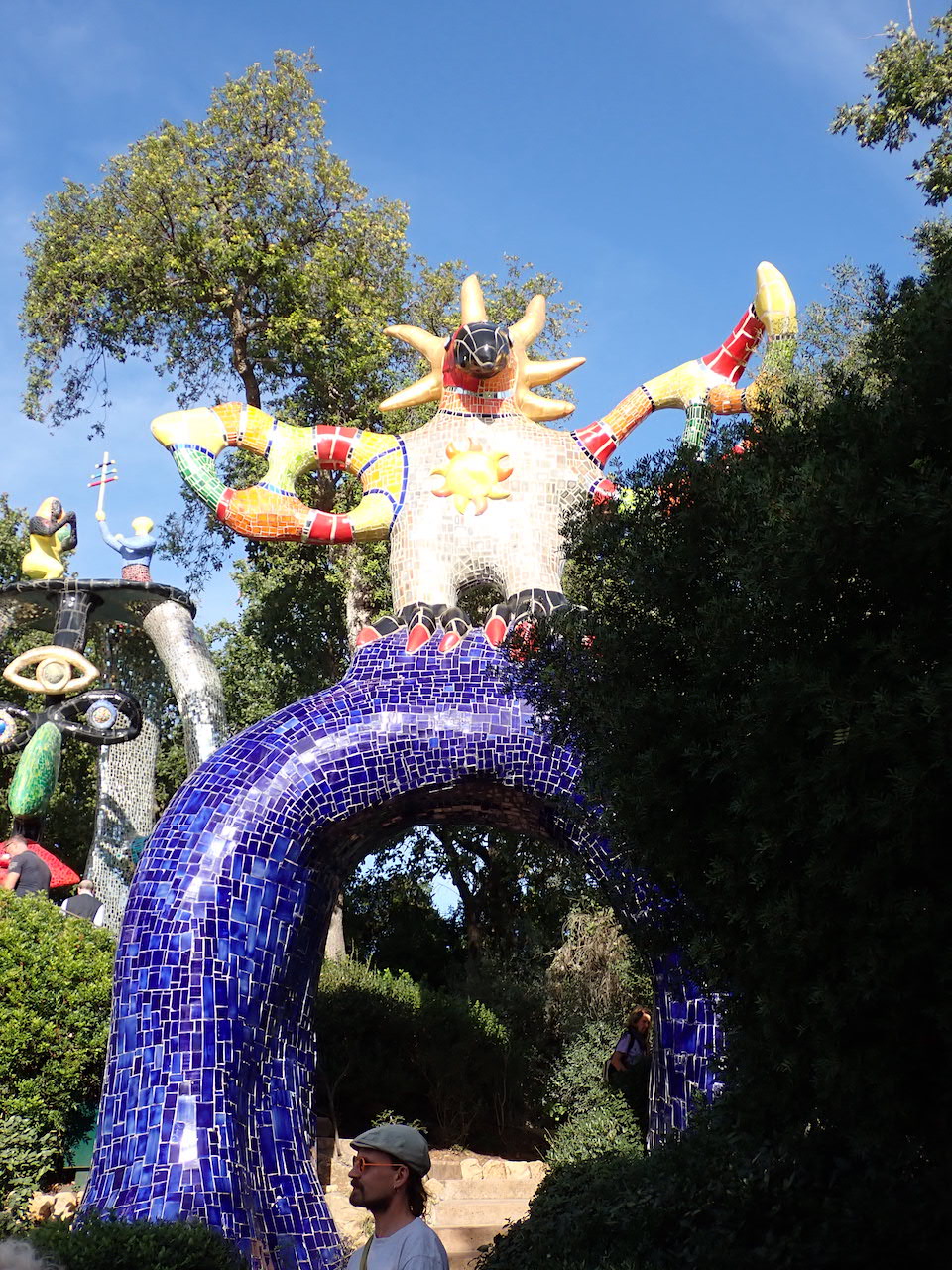
The Tarot Garden was AMAZING!  Truly gorgeous!  A bit more macabre than Parc Güell, but equally colorful and frivolous!  I don’t know all the figures in a tarot deck, some of these are rather ominous (such as the multi-headed beast, which may be a hydra?).  Over all, though, it was incredible. 


For readers who want a description of working on the garden, it begins at the website under “Chronology,” at the 1979-1980 dot, if you want all the details. (I did – I’ve worked in enough mosaic that I could guess how these sculptures were made, but I like to be certain.)  Website (in English): https://ilgiardinodeitarocchi.it/en/


The short summary: the land was cleared.  Each building or sculpture had a foundation laid.  Then the shape of the structure was created using iron bars (armature), which was then covered in cement.  Wire nets were wrapped over that.  Tiles were created at the studio for each structure, and cemented in place.  Grout between the tiles was the last step, and voila, we have a garden.


One of the things that struck me was the multitude of female forms, all looking like fertility goddesses.  Beyond voluptuous, with heavy breasts (often spouting fountains!), and wide child-bearing hips.  I couldn’t decide if the fertility goddess motif reflected Niki’s years as a model, likely eating to retain a slim figure, or if this was her rejection of stereotypical female roles and her symbolization of women as strong powerful figures, the Mother Earth and Earth Mother concept.  Maybe a combination of both.  But either way, the women were decidedly powerful as well as lushly Junoesque.


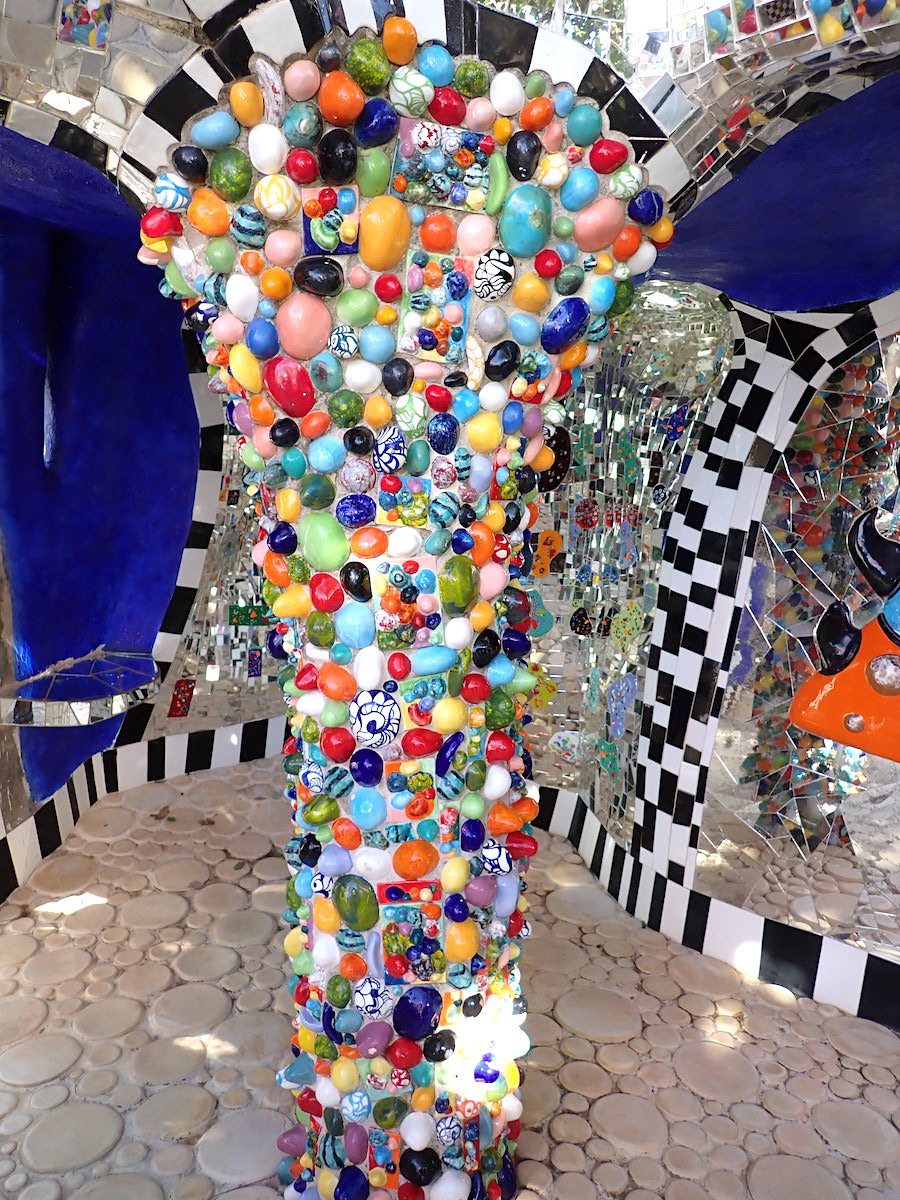
Every surface was covered in mosaic – embossed tiles, marbled tiles, hand-painted tiles.  From the fountain entrance to the female knight on a horse to the happy dragon to individual pillars at Niki’s former residence, everything was mosaic!  Ah yes, I was in absolute mosaic heaven!


We wandered around, in and out of structures, just marvelling at the beauty or strangeness of it all, depending on your perception.  For example, Niki’s house – the exterior was beautiful, with different sections tiled in solid colors separated by bands of hand-painted tiles.  One band of small tiles depicted that fertility goddess known as the Venus of Willendorf, one of the first known small sculptures of a fertility figure. 


But the interior of the house, all curving and undulating surfaces, was tiled in broken mirror.  Few windows, open doorways, electric lights, and yes, harsh and stark glass.  It was intense and somewhat disturbing, and decidedly strange.  We all agreed it was not somewhere any of us could live!  Definitely not cozy nor homey in any way, and rather cold, even in the warm Italian weather.  (Apparently Niki only lived there a short time.) 


All of those feelings maybe have been because the mirrored interior was such a stark contrast to the colorful and happier exteriors, I don’t know.  But no one seemed to feel happy or comfortable inside that house.


I loved the pillars, each with a different motif.  Some were covered with glass tiles, others with round balls of clay, each in a different color.  The whole place was an exuberant explosion of texture and color and shape!


Of course, I managed to get a bit lost trying to leave, and kept hitting dead ends.  I think I did see all of the garden that way, however, so I really didn’t care.  And I wasn’t the last person back to the bus, so it all worked.


I had never heard of the Tarot Garden, and am so glad we went here!  Absolutely worth another visit, and probably more time than the hour or so we had here.  It really is unique!!!


TONS of photos, but I will try to keep it manageable.


Monday, November 25, 2024

La Romita and San Gemini, Italia

11-12 October, 2024


I signed up for another class at the Italian art school I like in Terni (state of Umbria) – here’s the website for La Romita:  www.laromita.org.


This was my third visit, fourth class; I was here last in autumn 2022.  It’s a great school with small workshops.  Thus far I’ve taken classes in collage techniques, watercolor, and pastel painting.  This class was in tapestry weaving.  I will admit, I do not have a lot of weaving experience, probably my last woven item was in the late 1980s when I was in my teacher certification program.  But I like textile arts, I’ve done a lot of quilting and painting on fabric, and sure, why not?


Plus one of my good friends, R, a former college roommate, is a weaver.  When I sent her the workshop info, that was her reaction: sure, why not?


So we signed up, and her husband (J) signed up as a non-workshop-fun-only attendee.  (My husband chose to stay in Tucson.)


I’ve written about the school previously and included photos of the exterior.  Here’s the 2022 blog post with a little history of the school, as well as photos of the buildings and the garden.  There’s also a short history of the town of San Gemini, once again the first hill town we visited again this year:  https://rollingluggagers.blogspot.com/2022/10/pandemic-diaries-italian-interlude-1-26.html


The interior of the school is just as beautiful, although not quite as old.  There are bathrooms with running water, something the monks didn’t have in the 1500s.  Nor did they have electric lights, radiators, wifi, or even hot showers.  Fortunately, we no longer live as the monks did, and we have access to all those things.


Two photos of my room – I had a double room to myself, so I pushed the two single beds together.  It just makes it easier for morning exercises so I don’t fall out.  Beautiful Italian antique furniture, and that desk/vanity/dry sink had a gorgeous marble tabletop!


Our first afternoon was in the studio, which is in the former chapel.  Yes, a couple of frescoes, some paintings, a copy of a Rubens etching – all very arty!  The general schedule is that the first day we get oriented, and the rest of the days we have morning excursions to different towns/cities/sites, come back for lunch, and spend the afternoon in the studio.  Some days we visit more distant towns and spend the entire day, coming back in time for dinner.  The studio is open 24 hours a day, though, so people can work in there whenever they like.


We also explored the exterior, including the lovely garden full of color, and the olive grove.  Some of the other students, several who are professional weavers and very experienced in natural dyes, found some mushrooms that could be used for a series of colors ranging from beige to yellow to almost green depending on what chemicals are added.  (Quick aside – we would be weaving with wool yarn, which needed to be dyed.  Different fibers need different chemicals added to the dye in order for the fiber to really absorb the dye and make the color permanent – the chemicals are called mordants.  Cotton, wool, linen, flax, and silk all need different mordants, and those different fibers not only absorb the dyes differently but each also produces different colors.  Also, dye is not like paint, where you can mix yellow and blue to get green.  Some dyes work like that, but some don’t – so the best way to get multiple colors is to dye them the light color first, and when dry the fiber is dyed with another color.  This is overdying.)


Anyway, next thing we know, this group of dyers are boiling up mushrooms, squeezing them out, and dyeing the yarn!  We only had two burners and two huge pots to boil the plant stuff to make the dye baths.  Big, heavy, and probably not great for tabletops on metal sawhorse-type props – so everything was moved to the downstairs print studio.  And suddenly we had a designated dyeing studio.


It was a bit funny, because our group of dyers seemed to find leaves, mushrooms, nuts or nutshells, I don’t know – everywhere we went, they were collecting vegetation and whatnot, and then boiling it to make dye.  I’ll show all the dyes later on, the colors are gorgeous, though many of the colors are definitely earthy, as one would expect from mushrooms, twigs, and such.


While our four to six people were busy making dyes, the rest of us (we were a total of twelve, including our instructor, her husband, and her 88 year old mother who was a sweetheart and game for anything!) set up our stuff, talked about weaving, and the general plan for our ten day workshop.  I told our instructor, Shelley, I had a sketch that I thought would make a nice tapestry.  Showed her my watercolor sketch, the clock of Spoleto which looks like the sun.


Well, Shelley was polite – she said that the clock was pretty, but probably not the best design for a beginning tapestry weaver.  It was too complicated, with too many curves and too many parts.  I might be able to weave part of it, but something simpler would be a better design for a first tapestry.


Okay, I could understand that, not a problem.  I would keep my eye out for an easier, more basic kind of design.  We were supposed to be looking for architectural features on which to base our designs, so okay, I could do that.


So the day after our arrival, as I said, our first hill town visit, was to San Gemini.  I’ll include a map of where we went at the end of all my blogs about Italy, but San Gemini is roughly 15 minutes from La Romita. 


Hill towns truly are that – towns built on hills, usually surrounded by wide walls for extra protection from invading forces.  The walls often include forts, or at least watchtowers.  Most of the hill towns still have the walls and buildings built during the Medieval era, even though some towns were inhabited even earlier, way back to the Etruscans who pre-date the Romans.  Yes, we are talking 2000-something years ancient OLD!


San Gemini has the traditional town built on the upper end of the hill top, with Medieval walls and a huge gate.  This neighborhood is La Rocca, the castle.  The lower end of the hill top is the area built during the Renaissance, so that is the “new” section of town.  Of course, there’s the very modern section, built in the last 100 years or so, outside the walled city.  We skip that, it’s not as much fun.


Because I’ve been to San Gemini before, I have my little route, and my friends decided to hang with me and go along the route.  We headed through the old (Medieval) gate with Shelley and her family, and I stopped to take a photo of the stone emblem of this neighborhood, a castle.  Since Shelley was right there, I asked if this would be a good design for a beginner-level tapestry, and she said yes, this would be great.  So voila, I had my design.


R, J, and I wandered uphill, looking at the buildings, the views, the various banners denoting this is the La Rocca section of town.  We visited a church or two, walked along the ramparts (the top of the walls), and explored at a leisurely pace.  I always take photos of the banners, and I especially liked one in particular, which eventually became the sketch for my design.
 

My usual practice is to have a cappuccino about 11ish, since our breakfast is early and we’re on the bus by 9 AM.  Well, my friends aren’t so much coffee drinkers, and R wanted to try gelato as we travelled around.  Who am I to say no to gelato?


The little café on this side of town turned out to have incredible gelato, one of the darkest and richest dark chocolates I’ve ever had!  Italians believe in more than one flavor of gelato per cup or cone, so I mostly go with a small cup of dark chocolate and coffee gelato.  (Piccola copa, cioccolata fondante i caffe, per favore.)  SO good!!!


We still had enough time to walk through the newer part of San Gemini, the downhill side, all the way to the “new” gate (dating from the Renaissance, meaning it’s only 500 or so years old).  Back up to the old gate where we met our bus and the rest of the class, and headed back to La Romita.


I sketched my design and put it on a 5 x 7” watercolor block, so I was ready to begin weaving.


However, the looms weren’t ready.  Our little tapestry looms were made from copper tubing and elbows – really, pieces of copper pipe bent just like elbow macaroni!  Usually these are put together with caulking to attach the elbows to the pipe pieces, with large nuts and bolts to hold the top half to the bottom half.  (This allows the weaver to adjust the tension as the tapestry progresses.)


Well, apparently the local hardware store didn’t have normal caulk, or caulking guns, or something.  The owner recommended a silicone gel or glue, which is what plumbers would use to connect the pipes, creating a waterproof seal.  BUT!  Silicone gel dries slowly.  As in, not dry even with sitting overnight slowly.  So even though J, our instructor’s husband A, and the on-site program director, Edmund, put the looms together on the afternoon of our arrival day and the morning of our first full day, the looms weren’t ready for use.


The men all conferred and discussed this issue, along with Valerio, the assistant director – their best fix was to drill holes and screw small bolts in to hold the elbow joints to the straight pieces.  Eight holes and bolts per loom, twelve looms.  Oh well, these things happen.  The bolts were purchased, and the men had our looms ready by the next day.


Wednesday, October 9, 2024

Our Annual Migration South 2024

 September 5 through 15, 2024


Day 1 – 5 Sept – 58 miles – Bellingham, WA to Marysville, WA – We opted to make it an easy day.  I’m still a bit sick with whatever I developed from the cruise or the forest fire smoke, and it took a while to pack the car, so we got a later-than-anticipated start to our drive.  Richard and I like the Village Inn in Marysville, which my family still calls the Pie Place because the original building had a giant slice of pie billboard on their roof when we arrived in 1968.  You know a car full of kids will notice a giant pie in the sky!  We we’re spending our first night here, and will get an earlier start tomorrow.


Day 2 – 6 Sept – 284 miles – Marysville to Hermiston, OR – We drove through Snoqualmie Pass, which was somewhat clear but hazy due to all the forest fire smoke in the region.  It’s always dramatic with the tall evergreen trees, rocky cliffs, and soaring mountains.  No animals other than other drivers in cars, all with our windows rolled up to keep out that smoke.  (My smoke and fire map shows medium to heavy density smoke throughout the region, and most of the mountains are in the red flag warning stage.  Not a good time to be doing this drive!)  Then across central Washington with the rolling gold-beige hills, across the mighty Columbia River, and on into north-central Oregon for the night.


We stopped for coffee at a little drive-through shop, and the baristas were in bikinis.  Rather surprised the two of us, and I blurted out “oh, I didn’t know you’d be in a bikini!”  Yeah, we live such sophisticated lives.


Day 3 – 7 Sept – 335 miles – Hermiston to Bliss, ID – We were planning to get as far as Twin Falls, then turn south into Nevada.  Didn’t quite get that far, but it was a good long day of driving.  Nothing major, just lots of rest stops.  Some repeating places we’ve been before, some new stops.


Day 4 – 8 Sept – 87.3 miles – Bliss to Jackpot, NV – We like this quirky little town.  Plus it’s a long drive to go from north NV to south NV, so we like to break it up.  Still a lot of smoke in the air, so we opted to stop at our favorite Jackpot hotel, the Four Jacks.  I played my friendly slot machine Zeus Unleashed – he’s almost always good to me, and has all sorts of flashing lights and thunderous exploding sounds.  We had fun.


Day 5 – 9 Sept – 204 miles – Jackpot to Ely, NV – We stayed at the Copper Queen Hotel last time we passed through Ely several years ago.  We’re now staying at their second property across the street, in a quieter and more modern space.  The Copper Queen is definitely an old school bar/restaurant/hotel/casino, not quite of Miss Kitty’s era but about as close as one can find in the 21st century.


It's funny, we’ve been on this route before.  We stopped at the rest area dedicated to the Pony Express riders, I remembered the sculpture immediately!  But the scenery is pretty, the road (Highway 93) less travelled, and we both prefer to be off the beaten path.


Day 6 & 7 – 10 & 11 Sept – 215 miles – Ely to St. George, UT – Sort of a winding route through The Great Basin, and a corner of the Humboldt National Forest.  Plus I was stopped by either a state trooper or local police for speeding.  He let me off with a warning (and I told him he was a sweetheart) – but it was a little bit hairy for several minutes there!


We spent a second night in St. George – we found an inexpensive hotel that was comfortable, included breakfast, was walking distance to somewhere for lunch, and we were just tired.  So sure, a second night.


Day 8 – 12 Sept – 266 miles – St. George to Flagstaff, AZ – We swung around the north side of the Grand Canyon today, and had lunch at Jacob Lake, a place we stayed several years ago.  Good lunch and phenomenal cookies!  Then we continued south on US highway 89, through desert, hills, mountains, national forest, and along the Vermillion Mountains – such an incredible red!  Really a gorgeous drive, though it did make for a rather long day.


Day 9 – 13 Sept – 56.8 miles – Flagstaff to Camp Verde, AZ – We have favorite hotels and casinos in various places around the world, and one of those is the Cliff Castle Hotel and Casino in Camp Verde, Arizona.  We booked a room in their less fancy property, The Lodge, which is quite comfortable even if it isn’t in the posh hotel attached to the casino.  But we both had fun (and luck) in the casino, and we’ll enjoy a leisurely breakfast there in the morning before continuing southward.


Day 10 – 14 Sept – 143 miles – Camp Verde to Casa Grande, AZ – We tried driving on state roads today, but got hopelessly lost.  Greta the Garmin stopped speaking to us, so we had no idea where we were supposed to go.  Our maps didn’t show what we needed, and driving without any direction in the middle of Arizona is just not a good idea.  We finally went back to the interstates, and braved the highway traffic through Phoenix.  That included a detour off the highway and then back on, which took about an hour.  It looked as if there was some maintenance on an overpass, so, well, yes, if a bridge on the interstate needs repairs, sure, we'll take the detour.


Day 11 – 15 Sept – 69.5 miles – Casa Grande to Tucson, AZ – We’re finally here!  Long drive from Bellingham, but we managed to drive about 1576 miles in eleven days, with one rest day along the way.  Not too bad!  Though Google maps says our whole drive was closer to 1695 miles, but I did track our miles each day so who knows.  Somewhere between 1600 and 1700 miles.  At least we weren’t walking that!


Tuesday, October 8, 2024

Summer in Bellingham

June 1 to September 4, 2024


We spent our summer in Bellingham doing our normal medical stuff - the general doctor.  Specialists.  Dentists.  Eye doctors.  Lab tests.  Imaging stuff.  All kinds of doctors.  It gets the job done, and we both feel better seeing people who have become our medical team, who can see changes as we age and new body parts get used up or worn down.  Just kind of easier to see the same people who can see those changes, rather than always seeing someone new who says "hey, you're in great shape for a 70 year old."


Yes, I also turned 70!  Yikes, the first time I wrote that on a form was a bit frightening.  It's such a big number!  When we were 25 or so, did any of us think about what our lives would like at age 70?  No, of course we didn't!  We were too busy being young, exploring the world, figuring out who we were and how we fit into the greater scheme of things.


Now, at 70, well, some of us are still exploring the world.  We're pretty sure we know who we are by now.  And most of us have figured out that we're just one tiny dot in the world, and a tinier dot in the universe.  Maybe we've made the world a little better for having been here, maybe we haven't.  Hopefully we haven't made it any worse.  I like to think I've made it a little better for the people I've been close to: family, friends, colleagues, students.  But we really never know, we can only hope.


So with this momentous birthday, as my brother called it, I told Richard that what I really wanted to do was to go on another whale watch cruise.  I didn't want a big party, I didn't want anything fancy, I didn't even need a gift.  Just wanted to go out on the water and see whatever wildlife was around.


I didn't take any photos of whales, because then I end up focusing on the photos and not on what I'm seeing so I just enjoyed the whales.  So, photos of the ship, our great seat on the bow, islands, water, Mount Baker looming in the distance.


We encountered two young humpbacks.  Now, humpback whales are common in the Pacific, and they've started coming into the Salish Sea in recent years.  (The Salish Sea is used to describe the various straits and sounds and inlets that were originally named things like Puget Sound and the Straits of Juan de Fuca.  But they're all attached and connected, so the name the Salish Sea covers the combined waterways.)


Okay, back to our whales.  Humpbacks are called that because when they do a deep dive to hunt for food, they bend forward and arch their backs, hence the hump.  They dive down, and much of the time their tail comes up to help propel them deeper.


Now, the underside of the tail, called the fluke, is used to identify each humpback.  And, it seems that these two particular humpbacks had not yet been identified and named by the whale researchers!  Our naturalist onboard our ship went to the humpback ID website, and there were no matches - wow, new unidentified juvenile whales!  Exciting!


The naturalist contacted the researches nearby, and they said they'd come out and meet us.  She told the captain, and so our ship followed the two young humpbacks for probably a full hour, maybe more.  The two would surface, and breathe out, creating that typical puff of condensation.  They'd do a shallow dive.  Come back up, puff, dive again.  They'd do this maybe four to six times - and then they'd hunch their backs, flip their tales and do a deep dive!  SO exciting!


Sometimes the whales would surface way ahead of us, and the captain would speed the ship up so we could follow them.  Sometimes they'd head in a different direction, so we would too.  Regulations (or laws) state that boats need to stay 200 feet from sea mammals - but the whales don't know that, so occasionally they'd surface really close to the ship, so close we could hear them exhale in a loud whoosh!  WHOA!


It really was thrilling!  After roughly an hour of following the whales, the research vessel came up, and we let them take over.  It also was about time to head back to Bellingham.  But wow, what a great way to celebrate my birthday!


We also saw harbor seals, and stellar sea lions which are the really big sea lions that like to sit on buoys.  Seals and sea lions need to get out of the water after several hours and warm up in the sun, so buoys are very handy.  (Sea lions are larger, and have a different skeletal structure that allows them greater range of motion than seals - so seals can't get up on the buoys the way the sea lions can.)


We rented a house for the summer, which turned out to be in a wonderful part of Bellingham.  We were located across the street from a 70 acre park, and right by a designated green space that protects one of the small rivers or creeks in the area.  So we had deer walking through the yard on a regular basis.  Bunnies hanging out in the garden.  Hummingbirds in the trees, with the parents hovering overhead like drones, trying to get me to not sit outside and read so close to their nests.  I could hear the babies in the nest, making little ticking sounds!


Our landpeople lived in another house on the property, and kept a gorgeous garden!  They shared their bountiful harvest with us - zucchini, radishes, corn, eggplant, artichokes!!  I would periodically chase the deer out of the garden, or away from the rose bush.  And I shared the zucchini bread I made.


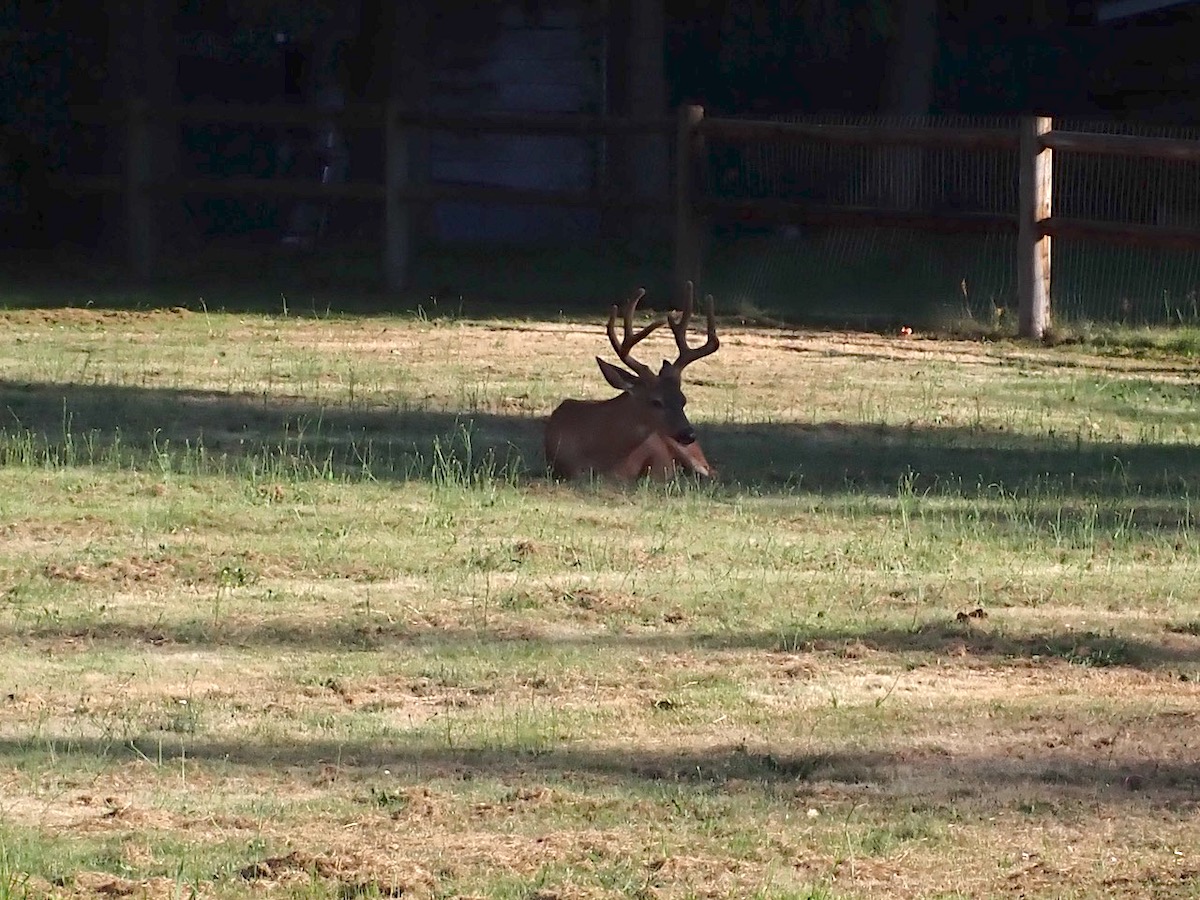
So it was a wonderfully relaxing summer.  Lots of reading outside, watching the gang of stags come through.  Really, grandpa stag was majestic - probably eight or ten points on his antlers!  A bit thick in the torso, so we could tell he was the oldest male in the posse.  He absolutely owned the neighborhood - he'd march down the street, and no one challenged him.  Every other deer either moved out of his way, or followed him down the street.  SO much attitude!  He knew he was all that!


One evening, Mr. Stag Sr and his gang decided to visit the neighbor's back yard.  I grabbed my camera, but by the time I went back outside, the three main stags were all sitting or lying down, eating all the dandelions they could reach.  I guess standing and eating dandelions was just too difficult, or they were too low, or hey, it had been a hard day.  It was funny to watch these magnificent and majestic animals lazily lying around and eating flowers from that position.


I did manage to meet up with most of my Seattle friends, and spend some time with my brother and sister-in-law.  Capped off the summer with the cruise to Alaska with another sister-in-law (the five previous blogs).  


And then we began our trip south to warmer climes.  But that will be another blog.