24 January 2021
 What an eventful couple of weeks! Not in our life exactly, just in our nation in general. And we thought that 2021 was going to be an improvement. Oh well, at least civility in politics seems to be returning, or maybe beginning to return. We'll see what February brings. Hopefully more vaccines,
  as well.
We're now down to eight weeks short of a year living with Covid-19. Forty-four weeks of social distancing and, for some of us, wearing a face mask. Nearly a year. Some of us are able to track down a place to get a vaccine, some of us are  still scrambling to make an appointment, and others are waiting for our group to be called.
Does anyone else find that their mindset has shifted? I know, most of us have realized that there are more important things in life than focusing on  buying the latest electronics or cars or whatever, that our physical and mental health is more important, our families and our friends are more important.
But does anyone else feel like their mindset has changed, so that staying home and staring outside  seems like you're doing something? That walking to the end of the street and sitting outside has become an event? That going grocery shopping for a weeks' worth of food is a major undertaking? Yeah, it feels like that for us.
I found an article about human happiness being  tied to bird diversity in one's environment. I suspect many people smiled at the photos from early in the shutdowns, where animals from monkeys to mountain goats roamed city streets. In our town that constitutes home base, mountain lions have been seen more than once within the city limits.
  Animals are wondering what happened to all the people, and are taking advantage of our time sheltering in place.
Of course, birds are also coming closer to human habitations and urban areas as well. Some areas, such as St. Augustine and Anastasia  Island, were already known as good locales for birding. But now, with the dearth of tourists, there are even more birds.
So, the article. This was a study conducted in Europe, and people self-reported on their quality of life and personal happiness. Combing  through the data, the researchers found that the happiest people consistently reported diversity in wildlife, especially birds, in their daily environment. In fact, that satisfaction in life was measured against financial gains in employment, and it was estimated that living in an area with greater diversity of birds was
  equivalent to a salary raise of roughly $150 per month!
I've never been big on birding. I'm not good at walking softly through the woods looking for birds, I don't recognize very many bird songs. But I notice birds, I notice animals in general. And with the abundance of birds in this  region, I'm getting better at identifying them.
My American white ibis has been sitting on the power lines behind our house a few times, looking rather ungainly as he/she stands on those long legs, balancing on the thin cable. I saw a few families of ibis, white adults and  beige to brown adolescents foraging in the grassy area between a strip mall and the road. They're such elegant birds with that long curving beak, but then they just wander around like chickens, pecking at the grass and mud.
I think I've seen several 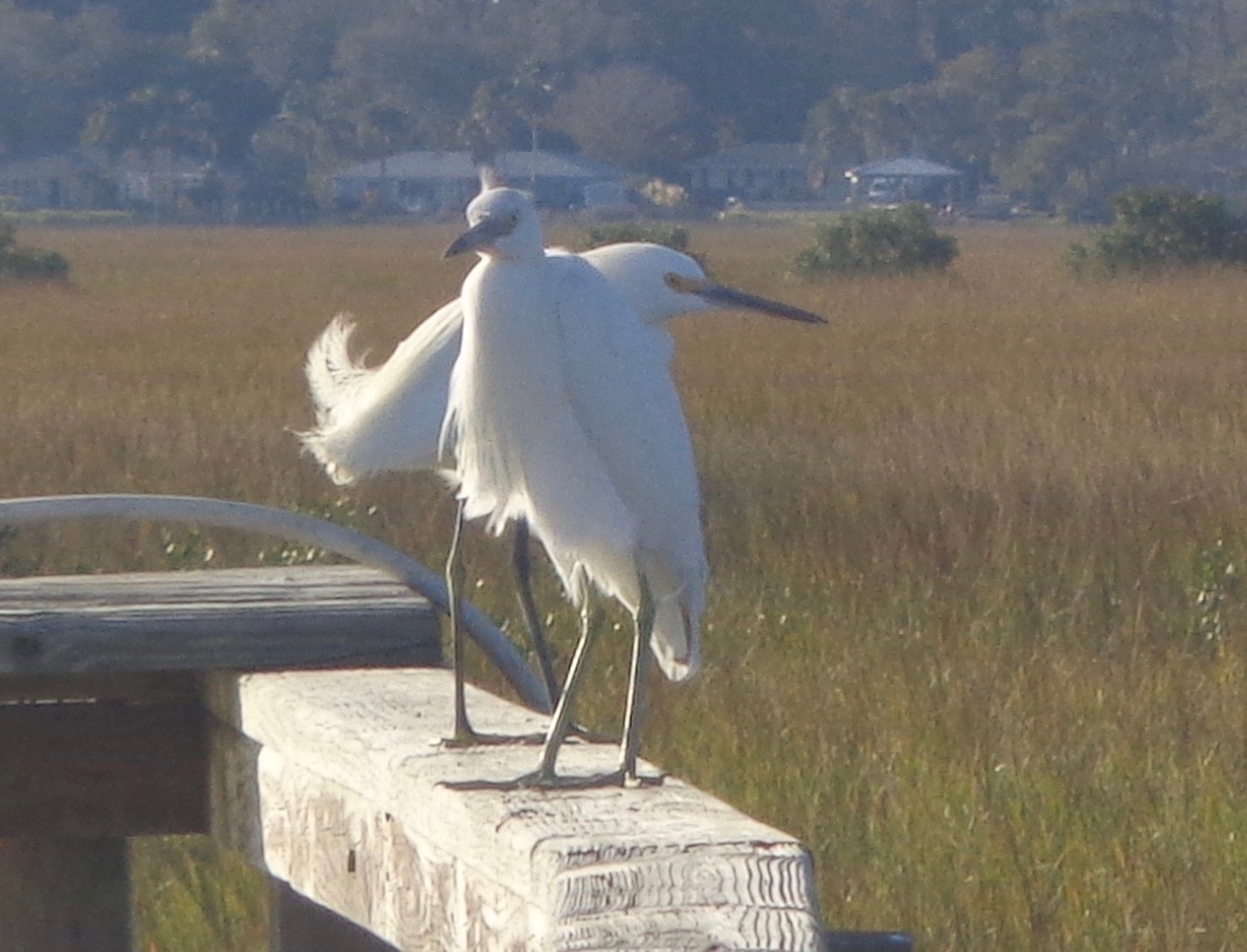 little blue herons hanging out around our dock, also searching the mud for tasty food items, or just standing in the water waiting for a fish to swim by. Their legs look like the reeds and grasses growing by the water's edge, so fish will swim right up to the bird and suddenly they've become lunch.

Occasionally a pelican will fly across the island and fish in the intracoastal waterway. The water is a mix of ocean water coming and going with the tides, and fresh water from the Matanzas River. Sometimes we see fish jumping, especially at high tide, so yes, the pelicans come to fish for dinner.

We've seen several great blue herons, standing at a distance or flying by, looking like feathered pterodactyls and sounding like raspy frogs croaking. I can never quite get a photo of them, they're too fast. But the reflections in the water show the huge birds quite well.

There are huge white water birds - either the white stage of the great blue heron, or more likely the great egret. The great egret has a yellow beak, black legs, and is about the size of a great blue heron. Young little blue and great blue herons go through a white phase, but they have dark beaks, so it's pretty easy to tell the  difference.
I've seen a few great egrets, usually in the shallow water - gorgeous and elegant, but yes, claws in the mud and muck. Sometimes with their neck stretched out, looking around, and sometimes with their neck curled into that S curve so characteristic of these birds.
 There were two white stage little blue herons huddled on the end of the dock one cold and windy day. They were not exactly posing, but they were willing to be photographed rather than fly in that cold wind. I apologized for disturbing them, and kept some distance between us so they'd feel safe. The wind was ruffling their feathers as they sat there in the
  cold. Eventually they did fly away, hopefully to a sheltered tree or bush.
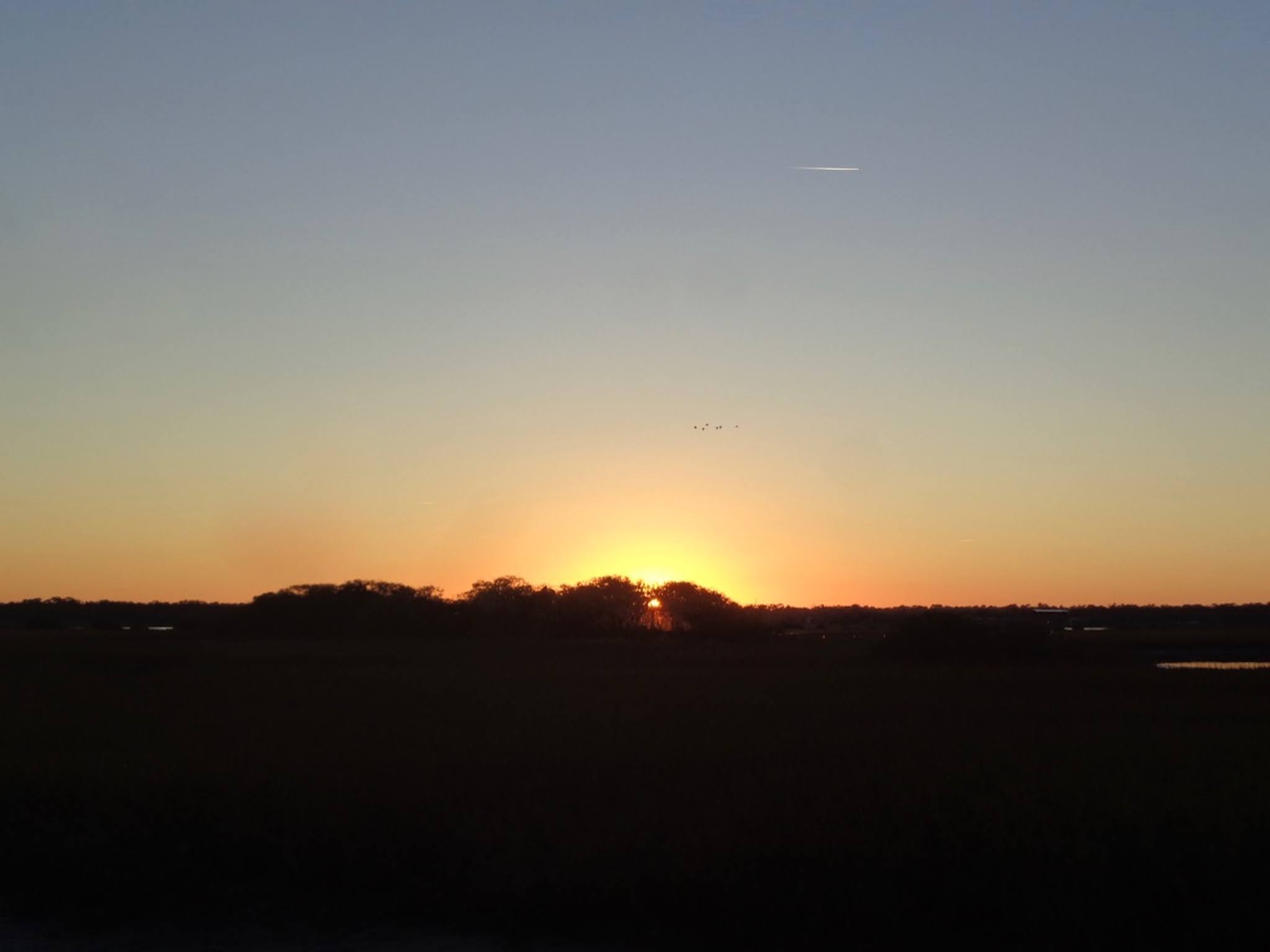
One afternoon, I headed down to the dock for sunset, and it was like magic. Flocks of herons and egrets flying through the sunset, unbelievably gorgeous against the coral-pink-lavender sky! I wish I had a better camera to zoom in and get better photos, but it really was incredible. And on my walk back to our house, more and more flocks of birds flew overhead, heading home to roost for the night.
There are lots of enlarged photos at the end so you can see.
I've been enjoying the varying moods of the wetland meadow, ranging from sunny to stormy days. I feel like one of the French Impressionists capturing the subtle differences of color and light depending on the time of day and weather, even if the subject is ever the same. It always looks different, and the ebb and flow of the tide exposes the oyster beds in the waterway. No wonder so many birds come through looking for a meal!
Another afternoon, walking back, I passed a couple of neighbors at the end of their driveway, and said hello. They had buckets of flowers, which turned out to be old flowers donated by the supermarket up the highway. The women told me that the supermarket calls when the flowers are getting too old to sell; one woman goes and picks up the buckets, and the other woman, who is a professional florist, makes lovely bouquets which they give to people in the neighborhood. So I came home with a beautiful bouquet, and most of the flowers looked good for over a week. It really was a nice bouquet, and it looked different from each side. We enjoyed the lovely free flowers, and it's a nice way to get to know some of the people in our neighborhood (while we keep our distance).
That's about it for our personal excitement. Well, a few cardinals flying by, even this far south. Several pileated woodpeckers who seem to like the trees we see through our bedroom windows, so I see them hopping up and down the trunks in the mornings - large dark woodpeckers with a bright red crest on their heads.
We spent about three weeks madly accessing websites at specific hours trying to sign up for Covid vaccination appointments, including a concert booking site that is now booking vaccine appointments. We finally managed to book something, in Jacksonville, about an hour north of here. Bigger city, larger population, and more doses of the vaccine. We received our first vaccine on Thursday, and are scheduled for our second injections in February. Hopefully this will prevent either of us from the more severe ravages of this virus, and will help us survive.
Until more people are vaccinated and life returns to normal again, we'll be here, enjoying the diversity of birds and sunsets over the river and wetlands.
Here's a link to the article for anyone interested:
www.sciencedaily.com/releases/2020/12/201204110246.htm
and
www.audubon.org/news/more-birds-bring-more-happiness-according-science
Enjoy the photos!