Sunday, March 1, 2020

Our Ships Passed in the Harbor


NOTE:  We're now in Lima, Peru, and I'll post a blog soon about why we didn't spend more time in Chile.  But I'm still finishing our blogs from the cruise, so remember to check backwards chronologically for any posts you may have missed. 

18 February 2020 

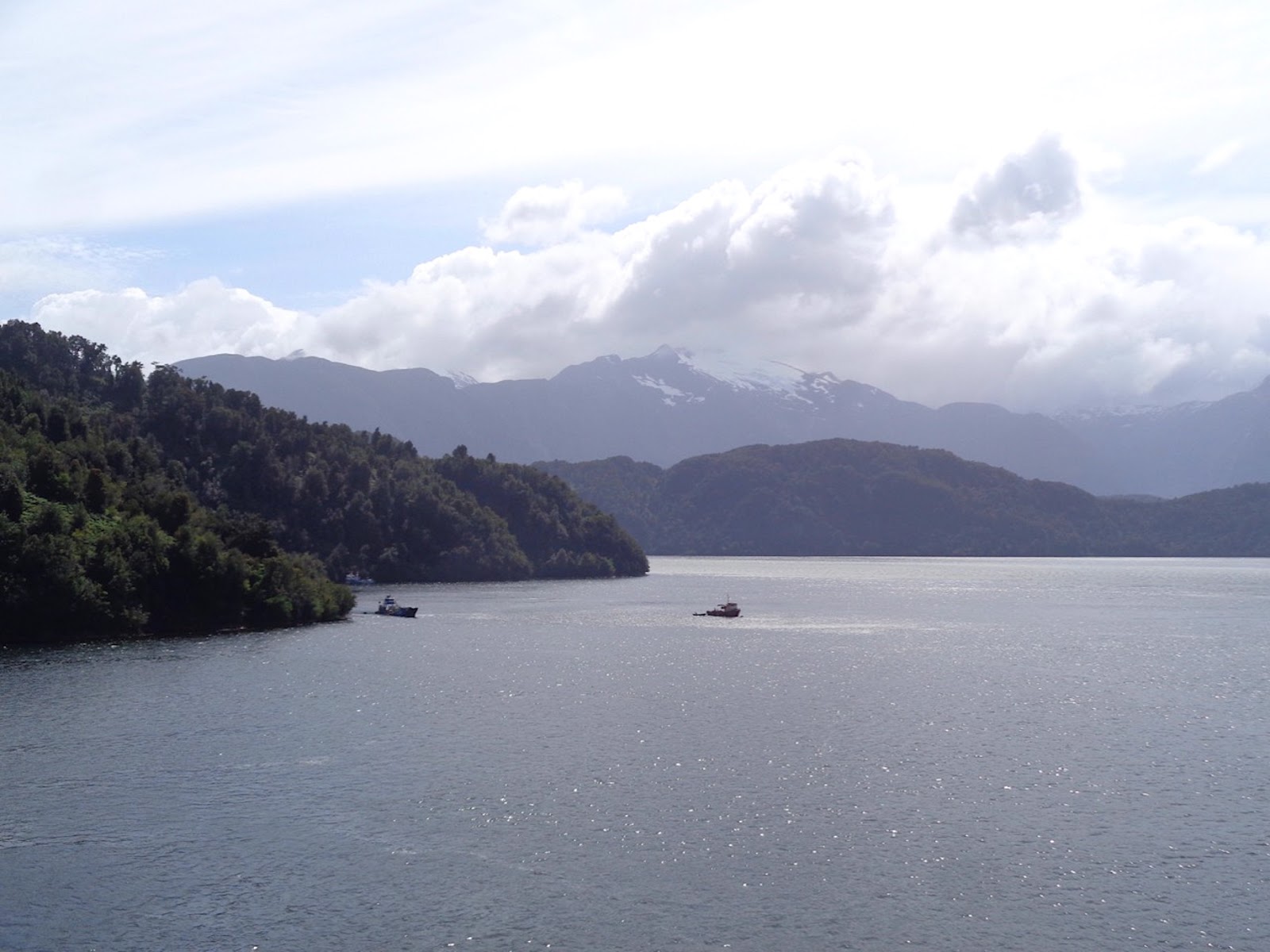
We had two “sea days” as we sailed through the inland waterway made up of fjords, bays, and natural channels on the lacy west coast of southern Chile.  It has been gorgeous, even with the moody weather, and the Tempanos Glacier deserves a blog to itself.

Today, we had a full workday in Puerto Chacabuco, from 8 AM to 5 PM. 

Richard and I had no plans, and originally thought we’d just wander a bit in this tiny fishing village in the fjord network.  See what happened.  Hang out.  Our usual way of approaching a new location.

But in Ushuaia, when I had to pay a bill so I used the wifi at the terminal building, I found an email from a friend.  Who was heading out on a cruise, from Santiago to Buenos Aires, and she saw that we’d both be in Puerto Chacabuco!

So of course, that became my new plan.  We had a few emails back and forth, and settled on meeting in the terminal building when her ship came in late morning.

We rode the tenders (the ship’s lifeboats – called botes salvavidas in Spanish – literally lifesaving boats!) and looked around the terminal.  Richard set up his computer, and I walked to the ATM to get Chilean pesos for us.  There wasn’t much to Puerto Chacabuco – a few small shops, an artisans’ market for the tourists, a collection of homes, and a fishing fleet because this is a salmon fishing village.  Not even a bank, just an ATM.

I went back to our terminal and saw that her ship had arrived, and the tenders were starting to make their way to the shore.  I waited a while, but she didn’t show up.  It took about half an hour for me to realize that all of the tenders coming to our terminal were from OUR ship, not the other ship!  I asked the lady at the info desk if there was another terminal, that I was waiting for a friend from the other cruise ship (crucero in Spanish).

She explained, in English, that they were going to the state port, down the road.  That they had security, and I wouldn’t be able to get into the port.  But that maybe I could find my friends that way.  Or I could go to the craft market, and catch one of the light blue shuttle buses that were being used to transport the passengers of that cruise ship around town.

I thanked her and headed off.  Reached the guard house and gate of the other port and terminal.  Tried to explain in my not great Spanish that my friends were on the other cruise ship, we were meeting, I came from the other terminal from my ship, and how can I find my friends.  They didn’t have any way to call the terminal to make an announcement, and they also couldn’t allow me to come into this port area.  They agreed I could wait at the gate in case my friends came.  I found two tourists from that ship who walked to the gate, and they said they’d make an announcement in case my friends were waiting there.  I gave it another half hour, thanked the guards for their help, and headed back toward our terminal.

On a whim, I thought maybe I should look around that artisans’ market, just to be sure.  And of course, there they were, wandering around the front, looking for me in the crowd of people from two cruise ships!

They had a tour scheduled, but we had about two hours so we had a cup of tea and talked and shared adventures.  They had been at the Rapa Nui Tapati festival, the yearly event of traditional cultural games like young men racing down steep hills sitting on banana tree trunks.  Or sailing out to sea on a boat, and swimming back.  Relay races carrying 44 to 55 lbs (20 to 25 kilos) of bananas on your back.  (The women use the lighter load, only 44 lbs or 20 kilo.  Lighter.  Yeah.)  And of course they loved our boating adventure in Punta Arenas.

It was great!  How often do you meet someone you know in the middle of the Chilean fjords?  In Chilean Patagonia? 

They eventually left for their tour, and I wandered back to our ship for lunch with Richard.  And spent the afternoon on our balcony, watching the changing light on the snow-capped mountains and the crystal blue water of Chacabuco’s fjord. 

It might be a teeny weeny itsy bitsy little town, with not much action.  But this fishing town is in one of those heart-stopping breath-taking gorgeous locations straight out of a postcard.  Narrow waterways full of deep blue water.  Undulating hills covered in green green trees and lush vegetation.  Stately rocky mountains topped with snow and glaciers towering in the background.  And cascading waterfalls thundering down the sides of the hills and mountains, icy white cold curtains of liquid lace falling into the wine dark water of the fjords.

This place is more than pretty scenery.  This landscape is the kind of place that makes geologists and scientists take notice and wonder how it came to be.  It makes the poets and musicians sing, the artists itch for the paintbrush and canvas.  It makes the religious and irreligious alike more reverent.

This kind of landscape makes the human soul soar with delight in our world’s beauty.


A Three Hours Late Tour: Adventures in Penguining

NOTE:  We're now in Lima, Peru, and I'll post a blog soon about why we didn't spend more time in Chile.  But I'm still finishing our blogs from the cruise, so remember to check backwards chronologically for any posts you may have missed. 

15 February 2020

We had a bit of a bumpy night sailing from Ushuaia, through various channels and around the islands of the southernmost section of South America, arriving at Punta Arenas by morning.  Richard and I had booked our only excursion with the cruise line, a trip to an island that is a protected national monument (like a national park) for just penguins.

We met with all the passengers going on various cruise tours, and received our color-coded sticker.  Our group eventually was sent out to get on a bus and head off to our excursion.  (I keep calling it a field trip!)

The bus took us through town, to another pier.  Some people were supposed to take a speed boat, while the rest of us were going to take a ferry.  The speed boat had cancelled, however, so three busloads of people, roughly 120 people, were handed a bag lunch (in a blue bag with a cute penguin), and we all climbed onto the ferry.

It was a grey and blustery morning, with a pretty strong wind.  There were several tour guides on the boat, which I’d guess might have been 50 to 60 feet (20 meters or so?) long.  Maybe more, maybe less. 

We sat upstairs, because it always has a better view.  We saw some seals bounding alongside the ferry as we rode the waves and motored over to Magdalena Island.  We arrived, and the penguins were on the shore to greet us.  Okay, so some penguins were on the shore, mostly to go off fishing.  Other penguins were all over the hills, doing their normal penguin stuff.

The usual procedure is that the captain drives the boat up onto the cobble beach, one of the rangers on the island hauls the gangway over and sets it up on the ferry deck, and passengers clamber off.  But we had arrived at low tide, and the boat wasn’t quite high enough on the beach for this system to work.  Our captain tried three times, and finally they announced that we all needed to stand at the rear of the ferry, at the stern, so that the captain could get the ferry higher up on the beach.  It was rather funny, but it worked.

We were told that there was a trail around the island, about 2.5 km (just over 1.5 miles).  Uphill to the lighthouse, and then downhill back to the beach.  The protocol here is to walk along the trail, stopping to take photos but trying to not stop for more than 2 minutes.  Don’t block the trail, leave room for people to get by.  Stay about 2 meters (6 feet) away from the penguins, don’t touch.  Just enjoy the penguins as they live their usual little penguin lives.  And penguins have the right of way when they decide to cross the trail, so stay out of their way.

Pretty basic, and it works fairly well.  There are ropes around the penguin areas, so people know to keep to the trail.

There are currently about 13,000 breeding pairs of Magellanic penguins on Magdalena Island.  There used to be three or four times as many, but more and more predatory sea birds have found this island, and now live there, preying on penguin eggs and little baby penguin chicks.  Sea gulls and especially skuas, a small greyish sea bird, have moved in and made the island less safe for the penguins.  So more and more of the penguins are finding other breeding grounds, and not returning to Magdalena Island. 

We walked up the hill to the lighthouse, stopping to watch the penguins, take photos, and talk to the penguins.  Really, I always give them a little pep talk, or maybe some advice.  Other people were also chatting with the penguins, telling them how cute they were, or please look this way, or whatever.  Something about penguins just seems to bring out the parental instinct in people.

At points along this trail across a barren and windswept island out in the middle of the Straits of Magellan, the wind was so strong that we truly had to struggle to walk and not be blown over.  Seriously, the wind was insanely strong, and it really was a fight to stay on the path!  My hood wouldn’t stay up, it kept blowing off my head – and I finally tied my scarf over my freezing cold head and ears, looking like a grandmother.  Then the wind tried to blow the scarf off as well!  It was a wild wind blowing that day, and the treeless island looked as if the wind is always like that!

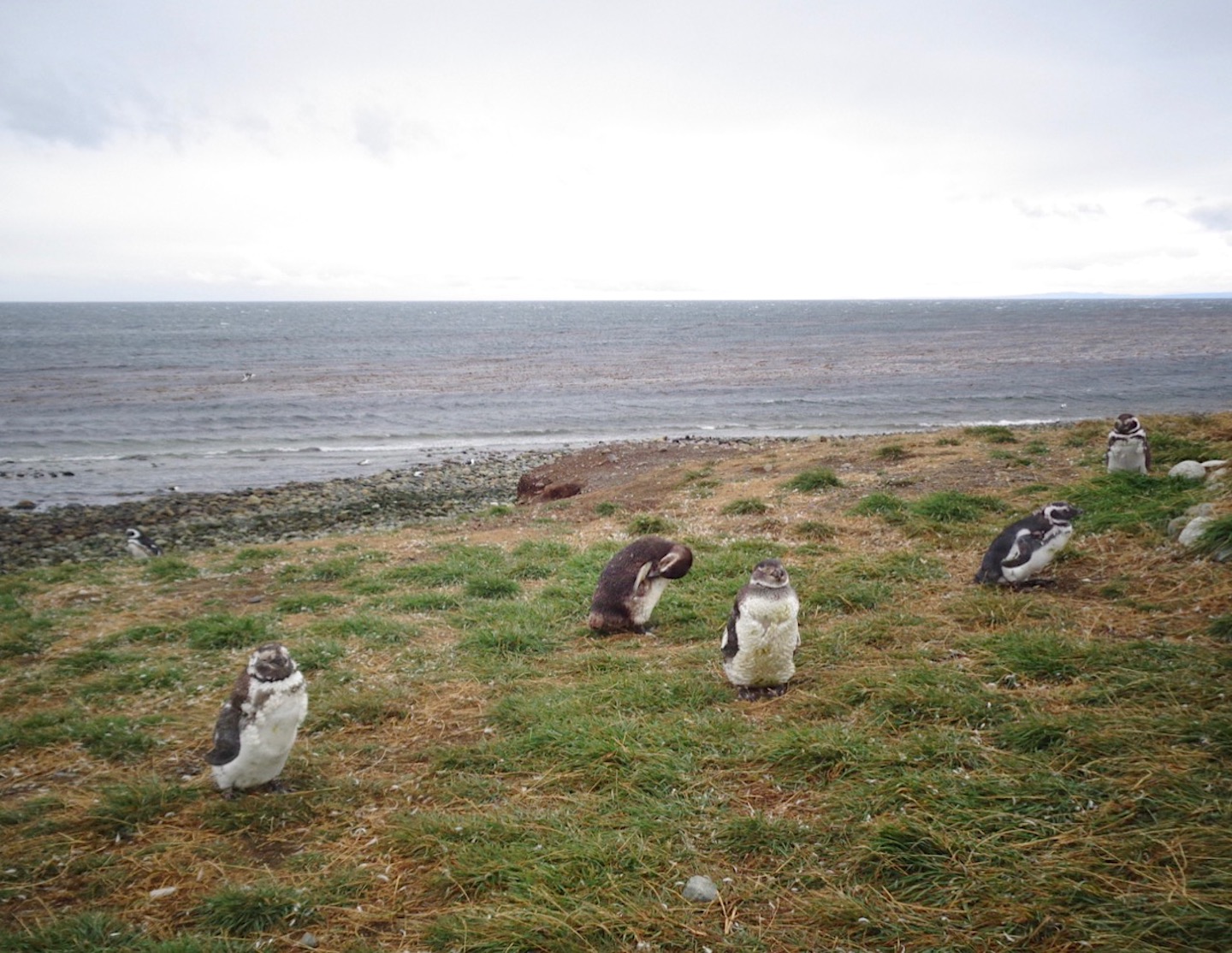
It was one of those wildly beautiful places, with the deep turquoise blue water being churned into whitecaps, and the dry grassy hills rustling in the wind.  Everywhere was dotted with the Magellanic penguins, with their racing stripe around their eye and belly.  And the evil sea gulls and skuas skulked around in the background, villains in the lives of our cute and friendly little penguins.

And the penguins were their usual adorable selves.  Walking around and visiting with each other, or hanging out with their brother/sister, or mate.  One penguin hopped out of the burrow, let the other penguin climb in, and then climbed back in – giving the mate the warmer spot deeper in the burrow.  Some penguin chicks were almost grown, with partial coats of down falling out over the new adult feathers.

We saw a few male penguins pulling out grass and moss to cushion their burrow – it was fascinating to watch them pulling moss or grass blades out of the ground using only their beak, and then carrying it off to their burrow.  The males build the nests, and the female finds her mate and shows up to lay their eggs.  Our guides reiterated that Magellanic penguins mate for life, and use the same burrow year after year.  And they lay two eggs, and raise two chicks.  (There was also penguin passion going on, but I left them with some semblance of privacy.)

Burrowing penguins usually build their nests up hills, so that rain or sea water won’t flood the burrows.  If the penguin chicks get wet while they still have only downy feathers, they won’t survive for long.

It seemed as if the rangers had some sort of marking system, with short stakes in the ground near burrows.  They had different color paint on top, so I was thinking maybe one color denotes a nest, another color for eggs, and a third color marking chicks have hatched.  No idea, and I don't have enough Spanish to ask questions like that, but you'll see some of these little stakes in the photos next to the penguins.

Eventually, we all walked the penguin loop, and boarded our ferry.  The wind had increased, and in turn so had the waves and the current.  Swells seemed to be maybe 2 meters (6 feet) or more.  We pushed off, and headed back toward Punta Arenas.

Now, the Straits of Magellan are the inland waterway that links the Atlantic and Pacific Oceans, and yes, sailed by Magellan and established as a trade route.  That mixing of two oceans with opposing currents, as well as different temperatures and salinity, causes a clash of currents.  It isn’t a nice smooth route even at the best of times.  And on a windy day, it can get rough.  On a really windy day, it can be bad.

Our captain tried, he really did.  We motored around the island and out into the open waters of the Straits.  Waves and spray were hitting the windshield of the pilot house on the upper deck.  I watched, and we were barely making any headway with these waves, we were basically fighting the waves and just staying in one place.  The captain called our tour guide, they conferred, and we were asked what time our cruise ship was due to leave.  We had plenty of time, we weren’t leaving until later in the evening.  So the captain turned around and cruised back to the island, where the ship sat partly on the beach on the leeward side of the island, waiting out the wind and waves.

We sat for about an hour, maybe an hour and a half.  Most of us ate part of our lunch, though some of us joked that we should save some of it for dinner, just in case we had to spend the night.  Really, the waves looked that bad.  When we looked out across the water, at times it seemed that there was more white than blue.  The skies cleared and the sun came out, but the wind kept blowing and the waves churning.

After a while, the captain thought we could try again.  We went around the island in the other direction, where it was a bit calmer, and set off.

Part of it wasn’t too bad.  Part of it was pretty rough.  Our ferry would rise up on the crest of a swell, and then drop down with a thud into the trough between swells.  Up and down, with life jackets periodically falling down on someone’s head.  I was watching the swells, and they weren’t the calm even swells one usually sees in a body of water.  No, with the opposing currents from two oceans, these swells were coming at us from all directions in a wild churning carnival ride!  At one point, we did the rise up on the crest and thud down into the trough, but then suddenly rocked violently side to side, feeling as if we might tip over at any moment!  THAT part was a little hairy.

I tried getting a few photos of the waves, but between the ferry's crazy bouncing and the sea spray on the windows, it was hard to get any decent images of the straits at this point!

Some people downstairs were feeling the effects of the rough seas.  Those of us upstairs fared better, overall. (And the reports from downstairs made us REALLY glad we were upstairs!)

We finally reached our destination, a small pier for the ferry.  Buses were waiting, and we rode back to our ship.  (As we waited a few minutes on our bus, several dolphins welcomed us back with a show out in the harbor!  They were leaping and dancing on the water and all the fancy maneuvers that dolphins seem to enjoy!)

We arrived back to our ship about three hours late.  Really, those crazy wild waves and swells probably added an hour to the trip back as the captain fought for every gain in distance.  It was one of the wildest rides of my life!

But we all can say we’ve experienced the real Straits of Magellan, and survived!

And we also saw more very cute little penguins!