28
February 2017 – posted on 10 March 2017 in Manaus, on the Amazon
 NOTE: This is the third blog I'm posting in the past few days, so go backwards to see our last couple of weeks. Wifi is difficult to find, so I'm catching up!
 Wow
wow wow wow WOW! This was AMAZING!
Wow
wow wow wow WOW! This was AMAZING!
Though I should back up and explain a little.
Carnaval
is the Portuguese spelling of  Carnival.
This is the pre-Lenten festival that goes back centuries, where people
party and celebrate life before Lent, when they didn’t
Carnival.
This is the pre-Lenten festival that goes back centuries, where people
party and celebrate life before Lent, when they didn’t  eat meat – hence the
name Carnaval, or “carne vale,” meaning literally “farewell to meat.” Various countries around the world celebrate
eat meat – hence the
name Carnaval, or “carne vale,” meaning literally “farewell to meat.” Various countries around the world celebrate
 Carnival, though in the US this is called Mardi Gras, the French term (“Fat
Tuesday”) for the day before the beginning of Lent on Ash Wednesday.
Carnival, though in the US this is called Mardi Gras, the French term (“Fat
Tuesday”) for the day before the beginning of Lent on Ash Wednesday.
 Carnival.
This is the pre-Lenten festival that goes back centuries, where people
party and celebrate life before Lent, when they didn’t
Carnival.
This is the pre-Lenten festival that goes back centuries, where people
party and celebrate life before Lent, when they didn’t  eat meat – hence the
name Carnaval, or “carne vale,” meaning literally “farewell to meat.” Various countries around the world celebrate
eat meat – hence the
name Carnaval, or “carne vale,” meaning literally “farewell to meat.” Various countries around the world celebrate
 Carnival, though in the US this is called Mardi Gras, the French term (“Fat
Tuesday”) for the day before the beginning of Lent on Ash Wednesday.
Carnival, though in the US this is called Mardi Gras, the French term (“Fat
Tuesday”) for the day before the beginning of Lent on Ash Wednesday.
So,
in Brazil, the Carnaval festivities feature samba parades. Samba is the music and dance that has its
roots in the culture of the African  slaves, mixed in with the Portuguese and
Spanish landowners. Samba has become an
entire cultural experience itself.
slaves, mixed in with the Portuguese and
Spanish landowners. Samba has become an
entire cultural experience itself.
 slaves, mixed in with the Portuguese and
Spanish landowners. Samba has become an
entire cultural experience itself.
slaves, mixed in with the Portuguese and
Spanish landowners. Samba has become an
entire cultural experience itself.
The
samba troupes are referred to as “schools,” because the people are truly
serious about the  music, dance, floats, costumes, themes, and culture – this
isn’t just a hobby, it has become almost a way of life.
music, dance, floats, costumes, themes, and culture – this
isn’t just a hobby, it has become almost a way of life.
 music, dance, floats, costumes, themes, and culture – this
isn’t just a hobby, it has become almost a way of life.
music, dance, floats, costumes, themes, and culture – this
isn’t just a hobby, it has become almost a way of life.
I
don’t know how many samba schools exist in Rio.
But the top twelve samba schools are invited to perform at  the
Sambadromo, a permanent parade ground for Carnaval. The Sambadromo is one kilometer long according
to their information (.6 or so miles) – equal to about ten football
fields. (Though I should add that we
estimated it at about half that distance, but at the height we were sitting,
distances are deceptive.)
the
Sambadromo, a permanent parade ground for Carnaval. The Sambadromo is one kilometer long according
to their information (.6 or so miles) – equal to about ten football
fields. (Though I should add that we
estimated it at about half that distance, but at the height we were sitting,
distances are deceptive.)
 the
Sambadromo, a permanent parade ground for Carnaval. The Sambadromo is one kilometer long according
to their information (.6 or so miles) – equal to about ten football
fields. (Though I should add that we
estimated it at about half that distance, but at the height we were sitting,
distances are deceptive.)
the
Sambadromo, a permanent parade ground for Carnaval. The Sambadromo is one kilometer long according
to their information (.6 or so miles) – equal to about ten football
fields. (Though I should add that we
estimated it at about half that distance, but at the height we were sitting,
distances are deceptive.) 
 There
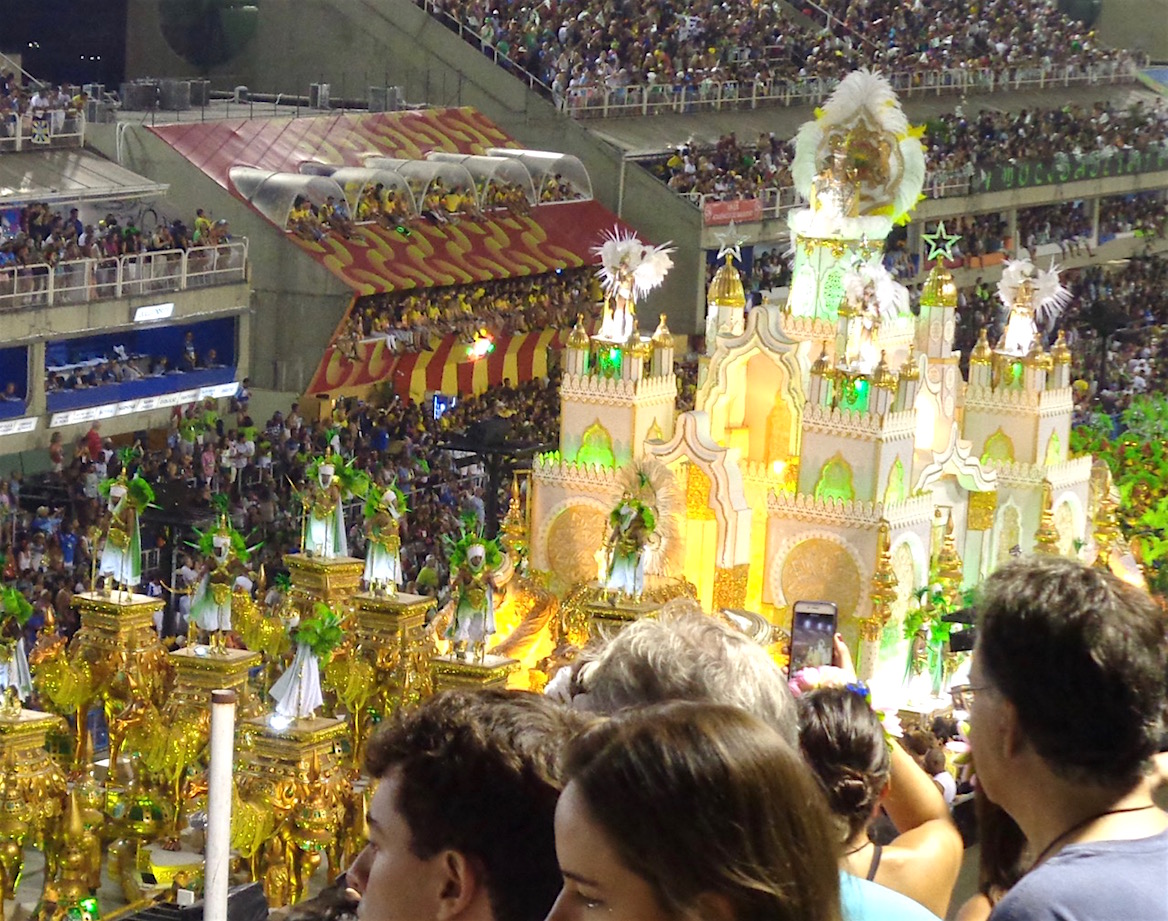
are various viewing stands on both sides of the parade runway, with several
levels. At ground level are the boxes,
the priciest seats because they’re right at parade level. Then there are two or three balconies, also
prime viewing areas. We were in the
upper stands, higher than the balconies, in the concrete bleachers. And somehow, we ended up in row Z, all the
way at the very
There
are various viewing stands on both sides of the parade runway, with several
levels. At ground level are the boxes,
the priciest seats because they’re right at parade level. Then there are two or three balconies, also
prime viewing areas. We were in the
upper stands, higher than the balconies, in the concrete bleachers. And somehow, we ended up in row Z, all the
way at the very  top.
top.
But,
in some ways, this was the best viewing area because we were able to see the
entire parade. Some of the floats are
several storeys high, like maybe 40 or 50 feet high – 13 to 17 meters
tall. So parts of some floats were
nearly at eye level for us.  Also, we
could look down at the hundreds and thousands of dancers in a school, and see
everything – at ground level, you just can’t do that.
Also, we
could look down at the hundreds and thousands of dancers in a school, and see
everything – at ground level, you just can’t do that.
 Also, we
could look down at the hundreds and thousands of dancers in a school, and see
everything – at ground level, you just can’t do that.
Also, we
could look down at the hundreds and thousands of dancers in a school, and see
everything – at ground level, you just can’t do that.
Anyway,
on Monday evening we packed some water, food, and insect repellent, and headed
off to collect our tickets and then boarded the bus. I  have no idea how many people went to this
second night of samba parades, but there were multiple busloads from our
ship. And of course from the numerous
other ships in port that day. Plus
umpteen people from all over this part of Brazil.
have no idea how many people went to this
second night of samba parades, but there were multiple busloads from our
ship. And of course from the numerous
other ships in port that day. Plus
umpteen people from all over this part of Brazil.
 have no idea how many people went to this
second night of samba parades, but there were multiple busloads from our
ship. And of course from the numerous
other ships in port that day. Plus
umpteen people from all over this part of Brazil.
have no idea how many people went to this
second night of samba parades, but there were multiple busloads from our
ship. And of course from the numerous
other ships in port that day. Plus
umpteen people from all over this part of Brazil. Traffic
was pretty congested so the ride was slow, but we had a guide who told us all
about the samba schools and the parades.
The Sambadromo holds something like 75,000 to 90,000 people (the number
varies depending on who you talk to).
Each samba
Traffic
was pretty congested so the ride was slow, but we had a guide who told us all
about the samba schools and the parades.
The Sambadromo holds something like 75,000 to 90,000 people (the number
varies depending on who you talk to).
Each samba  school has about 4,000 to 5,000 members participating in
their parade. And there are all kinds of
requirements upon which they are judged, to see which samba school is the
winner.
school has about 4,000 to 5,000 members participating in
their parade. And there are all kinds of
requirements upon which they are judged, to see which samba school is the
winner.
First,
there are the floats – each school must have between five and  nine floats in
their parade. Each float holds dancers,
and needs to have moving parts. (The
floats have driving mechanisms, though the parade moves so slowly most have
people who push them along the route.)
nine floats in
their parade. Each float holds dancers,
and needs to have moving parts. (The
floats have driving mechanisms, though the parade moves so slowly most have
people who push them along the route.)
 nine floats in
their parade. Each float holds dancers,
and needs to have moving parts. (The
floats have driving mechanisms, though the parade moves so slowly most have
people who push them along the route.)
nine floats in
their parade. Each float holds dancers,
and needs to have moving parts. (The
floats have driving mechanisms, though the parade moves so slowly most have
people who push them along the route.)  selects a theme, and all their floats, costumes, dancers, and
music need to portray that theme. Sometimes
the portrayal is literal, other times it might be more esoteric. But there needs to be a cohesive theme.
selects a theme, and all their floats, costumes, dancers, and
music need to portray that theme. Sometimes
the portrayal is literal, other times it might be more esoteric. But there needs to be a cohesive theme.
Each
school has their own music – I’m not clear on  whether someone in the school
writes the music for the parade, or if someone else does, or if there’s
Carnaval music and each samba school picks a song. But they play the same song over and over and
over for the duration of
whether someone in the school
writes the music for the parade, or if someone else does, or if there’s
Carnaval music and each samba school picks a song. But they play the same song over and over and
over for the duration of  their performance, which is precisely one hour and
fifteen minutes.
their performance, which is precisely one hour and
fifteen minutes.
 whether someone in the school
writes the music for the parade, or if someone else does, or if there’s
Carnaval music and each samba school picks a song. But they play the same song over and over and
over for the duration of
whether someone in the school
writes the music for the parade, or if someone else does, or if there’s
Carnaval music and each samba school picks a song. But they play the same song over and over and
over for the duration of  their performance, which is precisely one hour and
fifteen minutes.
their performance, which is precisely one hour and
fifteen minutes.
Most
schools have a single person who oversees the parade from idea to reality –
they  come up with the theme, design the floats and costumes to visually portray
that theme, find (or have written) appropriate music, teach the dances, all
that.
come up with the theme, design the floats and costumes to visually portray
that theme, find (or have written) appropriate music, teach the dances, all
that.
 come up with the theme, design the floats and costumes to visually portray
that theme, find (or have written) appropriate music, teach the dances, all
that.
come up with the theme, design the floats and costumes to visually portray
that theme, find (or have written) appropriate music, teach the dances, all
that.
Every
school begins with fireworks, which signify the parade is ready to begin. The entire school has  exactly 75 minutes, one
hour and fifteen minutes, to perform along the parade route. This includes all of their dances, all of
their floats, all of the 4,000 –
exactly 75 minutes, one
hour and fifteen minutes, to perform along the parade route. This includes all of their dances, all of
their floats, all of the 4,000 –  5,000 members, moving along singing and
dancing their way down that kilometer-long runway. With stops for special performances in front
of the judges.
5,000 members, moving along singing and
dancing their way down that kilometer-long runway. With stops for special performances in front
of the judges.
 exactly 75 minutes, one
hour and fifteen minutes, to perform along the parade route. This includes all of their dances, all of
their floats, all of the 4,000 –
exactly 75 minutes, one
hour and fifteen minutes, to perform along the parade route. This includes all of their dances, all of
their floats, all of the 4,000 –  5,000 members, moving along singing and
dancing their way down that kilometer-long runway. With stops for special performances in front
of the judges.
5,000 members, moving along singing and
dancing their way down that kilometer-long runway. With stops for special performances in front
of the judges. Schools
can lose points for not beginning on time, taking too long, moving to slowly or
quickly, not meeting various criteria.
Schools
can lose points for not beginning on time, taking too long, moving to slowly or
quickly, not meeting various criteria.
We’re
not sure what all the criteria are, we  were only told about these specific
items.
were only told about these specific
items.
 were only told about these specific
items.
were only told about these specific
items.
But
it seemed each samba school also had certain elements that I think most likely
are also part of their requirements: a
dancing couple at the beginning, with the woman carrying the flag of the samba
 school; one group of drummers, with a variety of drums; at least one woman
soloist who always seemed to have wings; a group of women in ball gowns,
twirling
school; one group of drummers, with a variety of drums; at least one woman
soloist who always seemed to have wings; a group of women in ball gowns,
twirling  and dancing their way down the runway; and some sort of historic
progression or reference as the school’s parade danced their way down the
route.
and dancing their way down the runway; and some sort of historic
progression or reference as the school’s parade danced their way down the
route.
 school; one group of drummers, with a variety of drums; at least one woman
soloist who always seemed to have wings; a group of women in ball gowns,
twirling
school; one group of drummers, with a variety of drums; at least one woman
soloist who always seemed to have wings; a group of women in ball gowns,
twirling  and dancing their way down the runway; and some sort of historic
progression or reference as the school’s parade danced their way down the
route.
and dancing their way down the runway; and some sort of historic
progression or reference as the school’s parade danced their way down the
route.
The
first samba  school parade began right at 10 PM.
And yes, this is an all night event, with six schools at 1.25 hours
each, and then a 20 minute or so interval between each parade. Plus the clean up crew during each interval,
performing
school parade began right at 10 PM.
And yes, this is an all night event, with six schools at 1.25 hours
each, and then a 20 minute or so interval between each parade. Plus the clean up crew during each interval,
performing  almost a ballet of sweepers and street cleaning machines, they were
so well coordinated.
almost a ballet of sweepers and street cleaning machines, they were
so well coordinated.
 school parade began right at 10 PM.
And yes, this is an all night event, with six schools at 1.25 hours
each, and then a 20 minute or so interval between each parade. Plus the clean up crew during each interval,
performing
school parade began right at 10 PM.
And yes, this is an all night event, with six schools at 1.25 hours
each, and then a 20 minute or so interval between each parade. Plus the clean up crew during each interval,
performing  almost a ballet of sweepers and street cleaning machines, they were
so well coordinated.
almost a ballet of sweepers and street cleaning machines, they were
so well coordinated.
We
were there until sunrise.
But
WOW! We  weren’t prepared for how
elaborate and intricate each float would be, nor how many smaller groups there
are within each samba school, nor how long it really
weren’t prepared for how
elaborate and intricate each float would be, nor how many smaller groups there
are within each samba school, nor how long it really  takes to get 5,000 people
to dance their way along a kilometer.
With, of course, the different dance routines for each component within
the parade!
takes to get 5,000 people
to dance their way along a kilometer.
With, of course, the different dance routines for each component within
the parade!
 weren’t prepared for how
elaborate and intricate each float would be, nor how many smaller groups there
are within each samba school, nor how long it really
weren’t prepared for how
elaborate and intricate each float would be, nor how many smaller groups there
are within each samba school, nor how long it really  takes to get 5,000 people
to dance their way along a kilometer.
With, of course, the different dance routines for each component within
the parade!
takes to get 5,000 people
to dance their way along a kilometer.
With, of course, the different dance routines for each component within
the parade! I
have to explain something here – my photos only come from the first two and a
half parades. Because we were so high
up, I set my camera to multi-photo, so I could focus and take a series of
I
have to explain something here – my photos only come from the first two and a
half parades. Because we were so high
up, I set my camera to multi-photo, so I could focus and take a series of
 photos without re-focusing each time.
Just seemed as if I’d get more, and better, photos.
photos without re-focusing each time.
Just seemed as if I’d get more, and better, photos.
Except
I take a lot of photos anyway, and then just pull out the best ones.
 So
by the middle of the third parade, I managed to fill up the camera card with
980 photos. Yes, I know. You wouldn’t think that would be possible. I didn’t
So
by the middle of the third parade, I managed to fill up the camera card with
980 photos. Yes, I know. You wouldn’t think that would be possible. I didn’t  expect this to happen. But, well, there you are.
I
don’t have photos of the winning samba parade, which was my favorite one
anyway. I  don’t have photos of the
weirdly confusing parade, either. Nor
the young hunky men painted gold, wearing only golden masks and golden loin
cloths. Or the
don’t have photos of the
weirdly confusing parade, either. Nor
the young hunky men painted gold, wearing only golden masks and golden loin
cloths. Or the  people wearing bird
costumes and flying on swings over the runway.
people wearing bird
costumes and flying on swings over the runway.
 don’t have photos of the
weirdly confusing parade, either. Nor
the young hunky men painted gold, wearing only golden masks and golden loin
cloths. Or the
don’t have photos of the
weirdly confusing parade, either. Nor
the young hunky men painted gold, wearing only golden masks and golden loin
cloths. Or the 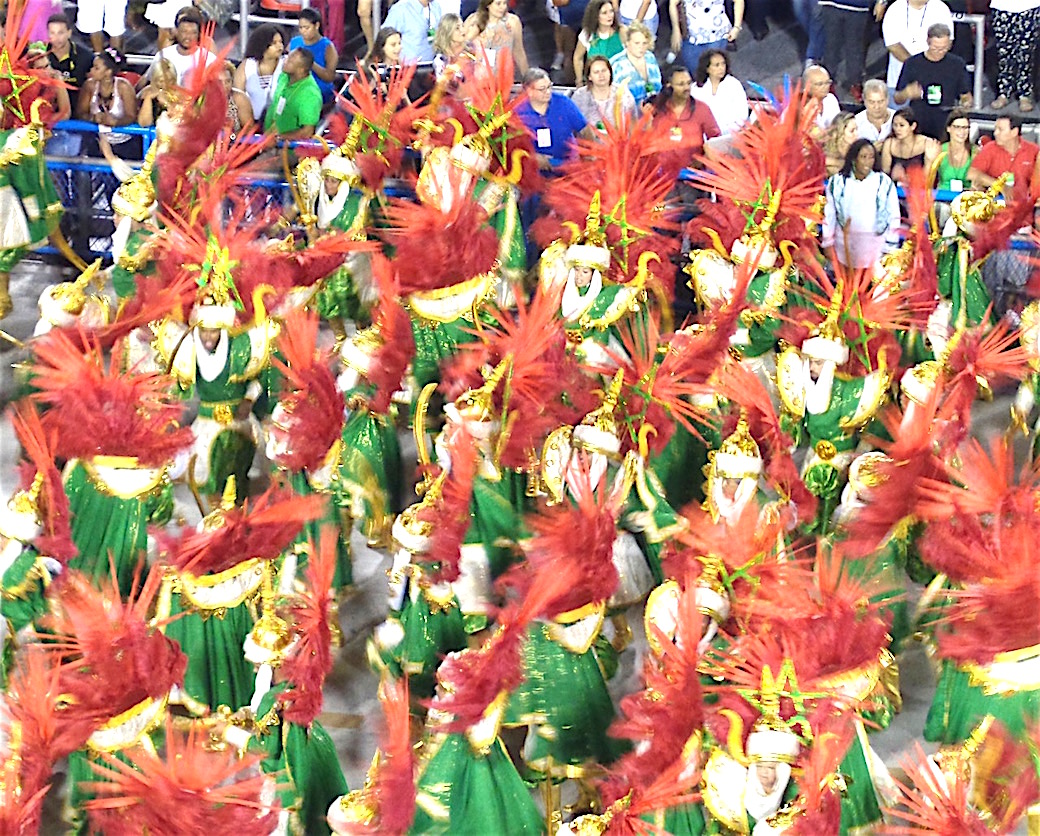 people wearing bird
costumes and flying on swings over the runway.
people wearing bird
costumes and flying on swings over the runway.
Plus
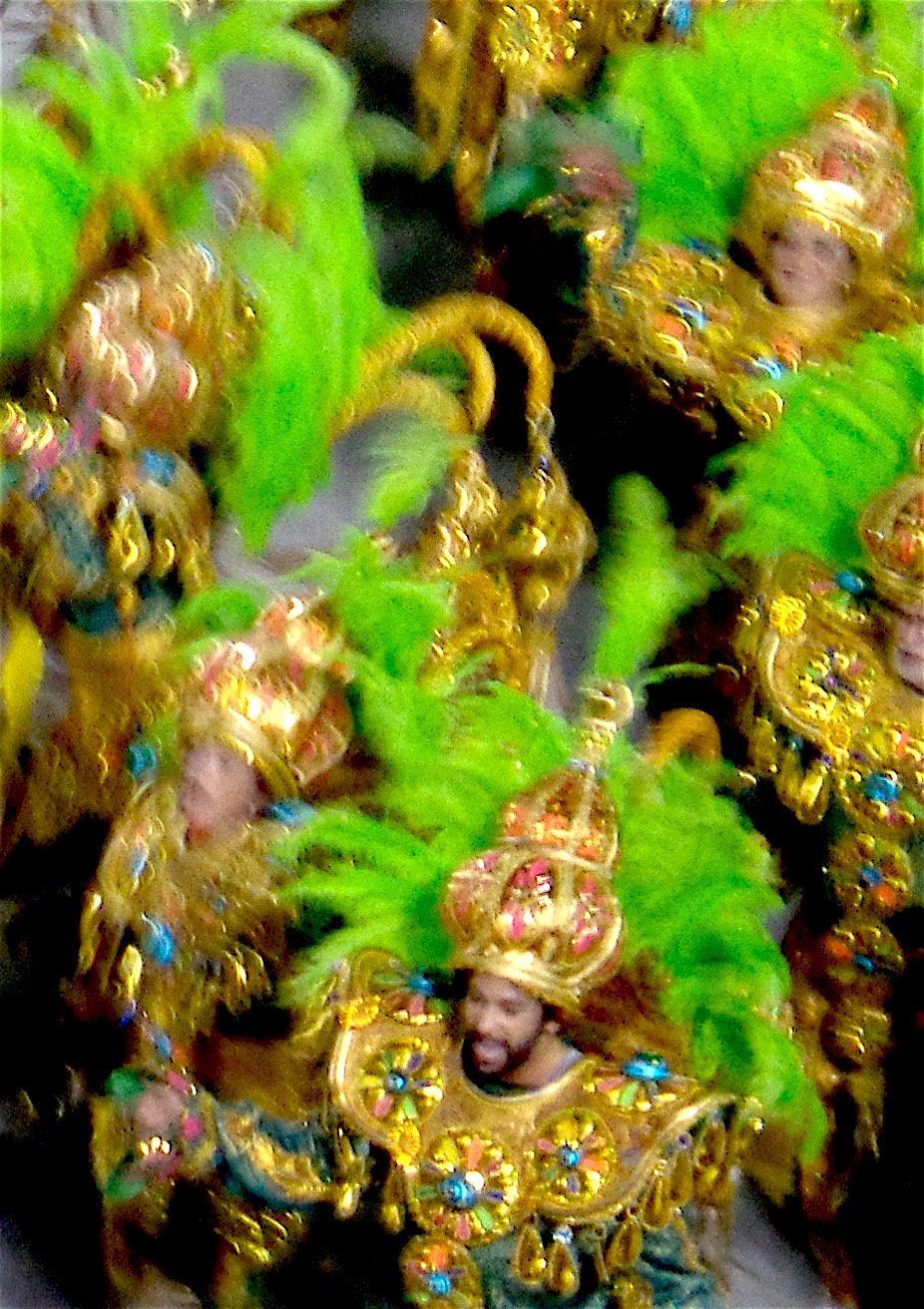
the parade is constantly in motion, so even with a fast shutter speed,  there’s
a certain amount of blur because the subjects are all
there’s
a certain amount of blur because the subjects are all  dancing and twirling and
moving down the parade route.
dancing and twirling and
moving down the parade route.
 there’s
a certain amount of blur because the subjects are all
there’s
a certain amount of blur because the subjects are all  dancing and twirling and
moving down the parade route.
dancing and twirling and
moving down the parade route.
On
the other hand, the photos give a sense of the splendor, drama, motion, and
emotion of Carnaval in Rio.
But
I’ll do a quick overview of the schools and highlights of what we saw, or at
least what it seemed to be the theme.
First
was União da Ilha, and their theme seemed to be  something about African slaves
first living freely in Africa, then being enslaved and brought across the ocean
to the Americas. Eventually they adapted
to the new country, flourished, and
something about African slaves
first living freely in Africa, then being enslaved and brought across the ocean
to the Americas. Eventually they adapted
to the new country, flourished, and  found their freedom. Plus contributed to the current culture of
the new land (Brazil, we presume). We
were excited that they had what in the Virgin
found their freedom. Plus contributed to the current culture of
the new land (Brazil, we presume). We
were excited that they had what in the Virgin  Islands are called moko jumbies,
the stilt dancers! Actually, stilt
dancing comes from West Africa, part of the secret society dancers, so it made
sense that there would be stilt dancers in a parade featuring the history of
slaves in the New World.
Islands are called moko jumbies,
the stilt dancers! Actually, stilt
dancing comes from West Africa, part of the secret society dancers, so it made
sense that there would be stilt dancers in a parade featuring the history of
slaves in the New World.
 something about African slaves
first living freely in Africa, then being enslaved and brought across the ocean
to the Americas. Eventually they adapted
to the new country, flourished, and
something about African slaves
first living freely in Africa, then being enslaved and brought across the ocean
to the Americas. Eventually they adapted
to the new country, flourished, and  found their freedom. Plus contributed to the current culture of
the new land (Brazil, we presume). We
were excited that they had what in the Virgin
found their freedom. Plus contributed to the current culture of
the new land (Brazil, we presume). We
were excited that they had what in the Virgin  Islands are called moko jumbies,
the stilt dancers! Actually, stilt
dancing comes from West Africa, part of the secret society dancers, so it made
sense that there would be stilt dancers in a parade featuring the history of
slaves in the New World.
Islands are called moko jumbies,
the stilt dancers! Actually, stilt
dancing comes from West Africa, part of the secret society dancers, so it made
sense that there would be stilt dancers in a parade featuring the history of
slaves in the New World.
Second
was São Clemente – their theme had something to do with the sun, because they
started with the French king Louis whichever, the one who called himself the
Sun King. There were all kinds of
dancers dressed in glittering gold costumes, some looking like they were on
stilts except we could see their feet – so I think the costumes had an inner
armature that extended over the dancers’ heads, doubling their height. They also had people dressed as garlands and
topiaries, maybe showing how important sunlight is for plants and the entire
world. They also had giraffes, and weird
pink birds – maybe part of the whole flora and fauna thing, I don’t know. The giraffes and big pink birds were a little
confusing, but added a whimsically amusing note to the parade.
The
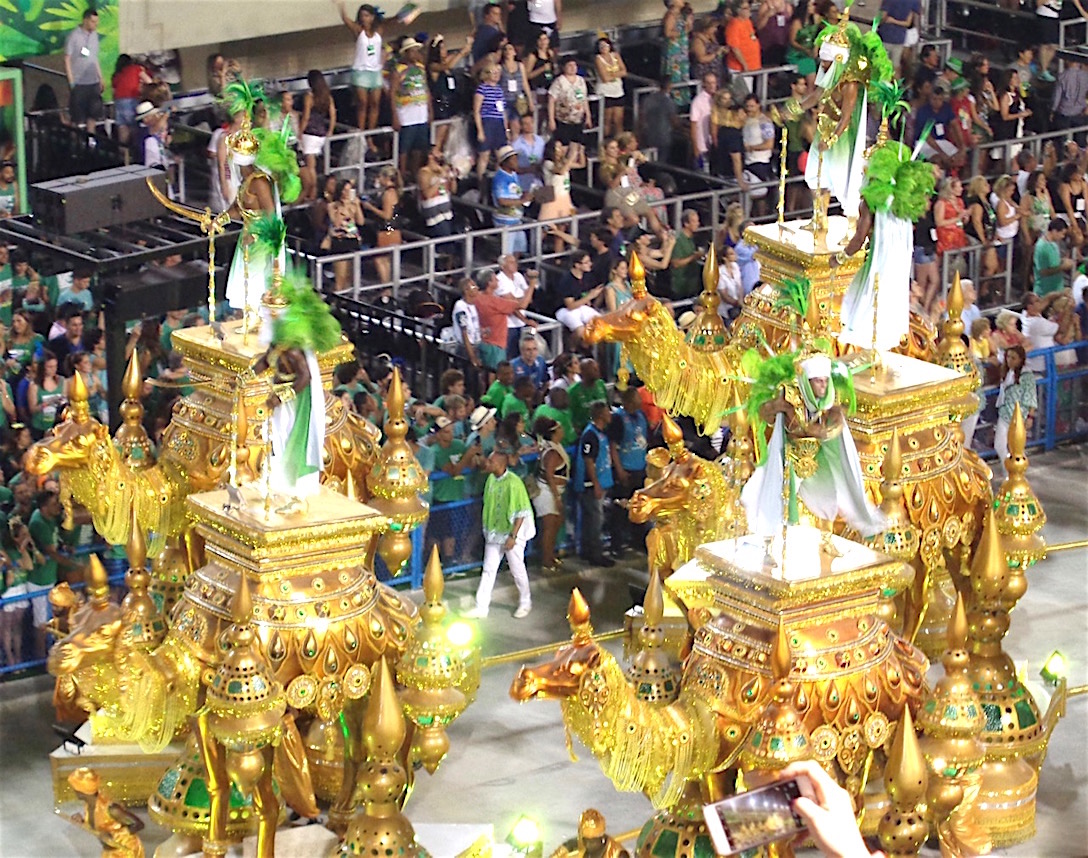
third school was Mocidade, and their theme was something about Middle Eastern
or Arabian cultures. Maybe the
influences on Brazil, or the sub-culture, or maybe just the stories like
Aladdin and One-Thousand-and-One Arabian Nights. Dancers with scimitars, giant tents, a float
that could be Moorish or even almost Taj Mahal – plus a flying magic carpet
complete with a rider! Okay, so it
really was a flying drone looking like a magic carpet, with a three-dimensional
cutout of a person on top. But truly
effective. My favorite part, though,
were the mechanical camels in sort of gold and copper, rolling along turning
their long necks and heads to look right and left, with dancing camel drivers
on their backs! This is also the samba
school with the nearly-naked golden men, so the women were kind of drooling
over them – they really were gorgeous!
Unidos
da Tijuca was the fourth school, and as far as we could figure out, their theme
was sort of a tongue-in-cheek history of American music. American as in USA, not North and South
America. They began with sort of an Art
Deco railroad car, along with a couple of saxophonists, and moved on to the
Civil War. They progressed through
Dixieland (with a riverboat float), the British invasion rockers, an Elvis
marching troupe, rainbow-dressed hippie era, country music, and the Beach Boys
(singing surfers, anyway). One of the
final floats was odd, though – decorated with skulls, which I think of as the
grunge or punk rock era, but the “musicians” were costumed more like the hair
bands of the 70s to 80s.
Then
last year’s winners, Mangueira, was the final parade. This one was weird and confusing, and I had
to talk to some other people from our ship to really understand what it was
about, or at least have some idea. The
theme had to do with religion, because there were images of saints on the
floats and banners. There were people
dancing with giant crosses. There was
even a float with a crucifixion scene on it.
And churches with signs saying “Salve” (I’m guessing salvation?) and
other words in Portuguese. My best guess
was that it was a reminder that Carnaval ends with Lent, that this is a
religious holiday, that people need to repent or something like that. However, one of the people I spoke with later
said their guide explained that the theme really was more about how the
Portuguese forced Catholicism on the African slaves, and that it was about
religious persecution, and some of the rebellions against this forced
conversion that went on during Brazil’s history. So while it was interesting, it was just kind
of confusing. And weird. Not exactly the happy, uplifting, celebratory
kind of parade, that was for sure.
There
were two busloads of those of us who made it to 6:00 AM or so. We got back to the ship about 7:30 AM, just
in time for breakfast. And then a nap.
So
all in all, it was wild, loud, crowded part of the time, totally colorful and
enthusiastic, and absolutely wonderful!
An explosion of color and sound and movement, with gorgeous bodies added
in! One of those once-in-a-lifetime and
gotta-do-it kind of experiences. SO glad
we did this!
It
was like a Hollywood spectacular musical extravaganza, complete with the
Rockettes, Chippendale dancers, with a Latin beat and some South American
history added in!!!
Of
course, there are tons of photos to enlarge, so here you go – it’s the best way
to share the experience.