4 June 2015

 We continued our drive to the northern end of Grande Terre, our destination being Hotel Malabou Beach. It was a
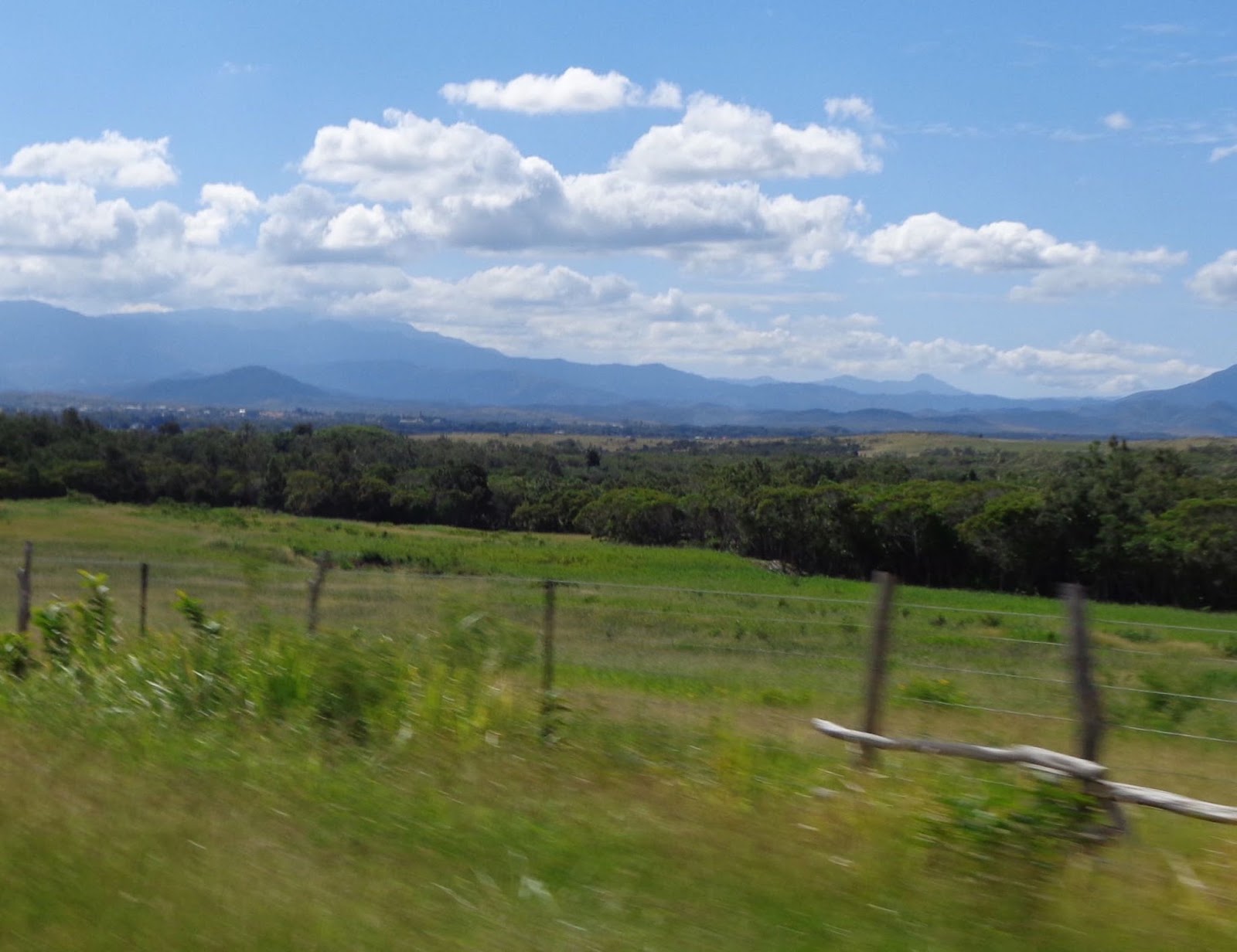
  grey and overcast kind of day, with rain in the early morning but not much for the rest of the day - just grey with low hanging clouds, covering the tops of the mountains as we drove
  along.
We knew that Malabou was a tiny town, so we stopped in Koumac to buy
along.
We knew that Malabou was a tiny town, so we stopped in Koumac to buy  some groceries and fill the gas tank. Our map indicates what towns have gas stations - some of the towns are so small, gas isn't available. The northern end of the island is less
  densely populated, and the farther north one goes, the less populated it is.
Anyway, I was totally impressed with the bread
densely populated, and the farther north one goes, the less populated it is.
Anyway, I was totally impressed with the bread  options.
So we wound around hills, up and down, glimpses of the lagoon in the distance, dodging one-way bridges and friendly dogs. Suddenly,  there was the sign for the Hotel Malabou Beach, we turned and followed the signs, and we hit paradise.
The hotel is
there was the sign for the Hotel Malabou Beach, we turned and followed the signs, and we hit paradise.
The hotel is  comprised of bungalows - little houses that look tiny on the outside, but inside they have either twin beds or one king, built in cupboards behind the bed with lights,
  storage shelves, a full closet, hot water pot for tea and coffee, a safe, etc. The bathroom is well-designed so there's room to move, but it isn't huge. There's a
  couch, coffee table, tv, desk and chair. All the mod cons like AC, fan, tons of indirect light, and free wifi. Thatched roof, but it really is just
  for show, there's treated plywood underneath so no
 insects. A wood deck on the front with lounge chairs, perfect for reading or just watching the view.
And the view! Really, just
insects. A wood deck on the front with lounge chairs, perfect for reading or just watching the view.
And the view! Really, just  across the lawn, maybe all of 30 yards (or meters), right THERE is the beach! A long flat stretch of fine pale grey sand, with ripples from the outgoing tide, and fascinating shells, and the occasional crab scuttling by. The beach!
Plus, at high tide, the
across the lawn, maybe all of 30 yards (or meters), right THERE is the beach! A long flat stretch of fine pale grey sand, with ripples from the outgoing tide, and fascinating shells, and the occasional crab scuttling by. The beach!
Plus, at high tide, the  water is nearly lapping the edge of the lawn! There's maybe 12 inches (30-35 cm) of beach and then the water! And that little bit of beach becomes
  cluttered with debris from the trees and the ocean, somewhat protecting the lawn from the ocean water. (It's just a day or two off the full moon, so high tide is probably a bit
  extra high right now. But I seriously wonder if they have problems during extra high tides. And if there's a tsunami, these lovely bungalows are in big trouble!)
 We loved the placed immediately. By early evening we agreed to book another night here, it was that great. Comfortable, roomy, a decent price if booked online, and we have plenty of food from the supermarket. Plus there's a little "snack bar" on the island attached to the property by a sand bar and bridge, serving sandwiches and lighter food during mid-day. (Geologically, it looks like a tombolo but really isn't, since at high tide the sand bar is underwater.)
We had a great time walking around the property and along the beach - the temperatures are in the mid 70s F (20 C), so very comfortable. But there's a strong wind that blows in from the ocean, since the lagoon has a large opening in the barrier reef and islands nearby. Also, the bay is facing into the wind. It was sort of like stormy weather without the rain, just grey clouds and the wild wind.
There were wonderful shells on the beach; since I no longer hold on to things like shells, I just take photos of them.
And then I found a turtle shell. Not the entire shell, just one scale. Which, I found out, is called a scute. (Rhymes with cute.)
This was sad. I figured it must have come from a dead sea turtle. Who are already endangered species. Who we've met and protected while they were laying eggs in Costa Rica. Who are my favorite animal to see while swimming or diving.
I talked to the guy at the reception desk, and he said yes, every so often, maybe once or twice a year, a turtle carcass washes ashore, apparently partially eaten by a shark. We talked about how sad that was.
So I took my turtle scute back to the beach, and said the mourner's kaddish, the prayer we say at a funeral. I just felt as if I somehow needed to acknowledge the death of this sea turtle, and mourn the loss.
Of course, I came inside and did a little online research. Turns out that sea turtles grow new scutes under the old ones, which they then shed. So this could very easily have been a scute that was just shed by a turtle busily growing a larger shell, and living to a ripe old age!
Totally made me feel better!!!
Today we drove up to the town of Poum, or Pum, which is where the national highway ends. More like fades out into sandy roads. It was pretty, but no beach, just a rocky shore. The town of Poum has an elementary school, a police station, a post office, and one store. Which closed at noon. A boat dock. That was it. We saw two cars go by, one being chased by a dog. We saw a few people at the store.
And that was Poum. (No photos here of Poum - haven't downloaded them yet.)
Tomorrow we'll traverse the island and head south on the eastern coast, stopping along the way. We also want to get to the Blue River National Park which is south of Noumea, in what is called The Deep South.
So we still have more exploring ahead of us!
We loved the placed immediately. By early evening we agreed to book another night here, it was that great. Comfortable, roomy, a decent price if booked online, and we have plenty of food from the supermarket. Plus there's a little "snack bar" on the island attached to the property by a sand bar and bridge, serving sandwiches and lighter food during mid-day. (Geologically, it looks like a tombolo but really isn't, since at high tide the sand bar is underwater.)
We had a great time walking around the property and along the beach - the temperatures are in the mid 70s F (20 C), so very comfortable. But there's a strong wind that blows in from the ocean, since the lagoon has a large opening in the barrier reef and islands nearby. Also, the bay is facing into the wind. It was sort of like stormy weather without the rain, just grey clouds and the wild wind.
There were wonderful shells on the beach; since I no longer hold on to things like shells, I just take photos of them.
And then I found a turtle shell. Not the entire shell, just one scale. Which, I found out, is called a scute. (Rhymes with cute.)
This was sad. I figured it must have come from a dead sea turtle. Who are already endangered species. Who we've met and protected while they were laying eggs in Costa Rica. Who are my favorite animal to see while swimming or diving.
I talked to the guy at the reception desk, and he said yes, every so often, maybe once or twice a year, a turtle carcass washes ashore, apparently partially eaten by a shark. We talked about how sad that was.
So I took my turtle scute back to the beach, and said the mourner's kaddish, the prayer we say at a funeral. I just felt as if I somehow needed to acknowledge the death of this sea turtle, and mourn the loss.
Of course, I came inside and did a little online research. Turns out that sea turtles grow new scutes under the old ones, which they then shed. So this could very easily have been a scute that was just shed by a turtle busily growing a larger shell, and living to a ripe old age!
Totally made me feel better!!!
Today we drove up to the town of Poum, or Pum, which is where the national highway ends. More like fades out into sandy roads. It was pretty, but no beach, just a rocky shore. The town of Poum has an elementary school, a police station, a post office, and one store. Which closed at noon. A boat dock. That was it. We saw two cars go by, one being chased by a dog. We saw a few people at the store.
And that was Poum. (No photos here of Poum - haven't downloaded them yet.)
Tomorrow we'll traverse the island and head south on the eastern coast, stopping along the way. We also want to get to the Blue River National Park which is south of Noumea, in what is called The Deep South.
So we still have more exploring ahead of us!
2 June 2015

 We left lovely Bourail and continued northward, or vaguely northwest, along the main
highway
We left lovely Bourail and continued northward, or vaguely northwest, along the main
highway  on the west coast of Grande Terre. Some sources call it the
Cook Highway, others call it the Provincial Highway. Probably the
on the west coast of Grande Terre. Some sources call it the
Cook Highway, others call it the Provincial Highway. Probably the  same
road, just depends on whether one wants the English or more French
orientation.
New Caledonia is divided into three provinces, the
same
road, just depends on whether one wants the English or more French
orientation.
New Caledonia is divided into three provinces, the  Northern and Southern Provinces of Grande Terre, and the Loyalty Islands which are a group of smaller islands to the east. We've now entered the
  Northern Province, which seems to have more indigenous people and fewer European people. But French is still the official language.
  However, as we drive along trying to understand the road signs, we've seen more and more signs for various tribal communities.
I'm not sure how the indigenous
However, as we drive along trying to understand the road signs, we've seen more and more signs for various tribal communities.
I'm not sure how the indigenous  people prefer to be called - I know the museum refers to the various tribes as the Kanak people. I suppose it's similar to saying Native Americans
  in the US, or First Nations in Canada - a general term, with names for specific tribes or nations. At any rate, there are more Kanak people in the north - somewhat similar to New Zealand, where more Maori
  people live on the North Island, which is much warmer than the South Island. (I
  totally understand, I'd rather live where it's warmer as well!)
So while the signs are French, with odd things like "risque d'inundation" (risk of flooding, we suppose) or "din du poule" (we think this was idiomatic for potholes, since that's what we encountered on the road), we've seen more of the traditional carvings as entrances to houses and businesses.
And finally the flag of New Caledonia! I've been looking for this, finally saw one flying next to the French flag over the town hall. In the South Province, we've seen only the French tricolor flag, which of course is the flag of the administrative nation. But the flag adopted by the Kanak people has the horizontal blue, red, and green stripes with a yellow circle featuring the decorative wooden spear used atop the thatched great house or huts of the traditional dwellings. So I was excited to finally see this flag.
Of course, there's local disagreement about using the flag - some see the French flag as a symbol of colonialism. Others see the Kanak flag as divisive and continuing the ethnic separation. No one has proposed a compromise, such as maybe changing the stripes of the Kanak flag to vertical red, white and blue, so the compromise flag might be a French flag with the Kanak yellow circle and fleche faitiere, the decorative spear, in the center. (Wouldn't that be a cool flag?)
Anyway, this is one of those things to be worked out by 2018, when something closer to self-determination is to be established.
The scenery continues to astound - huge hills almost like mountain ranges, bright green farm fields, a mostly smooth national highway lines with beautiful trees, just like the boulevards en Paris. The sky ranges from aqua to cobalt blue, depending on the angle of the sun and number of clouds. And tropical flowers dotting the landscape, brilliant oranges and purples and reds.
We're now in Koné (pronounced COE-nay) - the Frenchified version of the local name, which is more like Kooune. I should add that the greeting in the local language is "Kia Ora," which is the same greeting as in Maori. So I suspect that, like many of the Polynesian languages, including Hawaiian, some Kanak words or names have many vowels and each vowel is pronounced separately. Not what Europeans were used to, so of course the British and French colonists in this part of the world changed the names. (As someone who has lived in places where Zorzor is pronounced "Zaw-zaw," I get a little frustrated with people trying to spell things in ways that have nothing to do with the pronunciation. Add hyphens. Spell it the way it sounds. It's like the people who took the Maori "F" sound and spelled it with a "WH" - why???? Which, in Maori, would sound like "fie" - see what I mean? Just one more way to confuse the rest of us until the end of time.)
Okay, rant over.
So we're in Koné, at a nice hotel, and enjoyed a gourmet dinner at the neighboring hotel. Food seems to be always French. I was thinking it might be the places we choose, but we had lunch at a food truck in the park, all traditionally French baguette sandwiches. So maybe French food is just the most common.
Anyway, we're heading north tomorrow, and trying to figure out what areas we want to see. We have a bungalow by a lagoon booked for tomorrow night, but no idea where we'll head after that.
Which, of course, is half the fun!
totally understand, I'd rather live where it's warmer as well!)
So while the signs are French, with odd things like "risque d'inundation" (risk of flooding, we suppose) or "din du poule" (we think this was idiomatic for potholes, since that's what we encountered on the road), we've seen more of the traditional carvings as entrances to houses and businesses.
And finally the flag of New Caledonia! I've been looking for this, finally saw one flying next to the French flag over the town hall. In the South Province, we've seen only the French tricolor flag, which of course is the flag of the administrative nation. But the flag adopted by the Kanak people has the horizontal blue, red, and green stripes with a yellow circle featuring the decorative wooden spear used atop the thatched great house or huts of the traditional dwellings. So I was excited to finally see this flag.
Of course, there's local disagreement about using the flag - some see the French flag as a symbol of colonialism. Others see the Kanak flag as divisive and continuing the ethnic separation. No one has proposed a compromise, such as maybe changing the stripes of the Kanak flag to vertical red, white and blue, so the compromise flag might be a French flag with the Kanak yellow circle and fleche faitiere, the decorative spear, in the center. (Wouldn't that be a cool flag?)
Anyway, this is one of those things to be worked out by 2018, when something closer to self-determination is to be established.
The scenery continues to astound - huge hills almost like mountain ranges, bright green farm fields, a mostly smooth national highway lines with beautiful trees, just like the boulevards en Paris. The sky ranges from aqua to cobalt blue, depending on the angle of the sun and number of clouds. And tropical flowers dotting the landscape, brilliant oranges and purples and reds.
We're now in Koné (pronounced COE-nay) - the Frenchified version of the local name, which is more like Kooune. I should add that the greeting in the local language is "Kia Ora," which is the same greeting as in Maori. So I suspect that, like many of the Polynesian languages, including Hawaiian, some Kanak words or names have many vowels and each vowel is pronounced separately. Not what Europeans were used to, so of course the British and French colonists in this part of the world changed the names. (As someone who has lived in places where Zorzor is pronounced "Zaw-zaw," I get a little frustrated with people trying to spell things in ways that have nothing to do with the pronunciation. Add hyphens. Spell it the way it sounds. It's like the people who took the Maori "F" sound and spelled it with a "WH" - why???? Which, in Maori, would sound like "fie" - see what I mean? Just one more way to confuse the rest of us until the end of time.)
Okay, rant over.
So we're in Koné, at a nice hotel, and enjoyed a gourmet dinner at the neighboring hotel. Food seems to be always French. I was thinking it might be the places we choose, but we had lunch at a food truck in the park, all traditionally French baguette sandwiches. So maybe French food is just the most common.
Anyway, we're heading north tomorrow, and trying to figure out what areas we want to see. We have a bungalow by a lagoon booked for tomorrow night, but no idea where we'll head after that.
Which, of course, is half the fun!
1 June 2015
We woke up at our B&B in Bouluparis, to find the bay as smooth as a lake, like silk, like a mirror, like glass. Just flat and  smooth, without a ripple whatsoever. Truly gorgeous.
So that was our view as we had a lovely French breakfast. Toasted baguette with cheese,
smooth, without a ripple whatsoever. Truly gorgeous.
So that was our view as we had a lovely French breakfast. Toasted baguette with cheese,  butter, and/or jam (confiture). Orange juice, and a giant cup for tea or coffee. Because many French people have a bowl of café au lait in the morning, so morning coffee cups tend to be
  huge. Of course, I'm a tea drinker, and I'm perfectly happy with the giant cup.
We chatted with Madame, played with
huge. Of course, I'm a tea drinker, and I'm perfectly happy with the giant cup.
We chatted with Madame, played with  the dog, and then left mid-morning, heading north.
I can't get over how blue the sky. I know, there should be another verb in there, but somehow, it
the dog, and then left mid-morning, heading north.
I can't get over how blue the sky. I know, there should be another verb in there, but somehow, it  just sounds so complete, so e. e. cummings, without the
  "is." How green the green and blue the sky. Doesn't that sound like our friend e. e.?
It definitely describes the scenery here!
We headed northward, stopping in the town of La Foa. Some of the towns have traditional Kanak names, others have Francophone versions of the traditional names. Same for the rivers, which have signs giving both names. Most of the  towns have both names posted as one enters the town, but the maps seem to have only the Francophone names.
Anyway, La Foa was quiet, because it was
towns have both names posted as one enters the town, but the maps seem to have only the Francophone names.
Anyway, La Foa was quiet, because it was  Sunday, when many shops close early. Plus the last Sunday in May is Mother's Day here, La Fete des Mamans - families seemed to be gathered in restaurants and cafés, having the traditional Mother's Day
  brunch, just like we do everywhere in the world.
We stopped at a branch of our one and only bank that accepts our card, and got a little more cash. Browsed  the supermarket, and bought a few things. Enjoyed the brightly colored houses against the blue blue sky. And yes, that solid blue photo is a picture of the sky. Just the sky with a
  wisp of cloud. Because it really is that blue. (Our little car is almost the same color.)
I especially liked the posts for the street signs - sort of like totem poles but with South Pacific  Tiki type faces - aren't they wonderful??
We headed off again, our destination being Bourail (pronounced boo-RAY in French). We had a wonderful  lunch in Bourail, tres French - we both had the duck confit (meaning anything but the breast of duck) with potatoes forestieres - I think in the style of foresters, or loggers, or woodsmen,
  or something - diced and sauteed potatoes with lots of onions, mushrooms, and bits of French bacon. Delicieux! (One of the tricks of budget travellers is to have a
  big lunch at a fancy restaurant, because lunch prices tend to be lower. Then have a


 lighter dinner, from a café or even the

 supermarket. Probably healthier way to do it,
  too.)
The restaurant owners also have a hotel upstairs, but they agreed that it's nicer down by the beach, in the village of Poé (POE-ay). They gave us directions to one
too.)
The restaurant owners also have a hotel upstairs, but they agreed that it's nicer down by the beach, in the village of Poé (POE-ay). They gave us directions to one  hotel, and we managed to find it - but the place was more posh and


 pricey than we enjoy. The lady there was very nice and looked through the tourism booklet with us, advising us of her
  personal favorite (not even the hotel where she works! - how nice is that!!!). She gave us directions, and we headed off. Found Poé, which
  is on Plage Roche Percée (Broken Rock or Pierced Rock Beach) and right on Turtle Bay - Baie de Gouaro, named for the Gouaro people who originally inhabited this area - but called Turtle Bay because this is a major nesting area for turtles!!!
There are signs all along the shore road, telling people (in French) all about sea turtles, things not to do to help protect nests, how to help injured turtles, the life cycle of sea turtles, etc. We're thrilled! Sea turtles are just wonderful to see when swimming or diving, and they're amazing up close - we helped nesting turtles in Costa Rica, and would love to meet up with nesting turtles here! Of course, this isn't turtle nesting season in the
Southern Hemisphere, so even though it's nearly the full moon we aren't
likely to find nesting turtles.
So, the name of the beach - Broken Rock or Pierced Rock Beach - at the northwestern end of the beach, there's a huge cliff with a couple of caves at the base. The rock of the cliff isn't solid, it seems to be comprised of compacted, fractured rock and thus is rather unstable. Part has eroded away, creating a wonderful free-standing sculptural sea stack, which can be reached if someone is willing to climb over the broken bits of rock that have fallen from the cliffs. Including some really big rocks, and near boulders. (As well as ignoring the sign, in three languages, saying "Entrance Prohibited - Risk of Death!!!")
But of course I had to get a little close, so that Dad's hat could enjoy this sight. (The hat was practically jumping up and down in excitement!) It really was gorgeous, one of those natural phenomena that doesn't look real or earthly, that looks like either a stage set or moon scape.
The sand on the beach is fairly coarse, almost like small pebbles or smooth gravel in places, between the packed sand. And there were wonderful shells, mostly white or beige but some in bright fuchsia or purples, and one in a bright bright orange! Love the color of the shells!
So we decided to spend two days here and enjoy the beach. The water is cold, so we're not swimming, but we've had two days of walking on the beach, climbing on the rocks, and of course enjoying the lovely food in Bourail. (Today's lunch was takeaway - salad with big slices of duck, along with Parmesan cheese, and a crusty roll on the side.) We took our food over to the town park by the river, and shared a picnic table with two women. They were curious about where we were from, and what we're doing in this small town in New Caledonia. I'm not sure exactly where they live, but they're Caledonians, and they were on their way to the next large town, Koné, to join the union workers who are on strike up there. The striking workers are members of the Labor Party, and I guess they needed some extra people, or extra support, or something.
Anyway, we talked about our experiences on strike, and how important unions are, and all that. And wished the women good luck on the picket line.
They insisted on giving us an orange, and I got a half-hug from the woman who spoke more English. I think union workers feel solidarity with anyone who supports their cause, whether they all belong to the same union or another union - there's a brotherhood/sisterhood amongst unions, a feeling of unity. We're all the "us," regardless of nationality or color, versus the "them" of management, administration, bosses, owners.
I never realized that my time on the picket lines in St. Thomas would have such far-reaching effects!
Tomorrow we'll head on up the road, and see how far we get, what we find.
is on Plage Roche Percée (Broken Rock or Pierced Rock Beach) and right on Turtle Bay - Baie de Gouaro, named for the Gouaro people who originally inhabited this area - but called Turtle Bay because this is a major nesting area for turtles!!!
There are signs all along the shore road, telling people (in French) all about sea turtles, things not to do to help protect nests, how to help injured turtles, the life cycle of sea turtles, etc. We're thrilled! Sea turtles are just wonderful to see when swimming or diving, and they're amazing up close - we helped nesting turtles in Costa Rica, and would love to meet up with nesting turtles here! Of course, this isn't turtle nesting season in the
Southern Hemisphere, so even though it's nearly the full moon we aren't
likely to find nesting turtles.
So, the name of the beach - Broken Rock or Pierced Rock Beach - at the northwestern end of the beach, there's a huge cliff with a couple of caves at the base. The rock of the cliff isn't solid, it seems to be comprised of compacted, fractured rock and thus is rather unstable. Part has eroded away, creating a wonderful free-standing sculptural sea stack, which can be reached if someone is willing to climb over the broken bits of rock that have fallen from the cliffs. Including some really big rocks, and near boulders. (As well as ignoring the sign, in three languages, saying "Entrance Prohibited - Risk of Death!!!")
But of course I had to get a little close, so that Dad's hat could enjoy this sight. (The hat was practically jumping up and down in excitement!) It really was gorgeous, one of those natural phenomena that doesn't look real or earthly, that looks like either a stage set or moon scape.
The sand on the beach is fairly coarse, almost like small pebbles or smooth gravel in places, between the packed sand. And there were wonderful shells, mostly white or beige but some in bright fuchsia or purples, and one in a bright bright orange! Love the color of the shells!
So we decided to spend two days here and enjoy the beach. The water is cold, so we're not swimming, but we've had two days of walking on the beach, climbing on the rocks, and of course enjoying the lovely food in Bourail. (Today's lunch was takeaway - salad with big slices of duck, along with Parmesan cheese, and a crusty roll on the side.) We took our food over to the town park by the river, and shared a picnic table with two women. They were curious about where we were from, and what we're doing in this small town in New Caledonia. I'm not sure exactly where they live, but they're Caledonians, and they were on their way to the next large town, Koné, to join the union workers who are on strike up there. The striking workers are members of the Labor Party, and I guess they needed some extra people, or extra support, or something.
Anyway, we talked about our experiences on strike, and how important unions are, and all that. And wished the women good luck on the picket line.
They insisted on giving us an orange, and I got a half-hug from the woman who spoke more English. I think union workers feel solidarity with anyone who supports their cause, whether they all belong to the same union or another union - there's a brotherhood/sisterhood amongst unions, a feeling of unity. We're all the "us," regardless of nationality or color, versus the "them" of management, administration, bosses, owners.
I never realized that my time on the picket lines in St. Thomas would have such far-reaching effects!
Tomorrow we'll head on up the road, and see how far we get, what we find.


 grey and overcast kind of day, with rain in the early morning but not much for the rest of the day - just grey with low hanging clouds, covering the tops of the mountains as we drove
  along.
 some groceries and fill the gas tank. Our map indicates what towns have gas stations - some of the towns are so small, gas isn't available. The northern end of the island is less
  densely populated, and the farther north one goes, the less populated it is.
  options.
  there was the sign for the Hotel Malabou Beach, we turned and followed the signs, and we hit paradise.
 comprised of bungalows - little houses that look tiny on the outside, but inside they have either twin beds or one king, built in cupboards behind the bed with lights,
  storage shelves, a full closet, hot water pot for tea and coffee, a safe, etc. The bathroom is well-designed so there's room to move, but it isn't huge. There's a
  couch, coffee table, tv, desk and chair. All the mod cons like AC, fan, tons of indirect light, and free wifi. Thatched roof, but it really is just
  for show, there's treated plywood underneath so no
 insects. A wood deck on the front with lounge chairs, perfect for reading or just watching the view.
 across the lawn, maybe all of 30 yards (or meters), right THERE is the beach! A long flat stretch of fine pale grey sand, with ripples from the outgoing tide, and fascinating shells, and the occasional crab scuttling by. The beach!
  water is nearly lapping the edge of the lawn! There's maybe 12 inches (30-35 cm) of beach and then the water! And that little bit of beach becomes
  cluttered with debris from the trees and the ocean, somewhat protecting the lawn from the ocean water. (It's just a day or two off the full moon, so high tide is probably a bit
  extra high right now. But I seriously wonder if they have problems during extra high tides. And if there's a tsunami, these lovely bungalows are in big trouble!)