9 January 2015
 First, my apologies for the way the photos are lining up - I'm not sure what the problem is, but I'm tired of fighting my computer and this blogging site, so we're just going with how things line up (or don't).
 A few days
  ago, we ran into two young French/ Canadian/ Rumanian young people we had met in Penang, Malaysia. It was fun to see someone we've met, and we had a nice lunch as we caught up on our travels. It's a very small world!
 Okay, we're now in Nha Trang. This is pronounced "nyah TRANG," not "nah trang" - and the Trang is a long A, as in train - TRAING.
As you can see on the map, we're roughly 25%  of the way along the coast from Saigon to Hanoi, our eventual destination. (I've circled Saigon and Phu Quoc, so you can see where we've been in Vietnam.)
There are several classes of service on the trains here. We opted for the soft seats in the air-conditioned car. There are hard wooden bench seats in the no-AC car. And there are cars with berths, either hard (no mattress) or soft (with mattress). We figured since
of the way along the coast from Saigon to Hanoi, our eventual destination. (I've circled Saigon and Phu Quoc, so you can see where we've been in Vietnam.)
There are several classes of service on the trains here. We opted for the soft seats in the air-conditioned car. There are hard wooden bench seats in the no-AC car. And there are cars with berths, either hard (no mattress) or soft (with mattress). We figured since  it was a daytime trip, we'd rather sit up and watch the scenery.


 Before I describe what we saw, I have to tell you about lunch. At various times during the trip, the attendants or conductors rolled carts down the aisle of the
  train, selling drinks and snacks. At noon, they came through with a series of pots and pans on the carts, and we bought
  lunch. Except the sellers don't speak much English, and we speak very little Vietnamese, so there's either pointing at unknown food or acting out the food. Luckily, the young man in back of me spoke excellent English as well as Vietnamese, so he assisted. And for 35,000 dong I
  had a container of rice, spinachy-like veg, and a chicken leg. I know, 35,000 dong sounds expensive. But $1 US = 21,500 or so dong. So that lunch was just under $1.50. Really.
 At one point in the mid-afternoon, I wanted a cold drink. Hadn't seen the food crew come through in a while, so I went through the train to find them. I walked forward
  toward the engine, through two or three cars with the hard wooden benches, full of Vietnamese families, with little kids who pointed at me and older women who smiled and smacked younger men to put their feet on the floor so I wouldn't have to climb over them. I found the food crew and bought a bottle of iced tea, and then had to make my way back, past the same pointing children, helpful women, and young men stretched out
  across the aisles.

 Our train went through the city of Saigon, then the suburbs and outskirts, and soon we were in country. Mostly flat farmland, with rice paddies and orchards and fields of some kind of strange green plant. It looked sort of like a cactus or succulent, coming
  up in a straight trunk and then spilling over at the top, like a giant fountain of green plant arms. Very weird looking, like green mop plants. Or the creeping plant that is the night-blooming cereus. Couldn't figure it out, but saw field after field and yard after yard of this weird plant.


 After a while, we began to see this plant with flowers on the ends of the hanging mop arms, sort of long drapey pale yellow or white flowers. And then what looked like maybe greenish balls, some kind of fruit. It wasn't until I saw the deep red balls that I realized: this was dragon fruit! This is how the fruit grows, at the end of the long draping branch of the cactusy plant.
 Then we started passing square cement posts, not
  very tall, with dragonfruit stems strapped to the four corners of the posts. Ah, so apparently the dragonfruit plant doesn't really have a trunk, it seems to be almost a vine that grows flat - or, in this case, is tied to a wide post so it can grow up and out, and bear fruit when it reaches that stage.
Very interesting!
In amongst (and sometimes next to) the dragonfruit fields were the rice paddies, also in different stages of
very tall, with dragonfruit stems strapped to the four corners of the posts. Ah, so apparently the dragonfruit plant doesn't really have a trunk, it seems to be almost a vine that grows flat - or, in this case, is tied to a wide post so it can grow up and out, and bear fruit when it reaches that stage.
Very interesting!
In amongst (and sometimes next to) the dragonfruit fields were the rice paddies, also in different stages of  growth. Sometimes they were brilliant green with growing plants;
  sometimes almost an ochre yellow, indicating the plants are going to seed, which is the rice we eat. Other fields were being molded into paddies, with mud walls being built to help
  contain the water. When rice paddies aren't your normal, everyday scenery, it's very interesting.
The topography of
contain the water. When rice paddies aren't your normal, everyday scenery, it's very interesting.
The topography of  Vietnam is varied - as you can see, the area around Saigon and to the coast is mostly flat and fertile. There's a ridge of hills and mountains running down the center of the country, like a spine. Some of the hills were green or even rather blue in the distance, but others were covered in rocks with barely anything growing on them.

 The houses were also interesting; in Saigon, buildings are either hotels and apartments, which tend to look the same, or older multi-storied houses that have businesses on the
  ground floor and residential units on the upper floors. But in small towns and rural areas, the houses are two storey cement or brick homes, often painted in pastel colors, with
  interesting ornamental molded cement designs on the area above the front door. They were lovely, and look like miniature versions of buildings in Saigon such as City Hall and the Opera House. I suspect this architectural style is one of those leftovers from the French colonial days.
 We even passed a small
  temple or shrine in a field, a more traditionally Asian shaped building, that might qualify as a small pagoda. And painted in the soft but bright colors of the houses. It was a lovely little counterpoint of color in the bright green rice fields surrounding
  it.
it.
 There were birds in the rice fields: herons great and small, snowy egrets and cattle egrets, ducks and geese, and some flying bird that was similar to a crow but with iridescent turquoise blue at the ends of the wings. No idea what this bird was, but just a surprising flash of color flying by.
 I was most fascinated
  with the people. Most of the time, travellers meet citizens of the countries they're visiting within hotels, restaurants, other service or travel industries, and sometimes just on the street. But we don't often see how rural life is lived on a day to day basis. So seeing people planting, plowing, harvesting,
 guarding their flocks of cows or sheep or goats, was a special feature of our trip. People were covered head to toe to protect themselves from the sun, and most people wore the conical hats that we saw all over Saigon.
And cows, Brahmin cows, with the big humps on their backs -
guarding their flocks of cows or sheep or goats, was a special feature of our trip. People were covered head to toe to protect themselves from the sun, and most people wore the conical hats that we saw all over Saigon.
And cows, Brahmin cows, with the big humps on their backs -  the cow that seems to
  do best in hot tropical climates.
 MOST exciting, though, were the water buffalo!!! They look like huge greyish-black bulls, but a little bit wider, the horns angle differently, and up close they're a little bit furrier. There were some walking on a path right next to the train, so I had a chance to see

 them up close, separated only by the window glass. Docile and huge. Yeah, I

 think I'll stay behind the window.
So, tomorrow I'll post a blog about Nha Trang, and coastal life in Vietnam.
think I'll stay behind the window.
So, tomorrow I'll post a blog about Nha Trang, and coastal life in Vietnam.
5 January 2015
 Saigon, in fact all of Vietnam, has unexpected and hidden treasures. The city of Saigon is old, dating back to the 17th
  century. Prior to that, the area was inhabited, but was mostly swampland. The region has been a crossroads of trade for centuries, with
  various national and ethnic groups coming and going in all directions, buying, selling, trading, and taking over.
So in the 1800s, Monsieur Gustav Eiffel, of Eiffel
various national and ethnic groups coming and going in all directions, buying, selling, trading, and taking over.
So in the 1800s, Monsieur Gustav Eiffel, of Eiffel  Tower fame, opened an engineering and architecture office in Saigon. The region was French, the French were
  building, there were rivers to cross and trade routes on which to expand.
And here the facts get a bit murky. Some people and
building, there were rivers to cross and trade routes on which to expand.
And here the facts get a bit murky. Some people and 
 publications claim that Eiffel was in Saigon, and did the hands on designing and building. Other people claim he had an office here but wasn't here himself. The main post office is sometimes attributed to Eiffel, sometimes not. Other buildings were supposedly designed by Eiffel but are no longer standing.
The one structure that is still in Saigon that is attributed to Eiffel, or at least his company, is Cau Mong, or in English, Mong Bridge. Which turned out to be the pretty bridge Richard and I
publications claim that Eiffel was in Saigon, and did the hands on designing and building. Other people claim he had an office here but wasn't here himself. The main post office is sometimes attributed to Eiffel, sometimes not. Other buildings were supposedly designed by Eiffel but are no longer standing.
The one structure that is still in Saigon that is attributed to Eiffel, or at least his company, is Cau Mong, or in English, Mong Bridge. Which turned out to be the pretty bridge Richard and I  noticed during our first walk along the river.
Cau Mong (pronounced "cow MUNG") is on the tributary that
noticed during our first walk along the river.
Cau Mong (pronounced "cow MUNG") is on the tributary that  feeds into the Saigon River, linking the center of Old Saigon with what was, at the time, the outskirts of the city and undeveloped
  land. These days, Mong Bridge links District 1 with Districts 4 and 5 - although District 1 still is the area with City Hall, the Opera House, and most of the many museums.
 It's a lovely bridge, turned into a pedestrian bridge because one needs to walk up the stone stairs to get to the actual bridge.
  Gorgeous curving riveted steel I beams, with criss-crossing smaller metal beams supporting the bridge itself. All painted a pretty copper-patina
 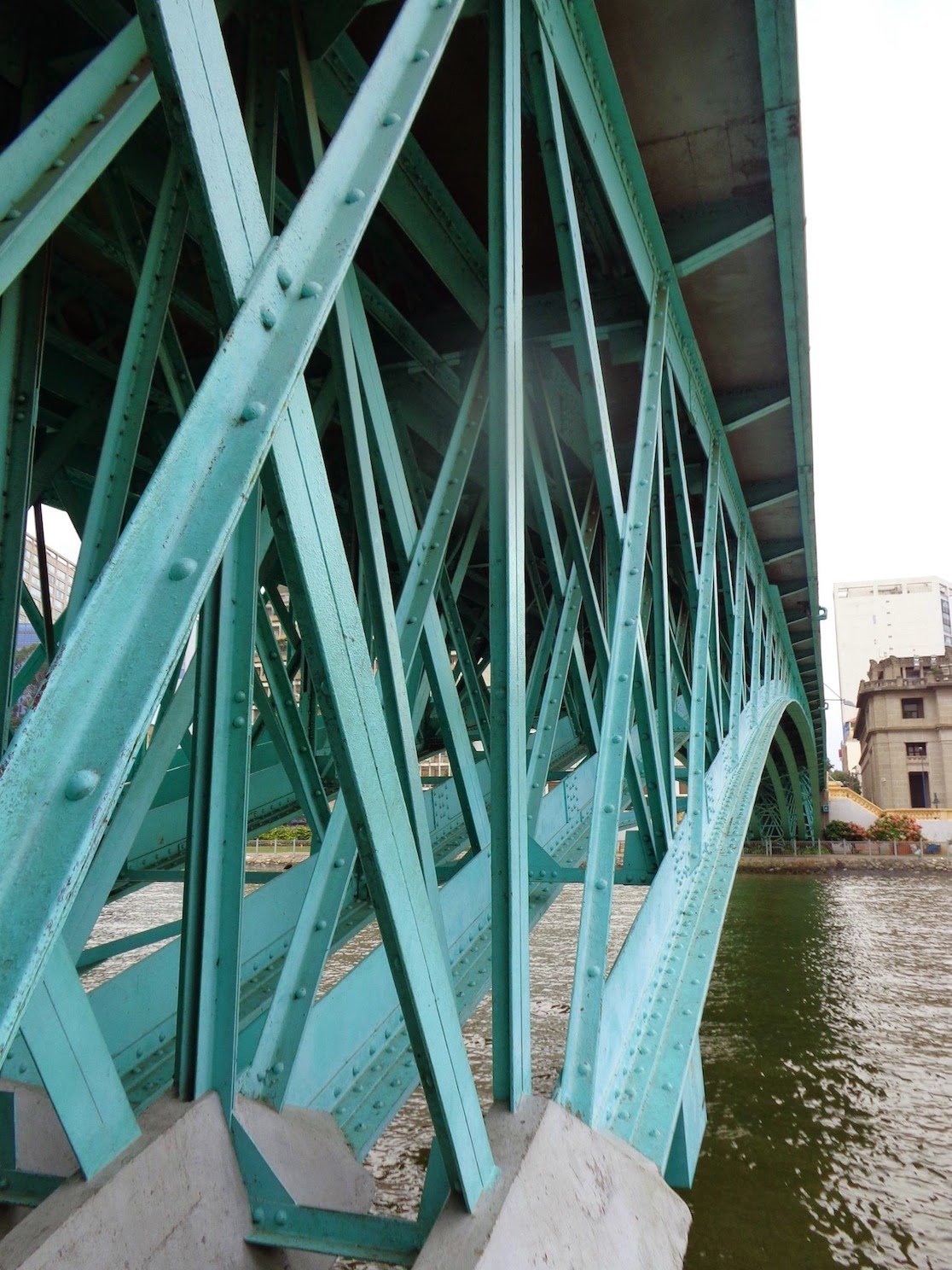 green, giving the bridge its nickname, the
  Rainbow Bridge. (Interesting aside here - the bridge is the same color as the Statue of Liberty in New York Harbor - which seems fitting, since Eiffel designed the internal structure of the Statue of Liberty, while the exterior sculpture was designed and created by sculptor Frederic Auguste Bartholdi.)
Some tourists and travellers come to the bridge to see what Eiffel or company created, others don't know who the designed might have been but know it's a pretty
Rainbow Bridge. (Interesting aside here - the bridge is the same color as the Statue of Liberty in New York Harbor - which seems fitting, since Eiffel designed the internal structure of the Statue of Liberty, while the exterior sculpture was designed and created by sculptor Frederic Auguste Bartholdi.)
Some tourists and travellers come to the bridge to see what Eiffel or company created, others don't know who the designed might have been but know it's a pretty  bridge. Apparently brides and grooms come here for photographs - we saw two couples with their
  photographers, though we were told these are pre-wedding photo shoots, with rented clothing, not the real wedding ensembles. (We met a Canadian man who has
  been living here in Saigon for nine

 years, as a photographer, and he gave us the inside scoop on the wedding
  photos. He's one of the people who said that Eiffel wasn't the designer, it was his company but not Eiffel himself who created this bridge.)
Anyway, I had a great time walking around under the end of the bridge, then the two of us walked across
photos. He's one of the people who said that Eiffel wasn't the designer, it was his company but not Eiffel himself who created this bridge.)
Anyway, I had a great time walking around under the end of the bridge, then the two of us walked across  Cau Mong. There were people fishing on the other side of the river, though they didn't seem to be catching much. And there was plenty of boat traffic on the river, my favorite being the coconut boat with the motorcycle on the bow.
We walked back and found the arch Christmas decorations, complete with fabric and
Cau Mong. There were people fishing on the other side of the river, though they didn't seem to be catching much. And there was plenty of boat traffic on the river, my favorite being the coconut boat with the motorcycle on the bow.
We walked back and found the arch Christmas decorations, complete with fabric and  styrofoam flowers. Not sure if the decorations
  are
are 
 being left up because they took so long to put together, or if they stay
  up for the twelve days of Christmas. Richard thinks the decorations will stay up until Tet, the Chinese Lunar New Year. Usually in January, this year Tet occurs around February 18 or so, and continues for several days.
Several businesses have taken down their Christmas decorations and put golden tree branch designs on their glass doors and picture windows. One store is more obvious, with gold coins on the
up for the twelve days of Christmas. Richard thinks the decorations will stay up until Tet, the Chinese Lunar New Year. Usually in January, this year Tet occurs around February 18 or so, and continues for several days.
Several businesses have taken down their Christmas decorations and put golden tree branch designs on their glass doors and picture windows. One store is more obvious, with gold coins on the  tree branch, we guess for a profitable new year. The others have yellow or gold flowers, probably to look like coins.
So things are still decorated and cheerful, and the holiday atmosphere continues!
tree branch, we guess for a profitable new year. The others have yellow or gold flowers, probably to look like coins.
So things are still decorated and cheerful, and the holiday atmosphere continues!

1 January 2015
We had a wonderful time in Phu Quoc, and flew back to Saigon so we could spend New Year's Eve here. We're back in our comfortable hotel near the Opera House, Tan Hai Long Hotel 4. They don't have a website, but they're listed with most of the major booking sites.
Everyone at our hotel said to just head to the river for the fireworks - apparently the tradition has been to fire the pyrotechnic display from there. And the river is just a few blocks down our road, so we figured fine, no problem.
We headed out at about 10:30 PM, ready for some beautiful fireworks. (I LOVE fireworks.) We came out and our road was packed. Cars and motorscooters and more motorscooters and people, just one slowly moving mass of humanity and machines, barely moving. We stopped for a quick drink (one coffee, one soda), hoping to give all this traffic time to move on. We came out of the coffeeshop, and found that the traffic and people jam only had gotten worse.
Well, not much to do but try to walk. Sidewalks were full of parked motorscooters, and barely moving motorscooters. Streets were parking lots. We sidled along, turning this way and that, climbing around and over whatever we needed to in order to keep moving toward the river.
We finally made it to the cross street, but motorscooters filled every inch of the street and sidewalks. I looked over the crossed streets and it looked like a sea of balloons, all those helmets and heads of varying colors, bobbing in the water. It was like approaching a cold ocean or lake, there's nothing to do but plunge in. So we did.
Crossing the street went like this: shuffle a few steps, smile at a bike driver, hold their handlebars while lifting a foot high and climbing over the front tire, turn, bring the other foot over. Say thank you. Another step or two, and clamber over another front or rear tire, holding either handlebars or the back of the seat. Smile at drivers and passengers, try not to knock over a motorscooter. Slither by a car and try not to get caught on the side mirrors. On and on, climbing endlessly and not too klutzily over scooter tires and around vehicles.
We finally hit the park across the street from the river. Scooters were just parked, with people sitting on their scooters waiting for the fireworks. This section of road was closed, perhaps not officially but the vehicles were turned off and not moving. Sometimes a driver would turn a wheel or shift slightly forward to make it easier for me to go around. Richard let me go first since the mostly male drivers seemed more willing to move for me. (In general, age is respected in Asia, and young people are helpful to older people, especially older women.)
It must have taken us almost 45 minutes to walk the three or so blocks to the river area. Really, it was that slow and that arduous a trip.
We finally arrived, and started asking people where the fireworks would be seen, which area of the sky - east, west, north, south, we had to idea. Most people didn't speak much English, or were just shy - but we've become adept at charade language, so I acted out fireworks exploding (with sound effects) and people all pointed in one direction. I thanked them in Vietnamese with a little bow, and turned around, only to encounter a little girl, maybe 10 years old, who was staring at me, dumbfounded. Really, she was transfixed, staring at me with her mouth hanging open. I laughed and said it's the only Vietnamese I can say, and her parents smiled and pushed her to move on.
We ended up in an open area with a few young men who spoke English quite well, and they spent the evening chatting with us, practicing their English and asking us questions and answering our questions. Always good to meet someone who can understand and explain!
Anyway, so the fireworks were going to be set off from the top of this big office building, the Bitexco Building. The countdown for the last 20 or so seconds was shown on the building, and then, well, the top of the building exploded into fireworks!!! Some shot up into the air, doing the usual big ball of sparks showering down. Some shot out of a device on the top of the building that was sort of like the gun on the top of a tank, a round thing that fired the rockets out sideways in a spray of color. There were flashing spotlights and colorful laser beams and continuing fireworks for about 15 minutes.
Actually, there were two sets of fireworks, because the building has sort of a flying saucer platform jutting out one side, and the main building tapers to a narrow top on the other side. Fireworks were shooting off both the top of the building and the disk platform, so we spent some time running back and forth to see both displays.
The crowd was oohing and aahing and cheering, and of course we couldn't understanding most of it. Although the oooh and aaah is universal.
It was a great display, except it was somewhat obscured by two tall buildings in front of the Bitexco Building. Probably would have been more visible had the pyrotechnics been shot off from the river area, as usual.
I don't understand the current trend of architectural fireworks. Why do they need to be shot from the Sydney Harbour Bridge? Or the Seattle Space Needle? Or the Eiffel Tower? Why aren't just plain old fireworks good enough any more? The fireworks off buildings and towers and such always makes it look as if the building is actually exploding. Which I find rather amusing, in a perverse kind of way.
And of course the crowd was filming on cell phones. And selfie-ing on phones. I've given up on trying to photograph fireworks, it interferes with my enjoyment of the fireworks. And they never look as good as the real thing, anyway.
So I'm including several youtube videos of the fireworks from last night. We hung out for nearly an hour chatting with our new friends, since they couldn't move their scooters, and we didn't want to climb over the scooters that were now turned on and revving as they waited to move, one centimeter (half-inch-ish) at a time.
Happy 2015 to all, and enjoy the fireworks display!
https://www.youtube.com/watch?v=gWwafxrggq0
https://www.youtube.com/watch?v=9Q-3duN6AEQ
https://www.youtube.com/watch?v=K6Q6XHaBe4s
https://www.youtube.com/watch?v=NYVUuh7gw8U
https://www.youtube.com/watch?v=pxKb_jo6AFg
https://www.youtube.com/watch?v=Nsk0ulBLarY
https://www.youtube.com/watch?v=R55JM8NOLLE
https://www.youtube.com/watch?v=HUUL3fjj-eM


