Tuesday, November 5, 2013

A Plane, A Boat, And We're In Gizo!

5 November 2013

Everyone who talks about the Solomon Islands says you have to go to the Western Province, that the islands there are the most beautiful.

So that's what we did today, headed up to the WP for a week.  We picked the island of Gizo because it's kind of centrally located, and there's more of a town here so we figured more amenities.

We started the morning by getting to the domestic air terminal an hour before the flight - so we were there by 7:30 AM.  To fly on Solomon Air.  We checked in, then had a light brekkie at the airport.  And waited.  And waited.   


A flight was called.  We went up.  It wasn't our flight.  It was now 9 AM, and our flight was supposed to leave at 8:30 AM.  There were no announcements, no one came to the waiting area to say there was a delay.  We had NO idea what was going on.  But there were others who were patiently waiting, so that's what we did as well.  Waited.

Finally we were called into another waiting room, though we had to go through security first.  (They glanced in my purse, checked that the spoon was blunt, and waved me through.)  And we waited some more.

And then - TA DA! - we were told to go on out to the plane and board - it was a little plane, with maybe 20 seats?  And 14 of us.  So we could spread out a little bit.

It was AMAZING to see the islands from the air - sort of an abstract swirling quilt of deep cobalt with squiggles of aquamarine to turquoise, and all kinds of blobs of dark green.  Almost like marbled paper, or a giant caffe latte in water colors.

And an island shaped like a parrot fish, with lagoons creating the fins and gills, and a separate island for the eye!!!!!

Not the best quality photos, given the fact that we were several thousand feet above the sea.  And the window was scratched and dirty.  And I don't know how fast we were flying.

But I was entranced by the colors and shapes and reefs and islands and just couldn't get enough photos of the whole thing!


 We finally (after about 75-80 minutes) began to descend.  And of course then there was more detail, and I kept looking for turtles, or sharks, or even crocodiles in the water - although saltwater crocs don't like this kind of crystal clear water.

Can you imagine staying at this lovely resort, built out over the lagoon????  So romantic!


We came skimming in over the water, looking like we might sprout pontoons and land in the sea.  Suddenly there was a teeny tiny island, and we had one of those light-as-a-feather touchdowns.  Our pilot turned out to be a woman - complete with a flower in her hair.  And the design on the tail of our plane is the Solomon Islands flag.

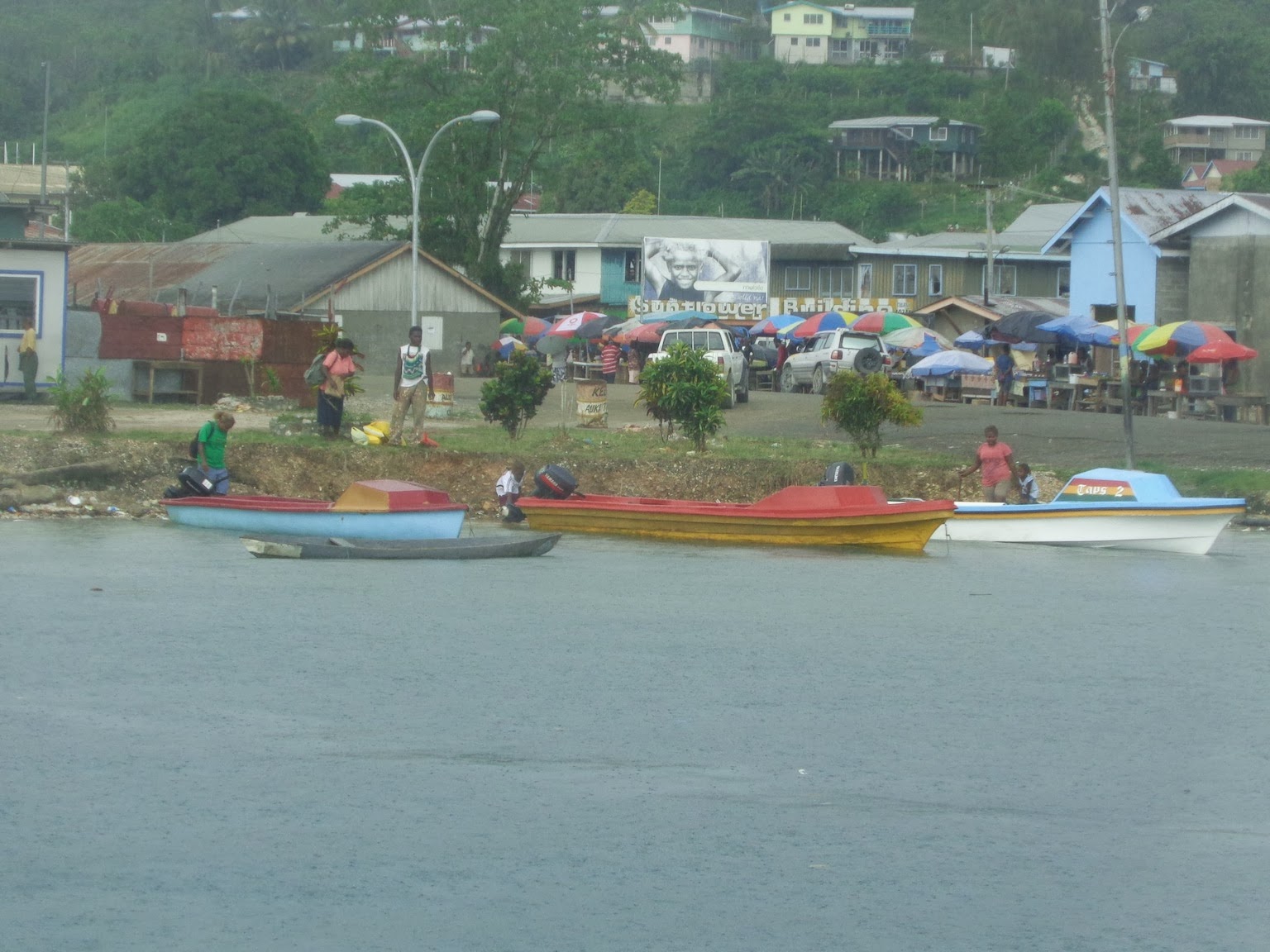
We gathered our luggage, and followed other passengers across this teeny little island.  Turns out that the airstrip is on a separate little island, across from Gizo.  So that we have to climb into a boat (about the size of the one we took from Tulagi to Honiara yesterday), and zoom across to Gizo.  Okay, no problem - of course, one has to wade into the water to climb into the boat, 
and I took off my Birks to do this - so my wet feet slipped on the bottom of the boat and I made a sliding entrance.  Gracefully.  We can call it a glissade, right?

So we motored across the lagoon or sound or bay or whatever, and landed at the town dock.  Got directions to our little hotel and walked to the Rekona Lodge.  Turned out that our original budget room had some kind of problem, so we were given a free upgrade to the deluxe rooms - hot & cold water instead of just cold water, AC instead of just a fan, bigger room, all good things like that.  We're happy and ready for a lovely week here.

We headed to PT 109, the restaurant (not the boat), and yes, they have a mirrored disco ball on their thatch and bamboo ceiling.
 
The also have an excellent lobster omelette, if you are ever in Gizo.

They also had this interesting statue - the person with the giant bird head is a local spirit (whose name I didn't catch), who appears to be friendly with the crocodile.  Just thought this was a very interesting statue.

We talked to the dive operator (who just happens to be across the street from PT 109) and we're set for a snorkel trip tomorrow.  We'll see how we feel, and hope to do some diving around here while we explore Gizo.

Post dinner note:  We had a wonderful dance troupe perform after dinner - but it's now 10:15 PM and I'm not quite up to downloading all the photos, going through to find the best ones, and posting a big blog about it.

Look forward to a dance blog AND a snorkel blog tomorrow!


Monday, November 4, 2013

Sailing the High Seas

4 November 2013
 
We spent much of the morning hanging around the hotel - word came that the ferry still wasn't running, but that a boat would be arranged for us.  The morning dragged on.  

We were told the boat would arrive before noon.  Noon arrived.  

So did the rain.  Pouring, torrential, tropical rain, bouncing off the ocean, clouding the surface, obscuring the islands across the water, and basically cutting us off from sight of anything beyond the immediate area.

Could we go through that rain?  All twenty-five miles or so from Tulagi to Honiara?  (We hoped not, we'd get drenched.)

Ellison, the owner of the hotel, came out and said the boat would arrive soon, and we'd definitely get to Honiara before the banks closed.

Fortunately, the rain stopped.  The air was still hazy, but no more rain.

And then our boat arrived.  Maybe fifteen feet long?  (Five meters)  Probably not much more than that.  We handed over our backpacks and extra bags, and the captain packed them into coolers, just in case in rained again.

We clambered in, sitting on the middle bench.  Bench?  Really more like a 2x6 plank of wood. 

And we were off!  Sailing around the island of Tulagi, and out into Iron Bottom Sound.  Past a few kids just outside our hotel, on home-made rafts of styrofoam.  Then past dugout canoes beyond the island.
Then off into the open ocean.  We literally were out of sight of any land for nearly half an hour - and the entire trip was just over an hour.  It seemed to go on and on forever, just zooming over the water, no fish, no humans, two birds, and just more and more water.  

Finally, finally, we could just barely make out the outline of Guadalcanal, a darker cloud on the horizon, fading into the rain clouds above.

Eventually we made it to land, and we climbed out, stiff and happy to have arrived in Honiara.   In time to go to the bank.

Except I couldn't take any money out.  There is confusion with the way the teller ran my charge last time (he messed up, voided it, ran it again, somehow one of the charges didn't go through or the account was voided twice?) - anyhow, they say their accounts don't balance, I say I have three receipts for two charges and one void.  It's a mess.  I'll wait and see what appears in the bank account online before I let them re-charge the account.

So it was just one of those very weird days!!! 

We leave early tomorrow for Gizo, up in the Western Province.  Let's hope that the weirdness has worn itself out.


Sunday, November 3, 2013

What Do You Do When You're Stranded in Tulagi?


 3 November 2013

We spent Saturday exploring Tulagi (which, it turns out, is the name of the island as well as the town).  We walked down to the market, passing ancient trees (I love how huge this tree is!), strange blossoms that look more like ornaments than flowers and seeds, and various other spots.  

Tulagi doesn't have any paved roads - the entire perimeter of the island is about 11 km (7 miles or so?).  All the roads are more sand than dirt, because this really is just a tiny island.  It was originally British, and they established the town of Tulagi as their capital here in the Solomons.  The British also brought prisoners to these islands - and it was the prisoners who dug through the bedrock to create "The Cut Place," almost a tunnel through a hill linking the town with the wharf.

There isn't any commerce on the island other than subsidence farming and selling.  There was a tuna cannery at one time, but the company moved to another island which is larger, so that they had room for expansion.

People sell extra items that they grow - pineapple, bananas, watermelons, coconuts, various root vegetables - although the market was rather sad and limited.  And people often have small market stands in front of their homes, so they can sell items from there as well (or instead of) the actual market.

We walked around the market a bit, and headed back to our place.  We walked along with some people going in the same directions - people here are incredibly friendly and helpful, and curious about where we're from, what it's like there, and what do we think of the Solomon Islands.  
 
We also get asked frequently how  we heard about the Solomon Islands - and of course, that usually turns into a discussion about WWII, because most Americans only know about the war and all the fighting centered around Guadalcanal.  We've been told about the tunnel hideouts the Japanese dug in the hills, where they could fire out of one side, then run through a U shape and fire out of the other side, confusing the Allies.  We've heard stories about how the Japanese took food from gardens, or farm animals, and took women as well - but that the Americans weren't like that, and that is why the American soldiers are remembered in a much more friendly fashion - and why they were so welcomed at the time, and treated so well by the islanders.  I asked what the islanders did when the bombs fell here, because the island was bombed so heavily there isn't a single building left from the British colonial period.  The answer - they ran and hid in the bush, building leaf (thatch) houses to live in while the bombing went on.  All this on an island with an 11 km perimeter!

The children here, as children everywhere, are just cute and funny, and trying to be cool.  They seem happy to be photographed - in this middle group, when I asked the first two children if it was okay to take their photo, the other four boys to the right came running out from underneath a house on stilts, to get into the photo!  I just laughed, they were so funny!  Of course, I'm not sure where the gangland style hand gesture comes from - most likely TV, movies, CD covers, etc.  Something they saw somewhere else.  

And I think our little blonde is a girl, given her clothing and longer hairstyle, plus the fact that she wouldn't get too close to the group of boys.

We also walked by the art center - here, as in Honiara, there is an annual Pan-Pacific fine and performing arts festival, and so there's a beautiful building for performances, some smaller buildings for other functions and activities, and a series of interesting sculptures.  It's too bad that this place isn't used any other time of the year, since it really was a lovely structure and almost like a sculpture park.


We ran into Dan, the guy from Seattle who works with Construction for Change, the nonprofit organization that is building the school at Blue Beach.  He and James, the project supervisor (a volunteer, but in charge of the project), invited me along to see the school.  So I hopped in the truck after they loaded up all the metal beams and posts, and headed out to Blue Beach.  (Richard helped load the truck, and then was ready for our AC room - this place is HOT!)

Anyway, they are building a new building for the school - I peeked in some of the old buildings and they really are crumbling.  This weather, as in the VI, is just hard on most elements.  The school is K-12, but this particular structure will be for the secondary school, with academics upstairs and maybe a science lab and office downstairs.  Most of the workers are local men, so the project provides employment while also adding much needed classrooms for the school.  There were a few classes in session, even though it was Saturday, because final exams begin on Tuesday - and the exams qualify students to move up a grade, or a form as it is called here. 

I asked James what it's like to volunteer for this kind of project -  he said it's pretty frustrating, because it has seemed as if everything that could go wrong HAS gone wrong.  He hasn't encountered any WWII objects like shells or casings or anything - and he said he's very unsuperstitious - but sometimes he has wondered if there's just some kind of paranormal reason things keep going wrong.  Because this school is located at Blue Beach, where half the Allied forces landed (the other half going to Red Beach on Guadalcanal) - and casualties were heavy.  We talked for a bit about that - and, having spent two years in Africa, I know that there are things we can't rationalize away.  So I suggested that maybe he get the village medicine person (whatever they are called here) to come lay the spirits to rest - and, while he was at it, to tell the spirits that this project is funded by Marine Raiders who were part of that invasion and who survived, and this is their way of thanking the people of Tulagi.  He agreed that, while it might seem fanciful to some, this probably would be a good idea.  Solomon Islanders, like many people around the world, may seem superstitious to the "scientific" mind - but sometimes there are realms that are not part of the physical world.  So there may be some spiritual realm that is uneasy - and especially at a battlefield as bloody as these islands are.

Anyway, please check out Construction for Change -http://www.constructionforchange.org/ - they really are doing good things around the world!  (And if you want to make a donation, they definitely need support!)


So of course I went to look at the beach, which was peaceful and hardly seems the site of bloody battles and wholesale slaughter - but battlegrounds rarely appear as haunted as they feel.  It's a pretty beach, with old trees that either survived the battles, or have grown up since that time.


So, we need to spend another night here in Tulagi.  We planned to catch the ferry back on Sunday afternoon.  Guess what engine still isn't working?
 
We've had a relaxing Sunday - not much to do, and no point in fretting.  We called our hotel in Honiara, the lady said fine no problem.  Our hotel people here said they have a small twin engine outboard boat, and they can take us across on Monday.  We're still hoping the ferry is working by then, since a small outboard is not going to be the most comfortable ride across the sound - it's an hour on the ferry, and sitting on a wood plank in a small boat isn't going to be fun.  But if that's the only way across, then that's it.  What can you do, you know?  Life happens.

So we'll report in on Monday, and let everyone know how we crossed Iron Bottom Sound.


Friday, November 1, 2013

Making An Entrance Into Tulagi


1 November 2013


We did our usual morning routine of brekkie at the Bamboo Café, including a little time with the tiny kitten.  Then off to the market to buy some items for the boat trip to Tulagi.  (#2 on the map posted two days ago)

We waited on the dock at Auki, as boats were unloaded and cargo re-loaded onto trucks.  Right on the dock.  And various dugout canoes paddled by, the rowers travelling home from market, with various plastic bags and goods in the canoe.

Finally we boarded our vessel, the Discovery 360, and settled in.  And waited while people got on, loaded their luggage, and then the front deck was loaded with huge bags of coconuts and huge bundles of pineapples.

And then we left.  The open water crossing from Malaita to the channel between the Florida Islands of the Central Province was a bit rougher today, with some strong swells.  We kept getting pushed a bit west and the captain had to keep correcting our course, so we zigzagged our way across I don't know how many miles of open ocean.  As soon as we entered the channel between islands, we headed to one of the small cement wharfs.  
 
Richard went out to stretch and smoke, and came back in with bad news.  This was an unplanned stop.  Apparently one of the twin engines had conked out, and they were trying to fix it.  If it couldn't be repaired, we'd just head on our way, but at a slower pace.

Of course, the engine could not be fixed.

So we limped our way along, single engine puttering, and going way behind schedule.

I spent some time up front with the pineapples (which smell wonderful en masse like that) and talked to a lady who was sitting on the coconuts (which had to be uncomfortable).  And spotted a small pod of dolphins swimming along, on their way home as the sun was beginning to set.

Then a young lady who works on the boat came and told us that they wouldn't be stopping at the wharf, but would put us on a small boat and we'd go to Tulagi that way.  So we gathered our luggage (two backpacks, a beach bag, and a computer case) and went to the rear section of the boat.  Stood around waiting for the tender to come in.  

As it approached, we saw that this was the official police boat for the island!  Just a little whaler with an outboard, full of people who were coming to board the ferry.  And of course, there weren't any steps.  The poor women were a bit freaked out, trying to balance on the edge of the police boat while keeping their skirts down as they stepped about 3 ft up onto the edge of the ferry.  Children and luggage were just handed up.  People gathered their items and went into the seating area.

Then it was our turn.  We were the ONLY TWO who were going in to Tulagi.  We handed over our stuff.  I was shown how to walk along the outer edge of the ferry, holding on to the railing, and managed to sit down on the outer edge (explaining that I have an old knee injury so my knee doesn't bend as well as it should) - and the two men on the police boat helped me as I kind of dropped into the boat.  Oh my.  Richard could reach the boat, he has longer legs, but we were bouncing and bobbing and he wasn't much more graceful than I was.  But at least neither of us fell overboard, or even into the boat, so we were perfectly happy with our entrance.

And we were off.  Making our grand entrance into Tulagi, waving goodbye to the crew of the ferry boat and yelling thank you for the help, waving at passengers who were watching this unexpected excitement.  At the Tulagi end, we met passengers waiting to board the police boat to go out to the ferry, and some nice young men helped me climb out of our boat, through another boat, and up a breakwater of rocks onto the sand.  (Sometimes it helps to look like a middle-aged woman, since I really needed two hands helping me through this disembarking procedure!!!  Walking through two bobbing boats is hard enough - but after five hours on the ferry, my ears had me internally riding the open seas in a totally different rhythm of waves and swells, and my balance was essentially non-existent.)

The breakwater was right outside our hotel, and the owner met us and brought us inside.  We had some welcome fruit and lemonade, and eventually settled into our room.  During dinner out on the patio, we met a nice young man from Seattle, who works with an NGO (non-government organization - took me a bit to get that) non-profit - they are building a school at Blue Beach, one of the big WWII battlegrounds here in the Florida Islands.  This project is funded by the Marine Raiders, the group that first landed on Blue Beach in WWII.  Apparently the people of this island were so kind to the American marines and various soldiers, the veterans wanted to give something back to the island - and, although it has been a really long time putting together the project, it is now happening and the school is being built.  Very cool!!!

Anyway, that was our entrance into Tulagi.  We've met two police officers, also, and a nice kitty who shared our fish and chips dinner.

I hope the rest of this stay is equally adventurous, but maybe in a less dramatic way!!!