11 April 2019
 When I was researching who the artist was for the saguaro cactus murals, I noticed that he (Steve Farley) had also created a series of murals that were at the mall practically next door to the previous mall. Yeah, it's a mall
  neighborhood. But the murals are wonderful!!!
This series is called "Saguaro Kids: Oro Valley Gold." Yes, this part of Tucson is called Oro Valley. I'm guessing the children of any community are the gold - definitely children are  seen as the wealth of the community in many cultures.
The murals are set up in the same way as the mosaics I talked about previously - the tiles are on some sort of board that is mounted in a steel structure, and there are two murals back to back in the structure. But these are special murals. In the words of the artist, "Each structure has a saguaro cactus on one side, and a local kid posing like that saguaro on the other side."
Really, these are absolutely whimsical and funny and art with a sense of humor!
Did you ever pretend to be a plant as a child? Pose like a tree, or dance like a growing flower? Play a vegetable in a school performance? Or even the yoga pose, Tree. This is exactly like that, but the children are being saguaros!!!
I loved it, walking from mural to mural, laughing at these four kids having so much fun being immortalized as giant cacti!!!
So, big photos so you can see how wonderful these are. And I'm posting the photos saguaro and then saguaro kid.
Oh, interesting fact - the artist, Steve Farley, is a well known photographer, artist, and State Senator from Arizona!!! And yes, he uses a photo collage compiled of his photographs to then transfer the image onto unglazed tiles, which are then glazed and fired to create these mosaics.
Links: www.tilography.com/privateart.htm
www.tilography.com/
www.wescover.com/creator/steve-farley
seen as the wealth of the community in many cultures.
The murals are set up in the same way as the mosaics I talked about previously - the tiles are on some sort of board that is mounted in a steel structure, and there are two murals back to back in the structure. But these are special murals. In the words of the artist, "Each structure has a saguaro cactus on one side, and a local kid posing like that saguaro on the other side."
Really, these are absolutely whimsical and funny and art with a sense of humor!
Did you ever pretend to be a plant as a child? Pose like a tree, or dance like a growing flower? Play a vegetable in a school performance? Or even the yoga pose, Tree. This is exactly like that, but the children are being saguaros!!!
I loved it, walking from mural to mural, laughing at these four kids having so much fun being immortalized as giant cacti!!!
So, big photos so you can see how wonderful these are. And I'm posting the photos saguaro and then saguaro kid.
Oh, interesting fact - the artist, Steve Farley, is a well known photographer, artist, and State Senator from Arizona!!! And yes, he uses a photo collage compiled of his photographs to then transfer the image onto unglazed tiles, which are then glazed and fired to create these mosaics.
Links: www.tilography.com/privateart.htm
www.tilography.com/
www.wescover.com/creator/steve-farley


9 April 2019

 Some of the early cacti are blooming, and it's thrilling to watch this happening! I have several areas where I walk, and I've seen the prickly pear cactus starting to flower. It feels like such a special
  event, because it's seasonal. And in a dry dry desert, where the air and ground are so arid, it seems almost miraculous to see these gorgeous colorful flowers coming out of the dusty and desiccated-
 looking cactus plants.
But before I blog about the cactus flowers (because I'm waiting for the height of the flowering season for the prickly pears), I want to blog about the saguaro cactus murals I found.
These are wonderful tile
looking cactus plants.
But before I blog about the cactus flowers (because I'm waiting for the height of the flowering season for the prickly pears), I want to blog about the saguaro cactus murals I found.
These are wonderful tile  murals that portray the life of saguaro cactus. I found these murals at the far end of the shopping area around Richard's physical therapy place. I like to walk for a bit before I go inside,
  and one sunny morning I found these incredibly detailed murals.
Each mural is set in a steel sort of sign holder, and is roughly two and a half feet by five feet (.8 x 1.6 meters
and one sunny morning I found these incredibly detailed murals.
Each mural is set in a steel sort of sign holder, and is roughly two and a half feet by five feet (.8 x 1.6 meters  maybe) - and is comprised of 72 tiles, six tiles wide by twelve tiles tall. And each mural is on the front and back of the holder, so there are only four holders but a total of eight murals.
There aren't any signs at the site  telling us who these murals were designed by, no name of the artist or art group. But with my google search skills, I found out that Steve Farley, at
  Tilography made these murals.
Here's the website: http://www.tilography.com/privateart.htm
 Anyway, the murals! I've taken a distance photo of each, and then one or two close up photos so you can see the details.
We have a cactus
Anyway, the murals! I've taken a distance photo of each, and then one or two close up photos so you can see the details.
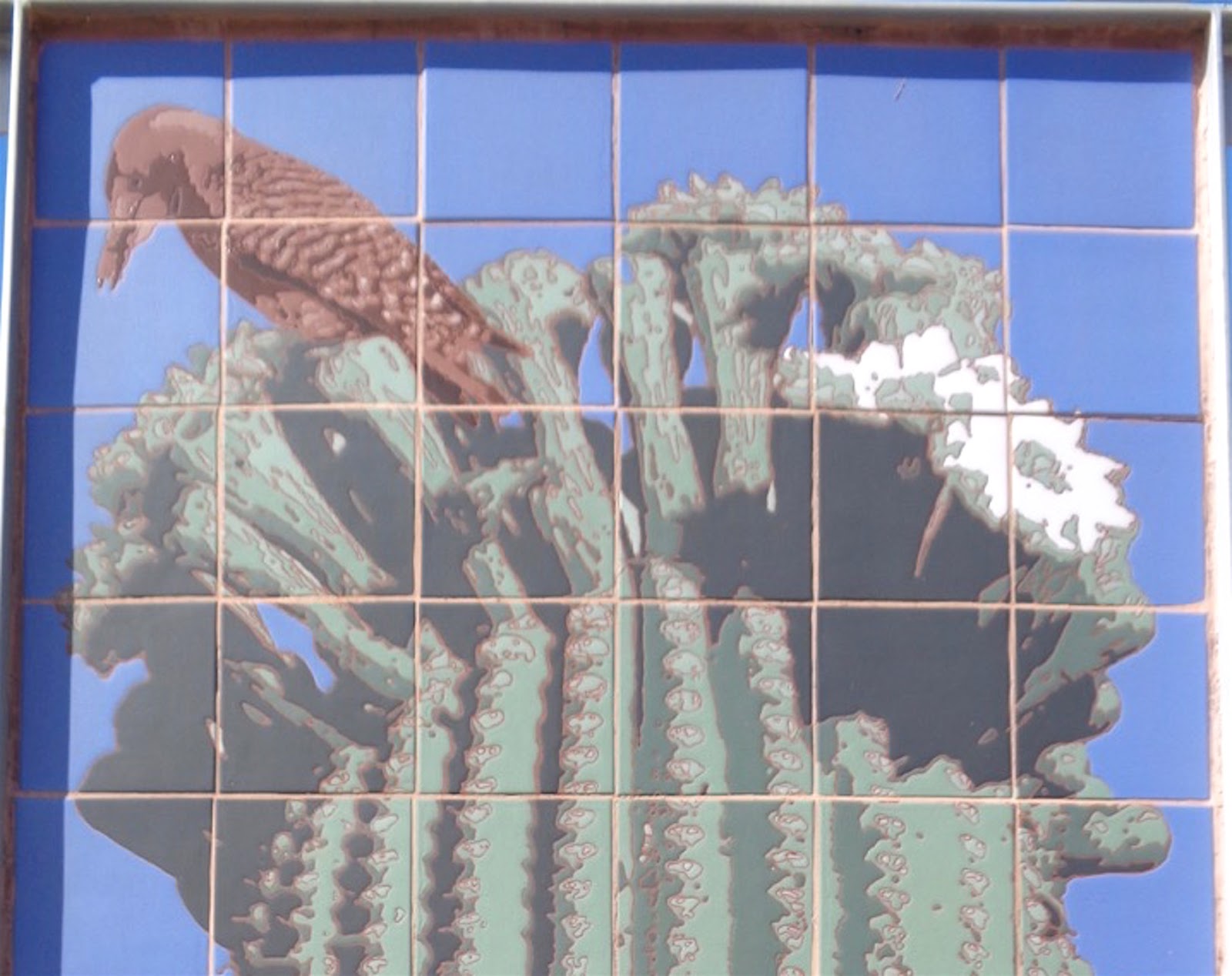
We have a cactus  wren hovering near the saguaro - at least I'm guessing this is a cactus wren. There are some birds who repeatedly peck holes in the saguaro and then enlarge the holes, making a
  cozy den in which to build their nests and raise their young.
Two murals have two different color saguaro flowers - and yes, the same kind of cactus can have different color flowers, depending on the plant. Just like we
cozy den in which to build their nests and raise their young.
Two murals have two different color saguaro flowers - and yes, the same kind of cactus can have different color flowers, depending on the plant. Just like we  can have red roses and white roses, we can have red or white saguaro flowers. The flowers seem to only cover the top or crown of the saguaro. They
  aren't blossoming quite yet, but I hope to see some later in May, saguaro season!
One mural shows the dried flowers turning into the saguaro fruit. These are gathered by the Tohono O'odham people, who make sweets and condiments with the fruit.
aren't blossoming quite yet, but I hope to see some later in May, saguaro season!
One mural shows the dried flowers turning into the saguaro fruit. These are gathered by the Tohono O'odham people, who make sweets and condiments with the fruit.  Yes, the fruit are way on the top of the saguaros - but the people learned to take the inside spines of dead saguaros, and use these to knock the fruit off the top of the saguaros.
There's even a mural showing the beginning of one of the arms which make the saguaros so unique and so human like.
I've included close up photos so you can see the detail of this mural series.
Before I found the name of the artist and his business, I looked closely at these murals to figure out how the images were made. It actually is an ingenious technique, although I'm not positive what all the steps are.
Basically, it seems the artist took photos of live saguaro. He may have used these to draw black and white images of the saguaro, or he may have used the actual photos. Then, using either drawings or contact images (might be using a different term, but basically a black on clear film image printed to life size), the image is transferred to either unglazed clay tiles or, less likely, a huge slab of unfired clay that is cut into the tile shapes. (It would save a step to transfer the image onto unglazed clay tiles.)
Once the image is transferred, then each tile would be glazed and fired. I would imagine there is also a numbering system, maybe on the reverse side of each tile, so that the artist knows where to place each tile for the finished mural. Usually a grid system is used, or at least that's what I did with the mosaic murals my classes made at school.
Anyway, the detail is amazing! Look at some of the closeups, and you can see every single needle coming out in little starbursts along the pleats of the saguaros. The colors vary so you can see the different needles, and this gives more depth to the image. But I can't figure out any other way to reasonably get that kind of detail in a mural of this size.
It also is very cool the way the image is comprised of a matrix of tiles, rather than cutting different colored tiles into the shapes necessary for creating the image.
So tiles plus photography maybe equals Tilography? That's what I'm thinking, anyway.
Yes, the fruit are way on the top of the saguaros - but the people learned to take the inside spines of dead saguaros, and use these to knock the fruit off the top of the saguaros.
There's even a mural showing the beginning of one of the arms which make the saguaros so unique and so human like.
I've included close up photos so you can see the detail of this mural series.
Before I found the name of the artist and his business, I looked closely at these murals to figure out how the images were made. It actually is an ingenious technique, although I'm not positive what all the steps are.
Basically, it seems the artist took photos of live saguaro. He may have used these to draw black and white images of the saguaro, or he may have used the actual photos. Then, using either drawings or contact images (might be using a different term, but basically a black on clear film image printed to life size), the image is transferred to either unglazed clay tiles or, less likely, a huge slab of unfired clay that is cut into the tile shapes. (It would save a step to transfer the image onto unglazed clay tiles.)
Once the image is transferred, then each tile would be glazed and fired. I would imagine there is also a numbering system, maybe on the reverse side of each tile, so that the artist knows where to place each tile for the finished mural. Usually a grid system is used, or at least that's what I did with the mosaic murals my classes made at school.
Anyway, the detail is amazing! Look at some of the closeups, and you can see every single needle coming out in little starbursts along the pleats of the saguaros. The colors vary so you can see the different needles, and this gives more depth to the image. But I can't figure out any other way to reasonably get that kind of detail in a mural of this size.
It also is very cool the way the image is comprised of a matrix of tiles, rather than cutting different colored tiles into the shapes necessary for creating the image.
So tiles plus photography maybe equals Tilography? That's what I'm thinking, anyway.
Our readers know by now that I love murals, especially mosaic murals. And this series featuring the emblem of the Sonoran Desert, the saguaro, is truly a special gift!!!
The whole shopping center has some quirky sculptures scattered around. A wagon with a bag of money by the bank, a woman with a shopping cart near the natural foods market.
My two favorite sculptures are the man taking a photo of the Catalina Hills, except the image is really a mural of the Catalinas! Just an art joke, sort of.
And outside the Italian restaurant, a nice metal man shares his metal pasta with a friendly metal dog.
Yeah, this is my morning walk two days a week - I visit my sculpture friends and my ceramic cactus friends.
They seem happy to see me on my morning jaunts, too.
5 April 2019
 About 50 minutes north of Tucson is Biosphere 2, a truly fascinating place.
Biosphere 2 was initially built as a
About 50 minutes north of Tucson is Biosphere 2, a truly fascinating place.
Biosphere 2 was initially built as a  microcosm of the earth, with the premise that the earth is Biosphere 1. Biosphere 2 was designed to create a closed ecological system
  which could support human life. So in 1991, a group of eight people, each specializing in area of knowledge or skill, entered Biosphere 2 and
  lived in a giant glass pyramid for two years. This huge glass pyramid was basically an enormous greenhouse! The scientist grew their own food,
  had a system set up to filter waste water to make it potable again, dealt with medical problems (other than one rather serious injury that
  required surgical intervention), all the normal things that are needed to sustain life.
With outside support, since there was also a scientific team monitoring  everything. From oxygen levels to air pressure to the actual structure, scientists were monitoring everything.
If you read  Biosphere 2's reports and publicity, this experiment was a major success. The people grew
their food, handled emergencies,
Biosphere 2's reports and publicity, this experiment was a major success. The people grew
their food, handled emergencies,  conducted experiments and recorded data, accomplishing all of the major goals of the project.
But if you read the story from  others' points of view, well, it wasn't such a success. It might even be deemed a failure, since there was more support given to the inhabitants than had been
  planned. That they really weren't self-sufficient, as first reported. There were also unexpected issues: the first winter was quite cloudy, so plants
  for food did not grow as planned and some food items were provided for the people living in the biosphere. There were structural problems - the
  Arizona sun overheated the air in the pyramid to the point that engineers feared the glass structure might explode from the
  air pressure, so a giant "lung" encased in a glass geodesic dome was constructed to allow the pyramid to "breathe" and provide an escape for the
  expanding hot air. And the air within the pyramid lost oxygen - some people blame microbacteria using the oxygen, while others say that the uncured
  concrete actually absorbed some of the oxygen. Whatever the cause, extra oxygen was pumped into the biosphere because the scientists inside needed to
  breathe!
Here's the website for Biosphere 2, so you can read about the positives of this experiment:
http://biosphere2.org/
 And here is a link to a recent article in The New York Times which is much more critical of
  the entire experiment, and tells an entirely different story:
www.nytimes.com/2019/03/29/sunday-review/biosphere-2-climate-change.html
 Eventually, Biosphere 2 was no longer used as a human experiment and became a huge "laboratory" for
  earth science experiments. First it was overseen by Columbia University, but since 2011 it has been supervised and administered by the University
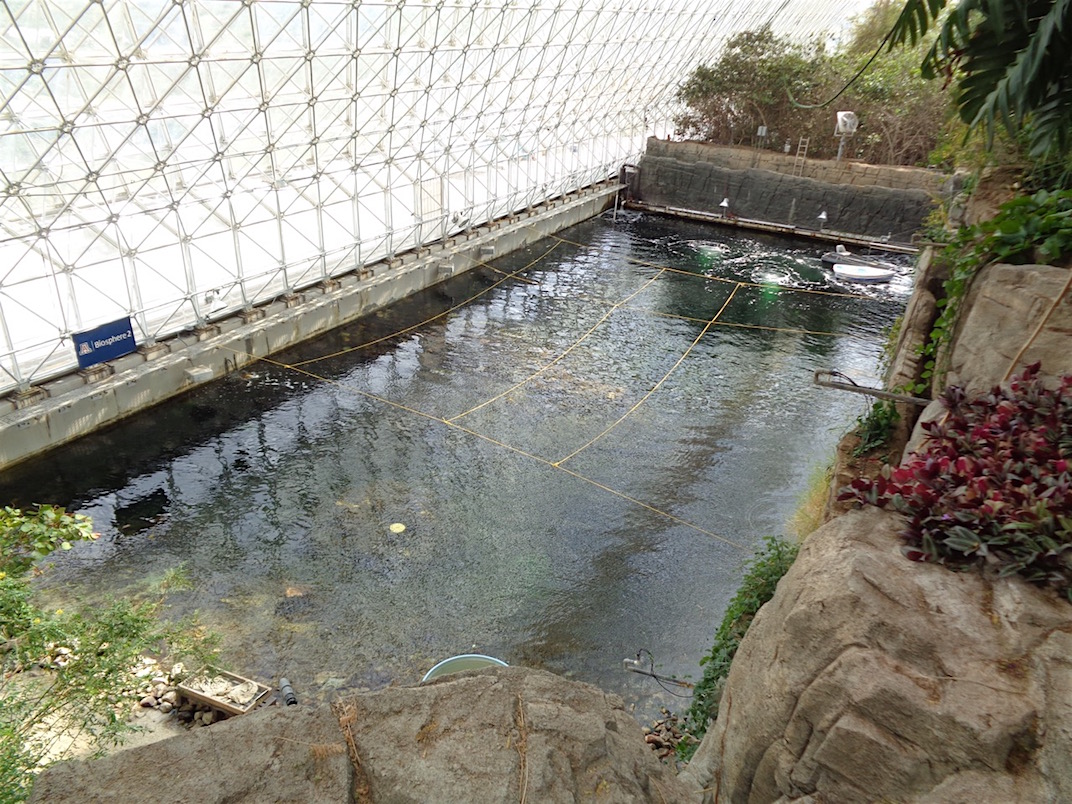
  of Arizona. Earth science experiments are conducted within the closed environments, which include a desert, a rain forest, even a small ocean and coral reef, complete with a wave machine!!!
The
purpose of having a facility like this is that scientists and science
students can conduct controlled experiments that they cannot conduct out
in the real environment. Within Biosphere 2, they can control the
rainfall, or fog, or flooding, and see how the plants react and
respond. Scientists can control the salinity of the ocean, and record
the responses of the sea life within that ocean. This place is a giant
earth science laboratory!
of Arizona. Earth science experiments are conducted within the closed environments, which include a desert, a rain forest, even a small ocean and coral reef, complete with a wave machine!!!
The
purpose of having a facility like this is that scientists and science
students can conduct controlled experiments that they cannot conduct out
in the real environment. Within Biosphere 2, they can control the
rainfall, or fog, or flooding, and see how the plants react and
respond. Scientists can control the salinity of the ocean, and record
the responses of the sea life within that ocean. This place is a giant
earth science laboratory!
Some facts and figures as posted at Biosphere 2:
"Construction of Biosphere 2 began in 1987. The facility cost approximately $150 million to build, and was completed in 1991. Many unique techniques and materials were used to construct Biosphere 2 which contributed to the final cost.
"Interesting facts and figures about Biosphere 2:
- 3.14 acres under glass
- 7,200,000 cubic feet of sealed glass
- 6,600 windows
- 91 feet tall (30 meters) tall at its highest point
- Sealed from the earth below by a 500-ton welded stainless steel liner
- 40-acre campus
- 300,000 sq ft of administrative offices, classrooms, labs, conference center, and housing
- The name 'Biosphere 2' derives from the idea that it is modeled on Earth, the first biosphere
- 3,820 feet (about 1200 m) above sea level.
"Ecosystems under glass include: Ocean; Mangrove wetlands; Tropical rainforest; Savanna grassland; Fog desert."
Okay, so our experience - we drove north to Biosphere 2, paid the entrance fee, and signed up for a tour. Visitors can only enter the various buildings accompanied by a guide. Fortunately for us, the staff suggested a modified tour since our visitors had limited time. So we had essentially a private tour for the four of us.
The facility looks something like a space age science fiction town. Many of the buildings utilize geodesic domes, popularized by R. Buckminster Fuller in the late 1960s/early 1970s. (Fuller assisted with the design of the architecture here.) Everything was steel and glass, or shiny frosted glass, all glaring in the desert sun. Very futuristic architecture, especially considering that the buildings are nearly 30 years old!
Biosphere 2 has a wonderful view of the mountains, including Mt Lemmon which is some 9000 feet tall (nearly 3000 meters, or 3 km)!! In the other direction, there's a view of the desert. At 3820 feet above sea level, even on a sunny day it wasn't very hot and there was a constant breeze. But this is too high an elevation for our friends the saguaros, so the landscape was covered with smaller trees and scrubby bushes. Although it's now spring, so there were clusters of wildflowers scattered around the facility and across the desert.
There were a few large chunks of petrified wood from the petrified forest a bit north of this location. Also a huge piece of rock full of azurite and malachite, two semi-precious rocks/minerals. (And really gorgeous in color!)
We walked through several of the environments, spending most of our time in the tropical rainforest. This is located in the 90 ft tall (30 m) glass pyramid, and it is HUGE! This is also the building where the scientists lived, grew their food, and all that.
The lemon trees are still growing there. The coffee bushes are still growing. The animals that were originally brought in no longer live there; turned out that the bush babies were eating the fruits and vegetables before the humans could get to them! (No surprise there.)
It really was like being in a huge rainforest. If you didn't notice the building structure, you'd think you were in some tropical country, not Arizona!
For me, the most interesting environment was the ocean. Sea water was brought in from the California coast and pumped into this giant sealed fake ocean, a beach was constructed, even an artificial coral reef was added! A wave machine provides constant water movement, although there really isn't a tide, just constant waves. There are fish living in the ocean, including shell fish, so that not only is the physical environment studied but also the biology of sea animals. The entire oceanic ecological system in included for scientific research.
The whole place was fascinating, much more interesting than I had expected it to be. I really liked the architecture - each building was a piece of art in itself, never mind the scientific side. I liked the way we could still see the mountains and the sky through all that glass. I really was so impressed with the visual aspect of this facility!!! Aesthetic, modernistic, scientifically based, and incredible!!!!
We left right about the time that some after-school groups arrived. The whole place is really educational as well as inspiring for everyone with an imagination, and/or a scientific mind.
I don't know whether the original project was a success or failure. But the current incarnation of Biosphere 2 really is worth a visit.
I'll end with some extra large versions of more photos, just so you can see how amazing this place really is!

 When I was researching who the artist was for the saguaro cactus murals, I noticed that he (Steve Farley) had also created a series of murals that were at the mall practically next door to the previous mall. Yeah, it's a mall
  neighborhood. But the murals are wonderful!!!
 seen as the wealth of the community in many cultures.