3 November 2018
 Days 15 to 17 - We decided to spend a few days in Los Angeles. Not that we love the city so much. Nor did we care if we saw all the sights, or saw any
  celebrities.
Mostly, we have people we want to see here. Family and friends. People we haven't seen in a while.
And we just needed a rest.
celebrities.
Mostly, we have people we want to see here. Family and friends. People we haven't seen in a while.
And we just needed a rest.  We spent our first two weeks driving with frequent stops. Up each morning, repack, reload the car, eat, head out. Drive for several hours,
  have lunch, drive a while more, find a hotel, unload the car, sleep. And the next day, do it all over again.
So it was truly
have lunch, drive a while more, find a hotel, unload the car, sleep. And the next day, do it all over again.
So it was truly  wonderful to sleep late, relax, and leave things unpacked for a few days.
Because we didn't know exactly when we'd be arriving, we couldn't really make plans ahead of time. And people live their lives. We ended up not being able to meet up with some of our friends - but we hope to do so once we're settled in Tucson.
We did, however, manage to hang out with our niece and significant other. A couple of dinners, and today a visit to the La Brea Tar Pits.
The Tar Pits are places where tar has seeped to the earth's surface and created huge deep lakes of tar. Over the eons, various animals have fallen into these pits, became stuck, died, and created fossil pits extinct creatures.
There's even a group of mastodon statues set up to show one animal stuck in the tar, while the rest of the family group freaks out!!!
It's a little bit creepy, and pretty morbid, but it also is an amazing place!
wonderful to sleep late, relax, and leave things unpacked for a few days.
Because we didn't know exactly when we'd be arriving, we couldn't really make plans ahead of time. And people live their lives. We ended up not being able to meet up with some of our friends - but we hope to do so once we're settled in Tucson.
We did, however, manage to hang out with our niece and significant other. A couple of dinners, and today a visit to the La Brea Tar Pits.
The Tar Pits are places where tar has seeped to the earth's surface and created huge deep lakes of tar. Over the eons, various animals have fallen into these pits, became stuck, died, and created fossil pits extinct creatures.
There's even a group of mastodon statues set up to show one animal stuck in the tar, while the rest of the family group freaks out!!!
It's a little bit creepy, and pretty morbid, but it also is an amazing place!

 The tar is still seeping to the surface, and methane bubbles up under the thick black tar, creating shiny
  black bubbles. They don't burst, really, because the tar is so thick and viscous. It's more like the bubbles develop a tiny thin spot and then deflate.
 It probably is easiest to quote from the various information placards that are around the various pits and displays:
"La Brea's unique tar seeps make each pit here a different Ice Age time capsule. This is because the tar oozes up in different places at different times. While one seep stops, another one starts up not far away. The types of plants and animals that get stuck in one seep are often different from those that get stuck in a seep that pops up later. This start-and-stop cycle has occurred many times here over the past 55,000 years.
It probably is easiest to quote from the various information placards that are around the various pits and displays:
"La Brea's unique tar seeps make each pit here a different Ice Age time capsule. This is because the tar oozes up in different places at different times. While one seep stops, another one starts up not far away. The types of plants and animals that get stuck in one seep are often different from those that get stuck in a seep that pops up later. This start-and-stop cycle has occurred many times here over the past 55,000 years.
"No two pits are alike. Each pit at La Brea is a unique time capsule from L.A.'s Ice Age past. These pits give us clues to how this area changed.

 "Fossils form side-by-side, yet they are from eras twenty to fifty thousand years apart.
 "The oil field that underlies La Brea is about 1,000 feet deep. Pressure forces some of the thick oil - asphalt - upward.
"As deep underground layers shift, cracks form in the overlying rock layers. Asphalt and  methane gas ooze and bubble up through these vents.
"The asphalt can ooze all the way to the surface to form shallow  pools that actively trap animals and plant pieces. Animals decompose and only their bones remain.
"Over many thousands of years, sand and  soil wash down from the mountains. This seals off the seeps and protects the fossils trapped inside.
"Methane gas  continues to bubble up, churning the bones from different animals and time periods into complex jumbles.
 "This peaceful park was perilous for animals who walked here 20,000 years ago. La Brea's tar made this unsafe ground for both predator and prey. Six
  foot tall 2000 lb sloths got stuck here and died. So did bison, horses, and camels. As these creatures lay dying, hungry dire wolves and other predators tried to live off their remains. Many of them died in the process.
"You are standing a thousand feet above a large underground oil field. This oil seeps to the surface as sticky asphalt. Plants and unwary animals have been getting trapped in this treacherous goo for tens of thousands of years. Being stuck in the La Brea Tar Pits was a terrible way to die - but a great way to preserve fossils!
"Finding fossils in asphalt takes hard work, and we have to dig below the surface to locate them. This is one of more than a hundred pits that we dug looking for fossils in this park. Inside you can see how fossils of an extinct mastodon, Harlan's ground sloth, and saber-toothed cat look when they are first discovered by scientists.
"Our team patiently uncovers fossils. We measure fossils in place once we find them and then use hand tools to remove them from the Tar Pits.
foot tall 2000 lb sloths got stuck here and died. So did bison, horses, and camels. As these creatures lay dying, hungry dire wolves and other predators tried to live off their remains. Many of them died in the process.
"You are standing a thousand feet above a large underground oil field. This oil seeps to the surface as sticky asphalt. Plants and unwary animals have been getting trapped in this treacherous goo for tens of thousands of years. Being stuck in the La Brea Tar Pits was a terrible way to die - but a great way to preserve fossils!
"Finding fossils in asphalt takes hard work, and we have to dig below the surface to locate them. This is one of more than a hundred pits that we dug looking for fossils in this park. Inside you can see how fossils of an extinct mastodon, Harlan's ground sloth, and saber-toothed cat look when they are first discovered by scientists.
"Our team patiently uncovers fossils. We measure fossils in place once we find them and then use hand tools to remove them from the Tar Pits.
"We prepare fossils for research and storage. We work in the lab to remove matrix, repair damage, and solve fossil puzzles.
"We care for the fossils we find. Inside the Museum, we make sure each fossil - and the information that goes with it - is maintained.
"It takes about a month to remove all of the fossils from a three-foot-square chunk of matrix. We've identified up to 1,000 fossils from a single chunk!

 "Tiny fossils of plants, insects, and other small animals give us information that we can't get from large fossils.
  These microfossils tell us about L.A.'s climate and habitat and how they've changed over the past 50,000 years. They can also help us understand changes that are happening now - and may happen in the future.
"The oldest fossils date back 55,000 years. The most recent fossils are 14,000 years old.
"We've dug 15 feet deep. We might find fossils up to five feet deeper.
"We've even found the fossils of flies that fed on dead animals trapped in the Tar Pits.

 "Big bones raise big questions. The Tar Pits trapped large animals that lived in the L.A. basin from
  55,000 to 11,000 years ago. Many of these species are now extinct. Each fossil we find provides clues about life in L.A. in the prehistoric past. But one of the biggest mysteries still remains: Why did so many of the largest animals we find here die out?"
As I said, creepy, morbid, and fascinating! And of course, Dad's hat was jumping up and down in excitement!
But now it's Saturday night, and we've said our goodbyes. We'll leave tomorrow to start our drive across the Mojave Desert, and then the Sonoran Desert. It sounds romantic in theory, but also hot, dry, and maybe a little treacherous.
55,000 to 11,000 years ago. Many of these species are now extinct. Each fossil we find provides clues about life in L.A. in the prehistoric past. But one of the biggest mysteries still remains: Why did so many of the largest animals we find here die out?"
As I said, creepy, morbid, and fascinating! And of course, Dad's hat was jumping up and down in excitement!
But now it's Saturday night, and we've said our goodbyes. We'll leave tomorrow to start our drive across the Mojave Desert, and then the Sonoran Desert. It sounds romantic in theory, but also hot, dry, and maybe a little treacherous.
That's all part of the adventure!
31 October 2018
 Day 8 - We left Arcata bright and early, and did our usual heading south on Pacific Highway 1, no
  specific destination in sight.
But along the way, there was a sort of detour to the Avenue of the Giants! How could we resist?
The Avenue of the Giants is a self-drive car
specific destination in sight.
But along the way, there was a sort of detour to the Avenue of the Giants! How could we resist?
The Avenue of the Giants is a self-drive car  tour through a series of redwood groves and forests that make
  up the Humboldt Redwoods State Park. There are maps and small brochures people can pick up to identify where they are going, and what
  they are seeing as they drive along amidst these
  magnificent trees.
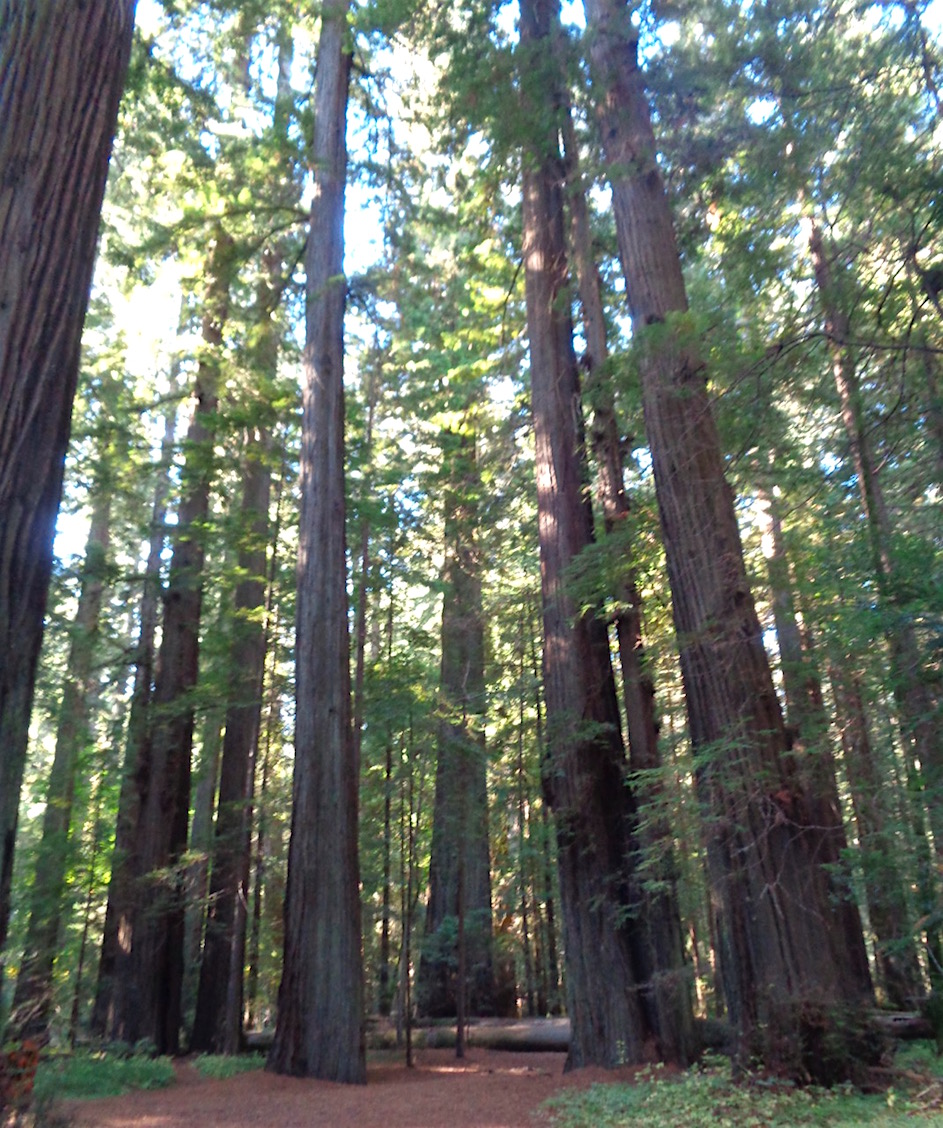
Not only were we seeing the huge redwoods - now we were seeing Sequoia Sempervirens - the sequoia trees, commonly known as Coast Redwoods. These amazing trees are taller than any other single living thing in the entire world!!!! The sequoias are the redwoods that can live over 2000 years! And they can survive forest fires and flooding!!! Absolutely incredible trees. Plus some of the groves we drove through are virgin forest (meaning they've never ever been logged).
As we drove along, we'd talk about these huge and majestic trees. I mean, think about living for 2000 years in the same place. Do trees think? Do they feel? Do they realize that the world around them is changing when roads come through? Did the original people who lived among these trees revere them? Does it tickle the tree to feel squirrels running up and down? Do the trees understand birds singing or chattering in their branches?
magnificent trees.
Not only were we seeing the huge redwoods - now we were seeing Sequoia Sempervirens - the sequoia trees, commonly known as Coast Redwoods. These amazing trees are taller than any other single living thing in the entire world!!!! The sequoias are the redwoods that can live over 2000 years! And they can survive forest fires and flooding!!! Absolutely incredible trees. Plus some of the groves we drove through are virgin forest (meaning they've never ever been logged).
As we drove along, we'd talk about these huge and majestic trees. I mean, think about living for 2000 years in the same place. Do trees think? Do they feel? Do they realize that the world around them is changing when roads come through? Did the original people who lived among these trees revere them? Does it tickle the tree to feel squirrels running up and down? Do the trees understand birds singing or chattering in their branches?
Tree philosophy.
We had a wonderful time driving along and stopping to see the trees. Talking to them, giving them occasional pats or hugs, and breathing in the wonderful redwood perfume.
Some of the trees even had faces somehow grown into the tree. These were probably random burls and growths, but they often looked just like the face of the tree. Adding, of course, to our anthropomorphising of the trees.
Eventually, we left the Avenue of the Giants, and continued on south. Nothing else that day matched the magnificence of the redwoods. We ended up staying in Fort Bragg.
And I know there are a lot of extra large photos here, but it's the only way to really see and feel how huge these trees are in a photo.

 Day 9 - We continued south the following morning, stopping at various scenic overlooks.
  Although here in California they seem to be called vista points.
The rocky coast continued, with headlands jutting out and scattered rocked rising
Although here in California they seem to be called vista points.
The rocky coast continued, with headlands jutting out and scattered rocked rising  from the sea. As Richard said, they look like an armada from a distance.
We occasionally would see whales - not close enough to see
from the sea. As Richard said, they look like an armada from a distance.
We occasionally would see whales - not close enough to see  the actual whales, or any flapping tails. But close enough to see two or three whales clearing their blowholes as they
  migrate south for the winter.
We also drove through small small towns. I mean, towns with maybe 170 people living there. Tiny little towns.
Our favorite town was Elk. Mostly because there was an Elk Store, where we speculated that you could buy an
migrate south for the winter.
We also drove through small small towns. I mean, towns with maybe 170 people living there. Tiny little towns.
Our favorite town was Elk. Mostly because there was an Elk Store, where we speculated that you could buy an  elk. (Not really, they had great food and coffee, as well as
  sundries and groceries.) Nearby was the Elk Garage, where yes, obviously, you could get your elk repaired. It was funny to play with the names of the businesses and just get silly with it. But Elk really was a cute little town, with buildings dating back to 1902 and 1927 or so.
Some of the gardens or landscaping in front of the shops had beautiful flowers. But I was most intrigued with some succulent plant that looks something like a jade plant, but the leaves grow in rosettes. I've asked at a few places, but no one knows what these plants are called. I just found them absolutely fascinating!
We spent the night in Gualala. We had no idea how to pronounce this, so I asked. The local pronunciation is gwah-LAH-lah. It's a Native American name (my source wasn't sure specifically which nation, but indigenous to this part of California). And the name means something like "fresh waters running down to the sea." A lovely poetic way of describing a region with rivers that run to the ocean.
sundries and groceries.) Nearby was the Elk Garage, where yes, obviously, you could get your elk repaired. It was funny to play with the names of the businesses and just get silly with it. But Elk really was a cute little town, with buildings dating back to 1902 and 1927 or so.
Some of the gardens or landscaping in front of the shops had beautiful flowers. But I was most intrigued with some succulent plant that looks something like a jade plant, but the leaves grow in rosettes. I've asked at a few places, but no one knows what these plants are called. I just found them absolutely fascinating!
We spent the night in Gualala. We had no idea how to pronounce this, so I asked. The local pronunciation is gwah-LAH-lah. It's a Native American name (my source wasn't sure specifically which nation, but indigenous to this part of California). And the name means something like "fresh waters running down to the sea." A lovely poetic way of describing a region with rivers that run to the ocean.


 Day 10 - More driving south along the Pacific Coast Highway 1, with gorgeous views, dramatic coastlines, and
  scattered redwood groves.
Really, the trees would be clustered together along the road. We'd be merrily driving along, and
scattered redwood groves.
Really, the trees would be clustered together along the road. We'd be merrily driving along, and  suddenly we'd go around a turn and find ourselves in a dark tunnel of trees! Redwoods towering overhead, blocking out the sun and creating
  a corridor below their branches, with us driving through with our headlights on, just to be able to see the dashboard gauges! More redwood perfume in the air, and that soft muffled quiet surrounding us.
Occasionally we'd drive through a grove of eucalyptus trees - peeling bark, curling leaves, and their slightly medicinal scent. Wouldn't it be nice to have some koalas come over from Australia and live in the eucalyptus trees of coastal California? I'd certainly be happy to see some koalas living here!
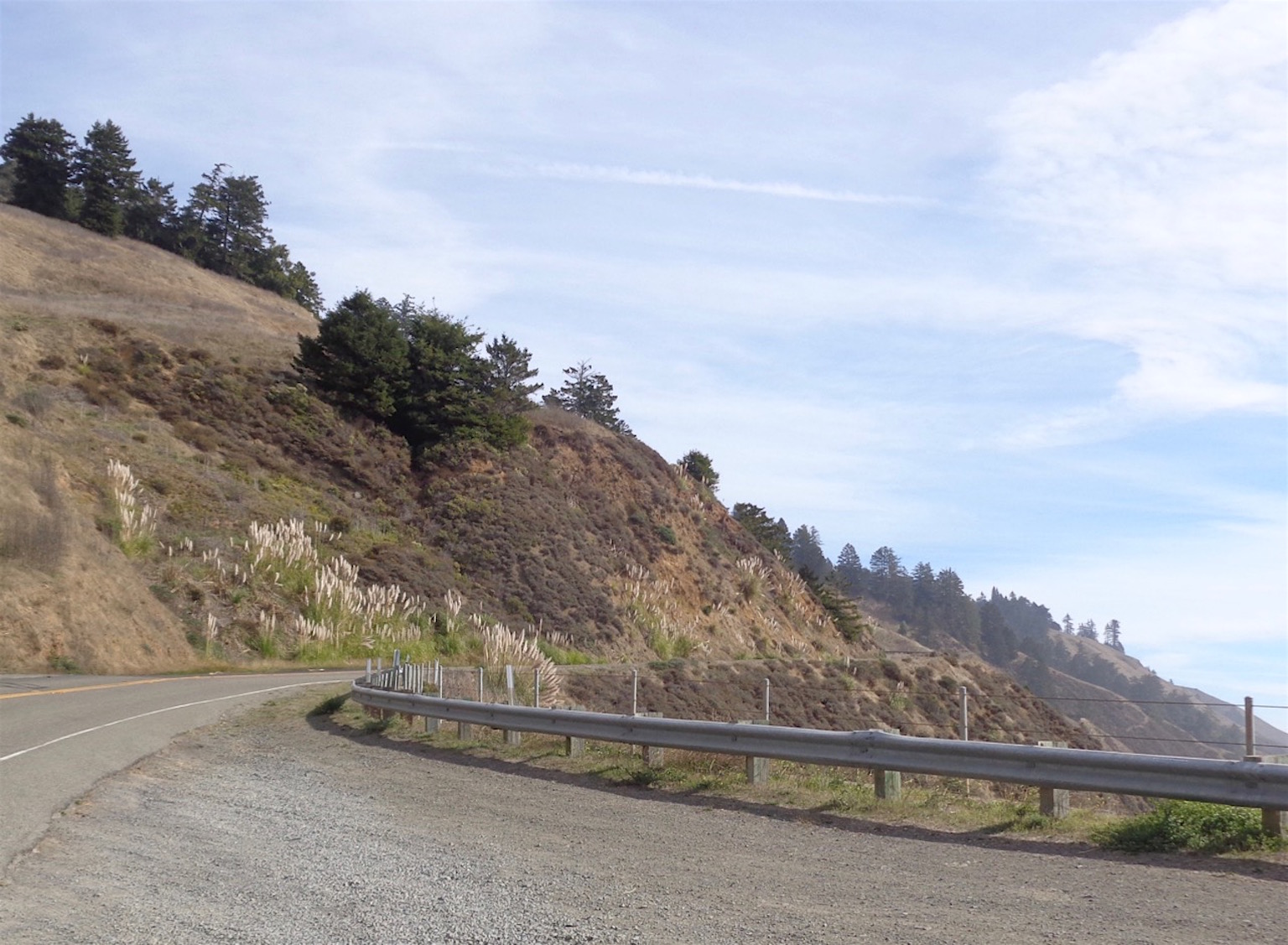
The hills in this area have pampas grass, the huge feathery fronds we saw growing all over Patagonia in the Argentinian side. No idea if this grass is native to this region, or imported from the Pampas region of Argentina. But such an elegant and beautiful contrast against the rugged rocks of the coast.
a corridor below their branches, with us driving through with our headlights on, just to be able to see the dashboard gauges! More redwood perfume in the air, and that soft muffled quiet surrounding us.
Occasionally we'd drive through a grove of eucalyptus trees - peeling bark, curling leaves, and their slightly medicinal scent. Wouldn't it be nice to have some koalas come over from Australia and live in the eucalyptus trees of coastal California? I'd certainly be happy to see some koalas living here!
The hills in this area have pampas grass, the huge feathery fronds we saw growing all over Patagonia in the Argentinian side. No idea if this grass is native to this region, or imported from the Pampas region of Argentina. But such an elegant and beautiful contrast against the rugged rocks of the coast.
The highway seems to come and go at times, sharing the road with other highways. Or maybe we just occasionally would lose it. We somehow made our way to Petaluma, a bit more inland, and spent the night.


 Day 11 - We made our way to San Francisco. The morning was sunny inland, but the fog blew in
  and smothered the Golden Gate Bridge. We drove across and could only see the structure immediately around us - could barely see 20 or 30 feet (7 to 10
  meters) in fron of us! On the other hand, it meant we also couldn't see how high up the bridge really is, since the entire area between the bridge and the
  bay was filled with fog.
Just so San Francisco!
We drove up and down hills and got a bit lost getting to our  hotel - but in our defense, it was the fault of the cable cars, which have their own traffic lights and turns. It makes it rather confusing for someone who isn't used to the system. After our second time around the block, we managed to find our hotel, and settled in.
On the map at the end, you can see that Petaluma is only a very short distance north of San Francisco. We planned it that way so I could meet up with a friend in SF - at Ghiradelli Chocolate, of course. Amazing chocolate, and we were good and shared a small item.
Throughout the day, I'd periodically get more photos of the Golden Gate. By evening, the bridge had finally emerged from all that fog, and could be seen in the distance.
And yes, there were people swimming in that water! San Francisco is almost always chilly and either foggy or wet - so I was walking around in a jacket. I cannot imagine swimming in the water - it must have been barely 50 degrees F! (That's maybe 10 C - that is COLD!)
We never managed to get our cable car ride, but we enjoyed our very brief return to a city we've both enjoyed for years. Somehow, San Francisco has a charm all its own, a feel very different from other cities.
We definitely need to come back and spend more time here!


 Day 12 - We left San Francisco, getting vaguely lost again. More steep hills, zigzagging through one way
  streets to the Embarcadero. Amazing how the names of the streets come back, even after some forty years.
We stopped at Half Moon Bay,
streets to the Embarcadero. Amazing how the names of the streets come back, even after some forty years.
We stopped at Half Moon Bay,  because it has always sounded so romantic and iconic. Turns out that Half Moon Bay is a huge crescent-shaped beach, with dunes covered in succulents, and waves crashing on the shore. We wandered around the dunes a bit, but couldn't find the paths down to the beach. Dad's hat enjoyed this beach, though, and had fun ambling around the dunes.
The redwoods continued, as did the eucalyptus. There are other trees mixed in, but these two are the most recognizable.
We drove through Castroville, apparently the world capital of artichokes. Really, complete with a giant artichoke statue. Then somewhere near Salinas, the city where the songster let Bobbie McGee slip away, we spent the night.
because it has always sounded so romantic and iconic. Turns out that Half Moon Bay is a huge crescent-shaped beach, with dunes covered in succulents, and waves crashing on the shore. We wandered around the dunes a bit, but couldn't find the paths down to the beach. Dad's hat enjoyed this beach, though, and had fun ambling around the dunes.
The redwoods continued, as did the eucalyptus. There are other trees mixed in, but these two are the most recognizable.
We drove through Castroville, apparently the world capital of artichokes. Really, complete with a giant artichoke statue. Then somewhere near Salinas, the city where the songster let Bobbie McGee slip away, we spent the night.
 Days 15 to 17 - We decided to spend a few days in Los Angeles. Not that we love the city so much. Nor did we care if we saw all the sights, or saw any
  celebrities.
 We spent our first two weeks driving with frequent stops. Up each morning, repack, reload the car, eat, head out. Drive for several hours,
  have lunch, drive a while more, find a hotel, unload the car, sleep. And the next day, do it all over again.
 wonderful to sleep late, relax, and leave things unpacked for a few days.
 The tar is still seeping to the surface, and methane bubbles up under the thick black tar, creating shiny
  black bubbles. They don't burst, really, because the tar is so thick and viscous. It's more like the bubbles develop a tiny thin spot and then deflate.
 It probably is easiest to quote from the various information placards that are around the various pits and displays:
 "Fossils form side-by-side, yet they are from eras twenty to fifty thousand years apart.
 "The oil field that underlies La Brea is about 1,000 feet deep. Pressure forces some of the thick oil - asphalt - upward.
 methane gas ooze and bubble up through these vents.
 pools that actively trap animals and plant pieces. Animals decompose and only their bones remain.
 soil wash down from the mountains. This seals off the seeps and protects the fossils trapped inside.
 continues to bubble up, churning the bones from different animals and time periods into complex jumbles.
 "This peaceful park was perilous for animals who walked here 20,000 years ago. La Brea's tar made this unsafe ground for both predator and prey. Six
  foot tall 2000 lb sloths got stuck here and died. So did bison, horses, and camels. As these creatures lay dying, hungry dire wolves and other predators tried to live off their remains. Many of them died in the process.
 "Tiny fossils of plants, insects, and other small animals give us information that we can't get from large fossils.
  These microfossils tell us about L.A.'s climate and habitat and how they've changed over the past 50,000 years. They can also help us understand changes that are happening now - and may happen in the future.
 "Big bones raise big questions. The Tar Pits trapped large animals that lived in the L.A. basin from
  55,000 to 11,000 years ago. Many of these species are now extinct. Each fossil we find provides clues about life in L.A. in the prehistoric past. But one of the biggest mysteries still remains: Why did so many of the largest animals we find here die out?"